


Manipur - Gem of Indian civilization !
Zomianists are doomed to fail in evil design!!
Niraj Kamal *
There has been a pumped up attempt by the Amerian and Dutch scholars to "Defragment Zomia and reunify this widers region", thereby implicating that India, China, Burma and Bangladesh must undergo re-fragmentation and to allow emergence of State-repellent "Zomia" which could serve the western geostrategic interests in Asia. Once Hillary Clinton visited Myanmar last year(December), the artificial discourse of Zomia is being manufactured. Western institutions across the full spectrum are busy trumpeting Zomia as an essentialist geographical vision to serve their evil designs in the pristine territory of Asia.
William van Schendel, the Dutch historian who have been roaming through the ethnic corridor of Bangladesh and Northeast India is credited with the coining of the term 'Zomia" in 2002 to describe the highlanders of North-east India, Bangladesh, Myanmar and South East Asia. Though, I had proposed to view the region as the corridor between two Buddhist enclaves of the South east Asia and the Himalayas and envisioned to build a geo-economic grid of co-operation in a paper presented in a huge gathering of parliamentarians, civil servants, military officers, and the various association of the Northeast India in 1999 ( "From Geopolitical arc of crisis to geo-economic grid of co-operation", 5th August, 2000 in Seminar on "Northeast: Looking for Peace and Prosperity", Constitution Club, New Delhi) the idea was picked up seemingly by the western academicians with an ulterior motive and the same was twisted to use it as a tool to further fragmentation discourse in Asia.
Schendels' term Zomia is derived from zomi, a term for highlander in a number of Chin- Mizo–Paite-Hmar languages spoken in India, Myanmar and Bangladesh. These languages belong to the family of Tibeto-Burman languages spoken all across the Himalayas from Ladakh, Kashmir, Nepal, Tibet, Sikkim, Bhutan, Northeast India, the Chittagong Hill Tracts in Bangladesh, highlands of Myanmar , Yunnan and Sichuan in China, Thailand, Laos, and Vietnam. The term was popularized by James Scott in his influential work, The Art of Not Being Governed(2009).
Nowadays Schendel is focused on the spatiality of the Northeast India and vows to defragment this area from the hold of the Indian state . He himself proposes that the North East India is "a new space, a space whose boundaries are contested, a vertical space and a disintegratingspace. Can we defragment, or re-unify, the study of this wider Asian region?"(2012)
My recent visit to Manipur gave an opportunity to contest the zomianist's paradigm and to discover the intricate relationship of the Northeast India with Indian civilization. Unlike Schendel, who admits that the Zomia discourse lacks the support of influential university-based groups(read western universities having expertise in conflict generation across the non-western socio-political space) and hence to become an outsider expert to provide thrust to an imaginary essentialist discourse unconnected with the people's collective imagination, I am on the border of the so-called "zomia" both socially as well as politically. Since, being on edge provides an insider-outsider perspective; I would like to dwell on my recent experiences in the gem-state of India-Manipur (Mani is the rarest jewel).
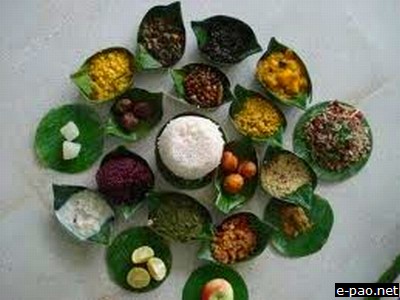
I landed at Imphal airport on 5th April (2012) and rushed to polo ground area at the centre of the city to enjoy mouthful of dishes in one of the Chak-luk hotels. This is traditional Manipuri thalis with wide ranging varieties like Hawaizar (fermented soya-bean), curry with Yongchak ( Parkia Speciosa) and potato, mangal (white pea) ooti, famous Soibum (fermented bamboo shoot), Ironba, fish Thongba (fish curry), Thambou Singju, Bora, Mangal Kangou and Chakhao Kher . One can order fried fishes separately.
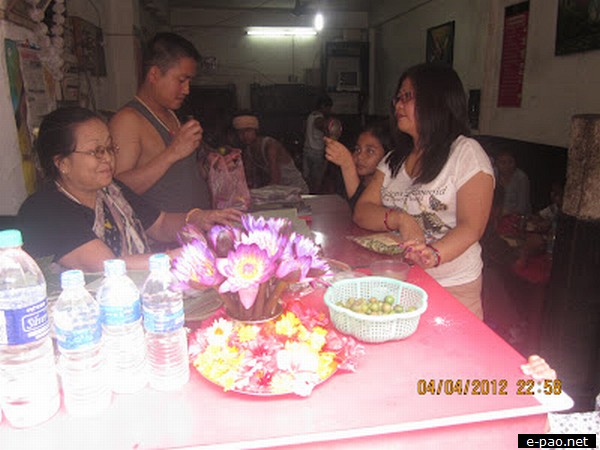
The food is served on a banana leaf places on a round thali of a diameter of one and half feet. The waiters wear traditional Manipuri attire (dhoti ) and put up long tikas (mark) on their forehead. It makes one forget what newspapers and now the academic experts keep on harping about separate essentialization of the region. While I took up meal along with my family and relative, my eyes glued to a bunch of flowers kept at the counter. It was blue lotus, the rare Neel Kamal. I took snaps of the flower. The lady was kind enough to take out two blue-lotus flowers and gift to a mayank(outsider). That was a prized possession indeed.
When we started for Lamka, I saw in the roadside ponds, blooming blue lotus. The sky was overcast with clouds. Pre-monsoon rain had arrived. The birds and the people were out in the open. One could see village after village the bunch of people wearing dhoti and kurta , keeping a gamccha on their shoulders. I felt as if I am in the state of Bihar and not some distant peripheral region of the Northeast India. The Tiddim road is the lifeline of people of Churachandpur valley, situated 50km from Imphal. Tiddim is a major city across the border in Myanmar and the road reminds one of the extant memories of the Chin family divided by national boundaries. Schendel's generalized assertion that there are no connection across the border in term of memories appeared blatantly abusive of the reality.
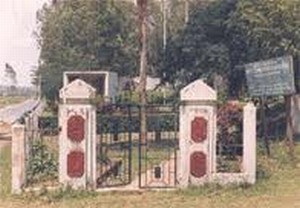
Peace Memorial
Before one enters the famous Bishnupur area, the Tiddim road cruises through two hillocks. The hills are known as Red Hill (Maibam Lotpa Ching). An Indo-Japanese Peace Cenotaph has been constructed as dedication to the lasting memory of the fallen heroes of INA and the Japanese soldiers, who laid down their lives for the control of Imphal (March 1944). Peace Memorial has been inaugurated in 1994 on 50th anniversary of the event. Enormous effort was made by Lt. General Iwaichi Fujiwara, the then Head of 'F' Kikan , who organized the INA along with Mohan Singh and later Subhash Chadra Bose.
It took him decades to convince Indian government to allow constructing a memorial at the Red Hill foothill, significantly the farthest point that the INA and Japanese Army could approach Imphal in May 1944. It is well known that Bose hoisted Indian flag in Moirang few kilometers before this point . But, the defeat of the Japanese-INA forces in pitched battle at the Red Hill marked the retreat of the liberating forces. While Indian government had allotted huge lands at premier locations inside the city of Imphal and Kohima for the war cemetery for the British war deads, the government took more than 4 decades to allow a memorial at a distant foothill in the memory of India's own liberating forces that reflect the continuing stranglehold of the former colonizers over Indian decision making even after independence.
One of my relatives narrated about the two hillocks. The left hillock is very huge compared to the right hillock which is hardly 70-80 feet high. There is an interesting local legend associated with different sizes of two hillocks. Zomis as well as Meiteis believe that while liberating forces were surrounding Imphal valley, each member of the incoming force put up a handful of red soil on the left side of road(Imphal-Lamka direction) and after the defeat on the right side.
The difference in size of hillock represents the gigantic death and destruction that the INA and the Japanese forces had to suffer in this battle. Schendel et al. concept of imaginary Zomia which lies decontextualized from wider Asian history, appears totally baseless. Its not that the people in the region has no pre-partition memory. They have memories about historical events that transcend even their regional boundaries.
Soon we arrived at Bishnupur, where lies the temple of Lord Vishnu built in 1467 during the region of King Kyamba. The architectural design is influenced by Chinese style. One could smell the spiritual fragrance of Indic civilization all across. Finally, we arrived at our destination, Lamka.
Lamka is abuzz with activities. It's an ethnic mosaic, polycntric and polyglot social space. What Schendel wants to study across the wider region can be examined in Lamka. There are cross-cutting linkages of clan and language, community and territory, pre-modern and postmodern. There are some who are spinster and many who have married many a times. It's a curious mix of identity politics, market, state, diasporas, jhumias. There is a heart-touching stench of roots ,stems, dry and fermented soyabeans, bamboo shoot and identities.
For me, it was nice to watch the sugarcane plants growing under the shade of the tamarind trees in the house compounds, both having knotted stem and fruit respectively so much eulogized in Indian spiritual tradition. There are Bihari and Zomi sugarcane juice seller, each picking up other's language. The cinema hall is dilapidated and people love to watch the Manipuri films but sing Bollywood songs. The valley is replete with the plants of Touch me not(Mimosa pudica). Just like the plant which closes its leaves on being touched, one identity closes paving way for new identity. It is a fluid segmentation of viscous identity.
While exploring the surface, I was inspired to probe into the sky. The Venus appeared so big and on the Full Moon night, there were two halos. The Moon with golden hue, surrounded by orange halo and the Venus with milky halo made me scream in delight. I could see the ears of the hare clearly on the surface of the Moon, and in front of me, pet rabbits were playing. The image of hare over the Moon's surface is as much visible in Delhi as in this cockpit of Zomia. I could not feel myself to be away from home. The Moon became the mirror in which the image of the playing hare seemed to reflect, and the small town of Lamka became a mirror in which India's whole civilizational glory was being reflected.
Manipur is the home of ponds , flora, fauna, ethnic groups and languages . It is surrounded by nine mountains of the Himalayan range and rightly termed the JEWEL(Mani). There are nine gems(navaratna), nine orifices in human body each corresponding to one of the navaratna. And here is the Manipur with ponds abundant in the rarest of the mythological flower of Indian civilization, Blue Lotus. By observing the Full Moon, I realized the significance of the blue lotus. The blue lotus signifies the Moon and the pink lotus signifies the Sun. The blue lotus, therefore, is the culmination, a signifier of the bliss and immortality in Indic tradition.
It is said that in the mythical geographical land of Meru(land of immortals), the ponds are full with blooming blue lotus. Blue lotus is held in highest esteem in the Asian civilization. It is a national flower in two countries, Bangladesh and SriLanka and popular in Thailand, Vietnam for decoration. Its significance in Buddhist iconography of northern and eastern Asia is immense. Even in India, the great epic Ramayana sings paean about the blue lotus. The eyes of Lord Rama appear as the blue lotus. Sita could see the face of Rama as reflection in water pond and got confused whether it was the blue lotus(eye) blooming amidst the pink lotus(face).
One of the legends about the origin of national festival of India, Durga Puja has to do with the story about blue lotus. It is believed that before the final battle of Rama with Ravana, Rama went to seek the blessings of Goddess Durga. Since Durga can be easily propitiated with offering of 100 blue lotus ,Rama roamed the earth trying to find 100 blue lotus(neel kamal), but he managed to find only 99. He could remeber how his eyes appear as the blue lotus. So, he gouged out his eye and offered the Goddess .Durga was pleased and she blessed Rama with victory. Rama gained back his eyes. This way two different tradition of Dushehra(Ramayana and Navaratri) is sought to be brought into coherence.
We are aware how Krishna's complexion in shyama(blue). It is not a coincidence that Manipur which abound in rare blue lotus is also the land of Radha-Krishna. Krishna's spouse, Rukmini, is believed to belong to Manipur. Majority Manipuri Meiteis are Vaishnavites and followers of Krishna. Manipuri dance evolved from the story of Rasleela of Radha-Krishna. What is interesting that Manipur is also internalized imaginary space in the yogic parlance and stands for the esoteric chakra located in the lower abdomen. It is represented as a 10-petalled blue lotus.

Thus, just as Manipur as a territory reveals the working of Indian civilization, Manipur is also an imaginative territory within India's internal sacred spiritual-graphy.
Many scholars consider lack of accumulation of tyrannical power in any political centre in India as absence of political system. In India, the social(samaj) overrides the authority of the State(rajya). One can see the same pattern even in the so-called 'zomia' or any diyara region of the Gangetic plain in the heartland of India, the State is conspicuous by their absence. Francis Fukuyama has summed up Indian condition brilliantly in his latest work, The Origin of Political Order (2011):
" There was never the social basis for the development of a tyrannical state that could concentrate power so effectively that it could aspire to reach deeply into society and change its fundamental social institutions. The type of despotic governments that arose in China or in Russia, a system that divested the whole society , beginning with its elites, of property and personal rights, has never existed on Indian soil- not under an indigenous Hindu government, nor under the Moghuls, and not under the British. "(p.187)
The protest in so-called Zomia is anti-government for sharing the reaps of modernity. The Dutch NGOs, Christian missionaries and foreign western agencies have tried too long to fiddle in the affair by trying to turn the protest from anti-government to anti-State. Unlike the American or Israeli administration which practices homicide against targeted individuals like Osama , Indian state engage in protracted negotiation with the west-supported protagonists of protests and accord the respectability due to any political leader. Non-tyrannical nature of Indian state cannot be equated with the absence of state. Hence state- repellent intrinsic virtue of "Zomia" trumpeted by such scholars is a hoax like Sokal Affairs.
It is neither the text nor the context, but it is the intent and own upbringing that makes one to discover the linkages. A Dutch or an American scholar groomed under dubious WOTRO programme intended to break apart the powerful nation-states by invoking mantra of global/local cannot comprehend the richness and complexity of Indian civilization. I did not find anyone even remotely aware about their lost "brethren" in the Naxi country or in Tibet. Schendel et al. are trying to superimpose an imaginative geography over a community in flux where it does not exist.
If the nation-state, in their view are an artificial construct, so are the tools of strategic intervention like "Zomia'. It would be apt to study the city-centred communities of Netherlands first and to defragment the city-communities to let it reunify in a wider European context before embarking on a political and heinous project to fragment India, China, or Myanmar. Since these social scientists have started instigating the local intelligentsia to rework their memories away from the nation-state, it would be apt for the respective governments to take stern action against such agents of Western hegemon masking as scholars and should seek reciprocal access to study their societies for evolving a counter-policy to rediscover "Whose Europe". The imperialist era is passé. The interventionist mindset of scholar-practitioners cannot be allowed.
* Niraj Kamal contributes regularly to e-pao.net
Niraj Kamal is the President of Society for Asian Integration, New Delhi and the author of magnum opus on Asianism, Arise, Asia!(2003) who can be contacted at ariseasia(at)gmail(dot)com
This article was posted on April 15, 2012.
* Comments posted by users in this discussion thread and other parts of this site are opinions of the individuals posting them (whose user ID is displayed alongside) and not the views of e-pao.net. We strongly recommend that users exercise responsibility, sensitivity and caution over language while writing your opinions which will be seen and read by other users. Please read a complete Guideline on using comments on this website.


