TODAY -
✦

Ratan

TOGETHER, THEY LIVE, WORK & PERFORM

Chorus Repertory Theatre


IN every art there are individuals who may not be known to the public at large yet are admired and even emulated by other artists in the same field. One might call them celebrities' celebrities.

Ratan Thiyam (pronounced RAH-tahn TEE-yum), the soft-spoken, 52-year-old director of the Chorus Repertory Theatre of Manipur, a state in the remote northeast of India, is one of these. Since the 1970's, he and his company have been staging dramatic spectacles, drawing on Indian literature and iconography, that have attracted the attention of eminent Western directors like Peter Brook, who made a pilgrimage to Manipur when he was preparing his theatrical epic "The Mahabharata"; Eugenio Barba, and Ariane Mnouchkine

Beginning Wednesday, Mr. Thiyam and his Chorus Repertory Theatre will present three performances in the Howard Gilman Opera House at the Brooklyn Academy of Music as part of the academy's current Next Wave Festival. The New York debut, the company's final stop on its first American tour, is being co-presented by the Asia Society.

Among Mr. Thiyam's longtime champions is Christopher Martin, the founding artistic director of the Classic Stage Company and the founder of ART/NY (Alliance of Resident Theatres). In 1989, Mr. Martin now a freelance director, designer and composer working primarily abroad first saw a Thiyam production. It was part of a festival of drama in New Delhi.

"We were knocked over by it," Mr. Martin said the other day. "If you go back and look at Ariane Mnouchkine's Shakespeare productions of the mid-1980's, you'll see that she was highly inspired by what he had done. He is a master of theatrical expressiveness. It's the energy and commitment of the actors. It's phenomenal to see this incredible, disciplined work, completely unified and emotionally grounded. So many other Theatre acrobatics seem empty inside."

Perhaps it is not surprising. As a collective, members of the Chorus Repertory Theatre eat, farm, build, and practice traditional as well as Western performing arts together pretty much from sunrise until deep into the evening. The teamwork of their daily lives is reflected in their physical vitality and group precision onstage.

At the Kennedy Center in Washington, where the company performed in September, Mr. Thiyam said, audiences were not even aware of at least one aspect of that teamwork: each time the actors made an exit, they would take on another role and become members of the orchestra, which played behind a screen. For the performers, there was no idle time.

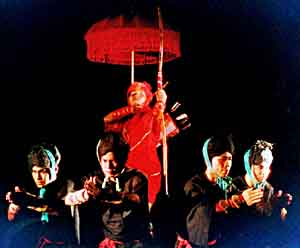
The program at BAM, as at the Kennedy Center, consists of one work: the 1996 spectacle "Uttar-Priyadarshi" ("The Final Beatitude"). The script, in Manipuri, is based on a Hindi poem in blank verse by the 20th- century poet S. H. Vatsyayan, known popularly as Ajneya. (There will be English surtitles during the performances.)

"Uttar-Priyadarshi" (pronounced OO-tahr pree- yuh-DAHR-shee) recounts an episode in the life of the second century B.C. emperor Ashoka. He is seen briefly as a child before the story begins with the adult emperor's victorious return home from war. But instead of celebration, he finds keening war widows and accusing monks who prompt him to reflect on the blood he has spilled. As an act of defiance, Ashoka creates a Kingdom of Hell and appoints the hideous Ghor its ruler. Ghor tortures the monks but then turns around and tortures Ashoka, too, forcing the emperor to reconsider the devastation the war has brought his people. In a spiritual transformation, he decides to overcome earthly woe by adopting the eight-fold path of Buddha. The title "Uttar-Priyadarshi" literally means "the later life" ("Uttar") of "one who looks with compassion" ("Priyadarshi"), and Ashoka was subsequently known as Priyadarshi.

In an interview last spring, when Mr. Thiyam was in New York working out details of his company's forthcoming tour, he cautioned against paying too much literal attention to the story. Speaking in precise British- inflected English, he said: "This is not a piece dependent on a plot. The philosophical idea is much more important."

Describing how he works, he said at the time: "I do the scenery, paint the props. I make the entire scene. Then I erase it, and the stage is once again blank." At that point, he begins work on the next scene.

The specific forms of torture he uses to represent Hell a garroting chair, a guillotine, a gallows were based on research he did of the French Revolution during a trip to France and are part of his effort to appeal to the imaginations of a modern audience. "The more civilized we become," he said dryly, "the more things we have for creating violence: AK-47's, bullets, more arms."

Mr. Thiyam said that his concern with violence is also related to the unrest in his home state. Manipur is in an area that at some points borders Myanmar, Bhutan and Bangladesh, and the region has been plagued with ethnic-based insurgencies. Over the years, according to officials and human-rights advocates, there have been widespread human-rights violations by both troops and insurgents.<

Mr. Thiyam emphasized, though, that his interest in the theatrical representation of war is wider. "The same thing happens around the world everywhere," he said. "My concern is with many places where the same thing is going on. I always felt one should try to stop this kind of violence, which is affecting the next generation. As a man of this century, I cannot be isolated by these problems." Despite the gravity of his themes, Mr. Thiyam said he is committed to the play of thought and to the craft that goes into the Theatre. In the course of "Uttar-Priyadarshi," his troupe recreates a procession of warriors surrounding Ashoka, who is mounted on an elephant; the whirlwind of blood that was the war they fought, and the cosmic image of the Wheel of Time, to which humanity is bound. The props are simple a painted shield-form or a scarlet cloth. Although dance steps occasionally surface, the overall result is not dancing but rather highly ceremonial. The show looks like Theatre, sometimes sounds like a street fight and feels like prayer.

Mr. Thiyam's own training in the Theatre has a strong Western influence. One of four children born to a pair of dancers, he grew up hating the performing arts, owing to the hardships that his parents' touring caused him as a child. He wanted to be a writer or a painter, not to work in Theatre, he said, and early on he published several novels, collections of short stories and poetry, all in Manipuri. (The themes of most of his writings concern the complexities of modern life.) However, during his early 20's he enrolled in the National School of Drama in Delhi, where the director, a native of Kuwait, was a graduate of the Royal Academy of Dramatic Art in London..

AT drama school, Mr. Thiyam began to fall in love with the Theatre, studying Western drama and performance techniques, in addition to classical Theatre and dance traditions from various parts of Asia. After he graduated, he became the director of the school. In 1974, he initiated a two-year selection process for actors for his own company, and in 1976, his team in place, he returned to his native Imphal, the capital of Manipur, to make his dream a reality.

"When we started this," he said, "I had an idea of running a professional company with productions of high quality. I ran a lot of Theatre workshops in different areas of Manipur, then asked actors to join. We started with a handful of very good actors because the selection process was done over two years. By the 1980's, we were getting support from the central Indian government but not from the state government. The central government still helps us, but the production costs are getting very high."

Since its founding, the company has survived a number of hardships, including several inundating floods that damaged its buildings and land (about 2.75 acres a short distance from the center of Imphal). The collective's members persevered, and today they enjoy a brand-new, 200- seat home Theatre, designed by Mr. Thiyam and built by the troupe. Although Mr. Thiyam's three teenage children do not participate in the Theatre , his wife works there as an administrator.

"The Theatre is our religion," he said, speaking of the collective."But I am not a messiah for all this work. I share my experience of the good and bad things in this so-called civilized world, where we are losing our spirit and balance. As an individual, I feel I must get control. I share the kind of power games we play, the factors that brew inside me, inside everybody, the way modern man feels in his way of life. Through Theatre, I try to share it with my audiences, as if to say, `Let's think together.' "

courtesy: Mindy Aloff - the dance critic for The New Republic.
The New York Times on the Web

* Comments posted by users in this discussion thread and other parts of this site are opinions of the individuals posting them (whose user ID is displayed alongside) and not the views of e-pao.net. We strongly recommend that users exercise responsibility, sensitivity and caution over language while writing your opinions which will be seen and read by other users. Please read a complete Guideline on using comments on this website.


LATEST IN E-PAO.NET
  • Langban Tha Katchaba @Haying #2 : Gallery
  • Violence in Manipur 2023-2026 : Timeline
  • Prof Kamal Mitra Chenoy : Obituary
  • Tale of Ahu, Alang & Apapang: Amur Falcon
  • Consumerism :: Poem
  • Condemns Khamenlok Killings
  • Humble Appeal to All Concerns
  • Envious of the Chief Minister
  • Delivering a powerful point
  • Catholic Valley Schools Sports #1: Gallery
  • When the extraordinary becomes ordinary
  • The Map We Chose :: Poem
  • Dhakeswar Potsangbam : ToI Wellness Award
  • Nigeria calls on world to turn AMR pledges
  • Understanding the pressure students face
  • Training on Mushroom at Khagempali
  • Pointing finger of accusation
  • Digital Revolution & MK Binodini Devi
  • Exploring The Vanishing Self #15
  • Letter From A Lost Crony :: Poem
  • Procedural lapses in dismissal of Dr Bimol
  • Manipur Sanaleibak (The Golden land)
  • Training on Seismic Hazard @MU
  • 2026 edition of Hnahsin Kut
  • Oncology & Neurosurgery OPD launched
  • Yaoshang Thabal Competition #5: Gallery
  • Orchids of Manipur
  • Pharmacists: A misunderstood profession
  • Vision Service Week at Ibotonsana School
  • Drone Tech Bootcamp at NIT Meghalaya
  • Athokpam Krishnakanta : World 2% Scientist
  • No Solution Without Identifying "Kuki"
  • Stands in Solidarity with Prof Bimol
  • Taking the idea of Manipur to Senapati
  • Yumjao Lairembi Haraoba #3: Gallery
  • 'Enoong Ngallamdai' :: Movie Review
  • VanDyke Release: Diplomacy or US pressure
  • Mental Health Awareness at High Court
  • 2026 NAMA Research Grant [Upd]
  • Fermented food for beauty
  • Mizoram Targets 5-7% Tourism Share
  • The hills continue to burn
  • Hearthside Story of Naothingkhong #2
  • Between Delhi Power & Valley's Protagonists
  • The Zeliangrongpui at a crossroad
  • Mushroom Cultivation Training at Konthoujam
  • Break from within :: Poem
  • White Canes to Govt Ideal Blind School
  • Concerned: Conflict - Yimkhiung & Tikhir
  • Mizoram Travel Fest 2026
  • Condolence : Kh Armstrong Charang
  • Turning Imphal into a dumping site
  • Sushila & Bichu @Airport #2: Gallery
  • When prime-time spectacle replaces priorities
  • For a new world organization for peace
  • Intl Day for Disaster Risk Reduction @MTU
  • Solidarity with Professor Angomcha Bimol
  • Intl Day for Disaster Reduction @Wangkhei
  • Condemns Barbaric Killings
  • Schools, roads, power & water supply
  • 'Meeyamgi Khollao Khongchat' #2 : Gallery
  • RIST Talk #76: Gravitational-Wave
  • Breast cancer month, October, 2026
  • Free Screening of "Ishanou"
  • Unlocking potentials of 7 horticultural crops
  • Skies and me :: Poem
  • Eramdam hanna kanbiyu
  • The hills, the SoO camps
  • Mera Chaorel Houba @ Kangla #1 : Gallery
  • China's Mayor Economy
  • My muse :: Poem
  • Condemns Killings & Beheading of Civilian
  • Who doesn't do Vote Chori ?
  • EZE Perfumes Enters Northeast
  • One to one meet with PM
  • Exploring The Vanishing Self #14
  • 61st Hunger Marchers' Day #3 : Gallery
  • Humlennganba, Saka : Eming
  • Two interviews, one empty table
  • A landscape of silence :: Poem
  • NSS Runathon for Peace 2026
  • Gender equality- central to diplomatic leaders
  • Manipuri Calendar for year 2027 : Download
  • Meiteilon not Tibeto-Burman language: Rvw
  • Visit to George Gordon's tomb at Canchipur
  • Anandkumar Naorem: World Top 2% Scientist
  • Protect the hills to protect the valley
  • Call for Papers on Manipuri Pony
  • Ashok Singhal Ji - A Karmayogi
  • Addressing the basics of life
  • 228th Bheigyachandra @Nabadwip #1: Gallery
  • Wildlife Week Celebration at Thanga
  • Evolving women's role in Manipur tourism
  • Where do we go from here ?
  • Training Programme on Mushroom
  • Festival look for Navratras
  • Condolence : Demise of Adino Phizo
  • Significant Delhi invite to 3 leaders
  • Heterogeneous Structure of Meitei Society
  • Concert @ 18th Orange Fest #1: Gallery
  • When water management was Statecraft
  • Who switched off the respect :: Poem
  • All is not yet lost for Manipur
  • Wildlife Conservation: Securing the Future
  • Exam : Post of Under Secretary (Law)
  • Understanding narco-terrorism
  • 1500 Burma Refugees Families in 1968-1973
  • 17th World Bamboo Day : Gallery
  • Land affected families: NH-202 in Ukhrul
  • Training Programme on PCB Repair
  • World Habitat Day 2026
  • AMR survivor & WHO call to protect medicines
  • Cut fuel taxes, not food
  • Creating chaos on roads of Imphal
  • Sushila & Bichu @Airport #1: Gallery
  • Manipuri Pony: Case for Animal Science Univ
  • Hemp plant for sustainable textile & Manipur
  • Flame of the lamp & our cultural sensibility
  • Without you :: Poem
  • Welcomes Lalremsiami, Lalthantluangi
  • On the growing roadside eateries
  • Naga Peace Process: Indo-Naga Talk: Timeline
  • 36 Names: Manipur at the Asian Games
  • Abok Ki Singju to Premiere
  • A vision fragmented by corruption :: Poem
  • Gandhi Ji's 3 monkeys and Manipur
  • AI-powered X-Rays are helping find TB
  • Mizoram Reward Lalremsiami, Lalthantluangi
  • 15 years in power Vs 10 years in power
  • Exploring The Vanishing Self #13
  • US-Manipur Digital Archiving Workshop
  • 8th Cultural/ Freshers' Meet for Rongmei
  • The Same Smoke :: Poem
  • Supriya looks at HYROX World C'ships
  • AI4SEVA Hackathon @IT SEZ, Mantripukhri
  • 38th Foundation Day- NIELIT Imphal #2
  • Heikru Hidongba @Bijoy Govinda : Gallery
  • Manipur's Indigenous Natural Farming System
  • Basic human needs a struggle for Sinakeithei
  • Demise of Pame, Marinmai, Lianvela
  • When I met the pugilist Sarita
  • 38th Foundation Day of NIELIT Imphal #1
  • Mizoram's Anthurium Festival Returns
  • Poll fever seems to be catching up
  • My attempt - Meiteilon is not Tibeto-Burman
  • XXXII National Thang-Ta C'ship concluded
  • One Village One Product: A better alternative
  • When machines can answer, who will judge ?
  • Explain motive- Tronglaobi Terror Attack
  • Merger of 5 elected members of NPP
  • Namghar Unites Assam & Maharashtra
  • Trade and commerce : In a limbo
  • 130th Irawat Anniversary : Gallery
  • Lamyanba Irabot Day at Itanagar
  • Irabot's Ideals Remembered at Mumbai
  • Coffee as a sustainable alternative to poppy
  • Her Godname :: Poem
  • Polyendocrine Metabolic Ovarian Syndrome
  • Rejoinder to NPCC
  • Need to get priorities right
  • Irawat and Meetei National question
  • XXXII National Junior Thang-Ta C'ship
  • World Heart Day 2026: Don't miss a beat
  • Science in everyday life
  • Nature Education Workshop
  • Rejoinder to Dr S C Jamir
  • Daslakshan Mahaparva: Festival of 10 supreme
  • Focus back on SoO camps
  • Raengdai Vs NEROCA : Durand Cup : Gallery
  • October Calendar for Year 2026 : Tools
  • Lebensraum or ethnic cleansing
  • World Alzheimer's Day 2026
  • Sensitization Workshop on POSH
  • Mourns Passing of Aribam Shantimo
  • Lecture on 'Indigenous Knowledge Systems'
  • Rejects allegations by NPCC President
  • The narrative Manipur needs
  • Tour Diaries of Maxwell & Higgins #2
  • Laitonjam Rishikanta @ Asian Bodybuilding
  • First poster of Interlude released
  • In the womb of time :: Poem
  • Running an abnormal State
  • Khunung Eshei & Mukna competitions
  • Conference: Challenge in Sustainable Science
  • Rolling back the highway blockade
  • Exploring The Vanishing Self #12
  • Manipur Mesopotamia Force WWI : Gallery
  • PhD in Manipur : Fund it, Fix it
  • Many Voices, One State: Manipur's dilemma
  • Me and Moon: Both do the night shift : Poem
  • Putting rights: Body autonomy & sexual health
  • Green Tea for beauty
  • Yaoshang Thabal @Khurai #2: Gallery
  • AI = Arangpham Intelligence, the Frankenstein
  • World Pharmacists' Day 2026
  • Tapes of 1979 Film 'Ashroy' Discovered
  • From Pangaea to the unpredictable Earth
  • In a Crooked Room :: Poem
  • Debt recovery should be done, but within law
  • Regionalism : New political flavour
  • Chali-Saba - Kang Ningol Palli #1: Gallery
  • Book Release: Exploring The Vanishing Self
  • The Echo After Forever :: Poem
  • The paradox of Kukiland
  • Dr Wairokpam Yaiphaba : Fulbright Fellowship
  • Essay, Painting & Speech Competitions
  • Manipur : Mixture of opposites
  • Naothingkhong & Pitanga #1: Hearthside Story
  • Meiteilon is still not a Tibeto-Burman language
  • 52nd Foundation Day of AMWJU : Gallery
  • The chokehold on Manipur's potential
  • Another Langban has com :: Poem
  • Ageing needs a gendered human rights
  • Mizoram's 2026 festival season opened
  • Inspect the SoO camps
  • 61st Hunger Marchers' Day #2 : Gallery
  • lEkoLdugi warisiH :: Seireng
  • Can Strong Anti-Racism Law save NE Indians
  • Before Building a Viksit Bharat, Learning
  • Quality planting for Pineapple & Banana
  • Seminar: Career Options in Life Sciences
  • Fitclass Gym Moti Nagar Opens
  • Burning hills of Manipur
  • Culturals @Beating of Retreat #4 : Gallery
  • Justice for 6 Liangmai Nagas #2 : Gallery
  • 17th World Bamboo Day 2026
  • 12th Manipur Legislative Assembly : Gallery
  • The 731, and those who may follow
  • Exploring The Vanishing Self #11
  • Little Flower School, 1973 batch : Gallery
  • Bichu Kharibam: FIH Magic Skill Award
  • Tour Diaries of Maxwell & Higgins #1
  • Ningol Phida - Shumang Leela #2 : Gallery
  • Study: Social Worker on Counselling Practice
  • India-Myanmar boundary : Mistakes of 1967
  • Radio E-pao: 5 new songs updated
  • Chiru Maroi : Scientific Documentation
  • Academic Administration Course @MU
  • To our star Tamo Vicky, Vikram Chongtham
  • Vice President visited Manipur : Gallery
  • Langban Tha Katchaba @Haying #1 : Gallery
  • Hiring @ 4-Star Hotel in Udupi
  • Ibudhou Pakhangba Haraoba #1 : Gallery
  • Protest by Researchers @DM Univ : Gallery
  • Meitei Esei
  • US Ambassador @ CM Mantripukhri : Gallery
  • Chongtham Vikram: Delhi Cannot Explain Away
  • A teacher does not leave when his classroom
  • 'Meeyamgi Khollao Khongchat' #1 : Gallery
  • Candle Light- Chongtham Vikram : Gallery
  • Manipuri Pony Heritage Talk to Students
  • Colonial records: Hill Areas, 1891-1947
  • Joint Resolution: Abrogation of SoO
  • Elimination of Racial Discrimination
  • Justice for 6 Liangmai Nagas #1 : Gallery
  • Manipur Can Simply Be Manipur
  • PhD Admission at Assam University
  • Teachers' Day Celebration : Gallery
  • Census 2027 for Manipur deferred
  • Read Meitei Mayek news in romanized English
  • 24-hour Gen Strike (Sep 1) : Gallery
  • Panthoibi Anoi Khuthek #1 : Gallery
  • 48-hour General Strike by JFD #3 : Gallery
  • The flame of Haipou Jadonang
  • Kang Khichri Chaba #2 : Gallery
  • Relevance of NRC, 1951 for immigrants
  • Featured Front Page Photo 2026 #4: Gallery
  • The King Who Caught a Bird : Konthoupa
  • Meira Rally 'No NRC, No Census' : Gallery
  • 48-hour General Strike by JFD #2 : Gallery
  • 35th Manipuri Language Day, 20 August
  • The chappals we leave behind
  • Search 25 years of e-pao.net
  • Colonial Knowledge Production in NE India #23
  • 360° panoramic view of spots in Manipur
  • Final Merit List : Manipur Civil Services 2022
  • PUCL Tribunal report: A shadow of partiality #3
  • PUCL Tribunal report: A shadow of partiality #2
  • PUCL Tribunal report: A shadow of partiality #1