


Narrating Lahore Trip
— Dance Drama at Pak-India Inter-Varsity Drama Festival 2008 —
By Rojio Usham *
With the invitation from the Government College University, Lahore to participate in the second Pak-India Inter-Varsity Drama festival held during 3-9 March 2008 the students of the English Department, Jamia Millia Islamia were invited to perform along with Delhi University colleges. What more, we decided to stage a play rooted to the soil depicting a variety of Indian traditions of performance.
The setting, characters, problems, everything lending a touch of authenticity combined with native genius, local rhythms, and a deep absorption of traditions hitherto only dimly understood.
There is a complex world to offer ranging from the Northeastern region of India all the way to Kerala at the other end of the subcontinent, all waiting to be interpreted, understood and absorbed both by the Indians and ouside the country who do not know the languages of the Northeast and Kerala, and many more. I feel I'm looking at a new world directing the play.
|
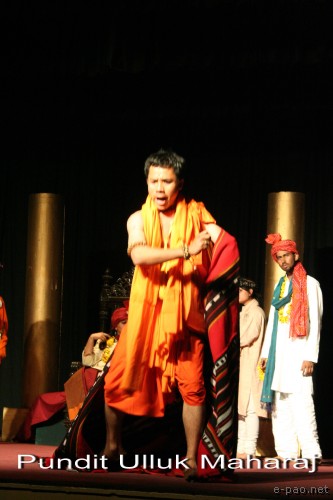
So, we chose Tota Kahini, a short story by Rabindranath Tagore and converted it into a musical dance drama on the theme of education. The traditional as well as the colonial system of education enforced by the British Raj was the subject of Tagore's critique.
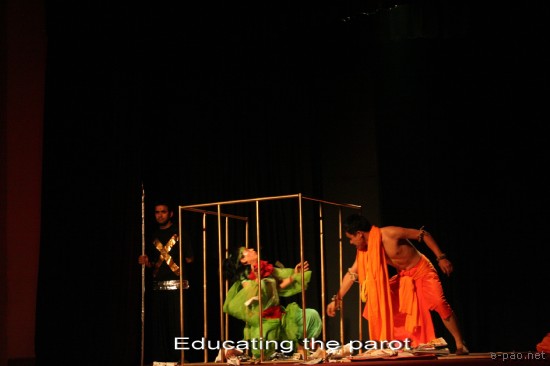
The simple story line of how a parrot disturbed the sleep of King Gobuchandra and thereby the royal fruit trade was caught by the guards.
The King after its trial decided not to kill it but to educate the bird and so scribes from all over the kingdom was called and Pundit Ulluk Maharaj was invited to educate the parrot. An elaborate cage was made and knowledge was stuffed down the bird's throat, finally leading to its death and the declaration that the "education was complete".
The play tried to examine how far a poet like Tagore could foresee a crisis that a civilization might face, of which education was and still is an important component, and how, as a sensitive, creative, responsible human being one can think of possible alternatives to counter it.
|
With his knowledge rooted in reality and his instinct and imagination flying into the distant future, he has a shrewd understanding of the course that human history is about to take and is pained and worried about the future of mankind that his poet's vision can foresee.
Our poet used his visionary imagination to predict and to solve the dangers that western civilization was creating for itself and for the rest of the world, because the east was emulating its ways partly by choice, and partly through values imposed by colonial educational policies.
The so-called mystic saint could very clearly see the logical, practical conclusions of a dangerous process that had already begun its course. And he tried to offer practical solutions, tried to change the course of history as far as he could by spreading his anxious thoughts far and wide and by actively working with the people. Rabindranath was very much of an educational activist as we understand the term today.
The play represents different sensibilities and at the same time, a link between micro and macro and tries to absorb the current trends without losing our diversified identity. While the language of the play scripted by Dr. Anuradha Ghosh is bilingual – primarily in English with a dash of Urdu – the body language and the rhythm also plays an important role in the play.
Choreography and direction comes from one's life and experience. The process starts much before the dance and acting. When the forms are in the mind and make a space in the mind, what you need is only a handful of actors, a stage and audiences.
|
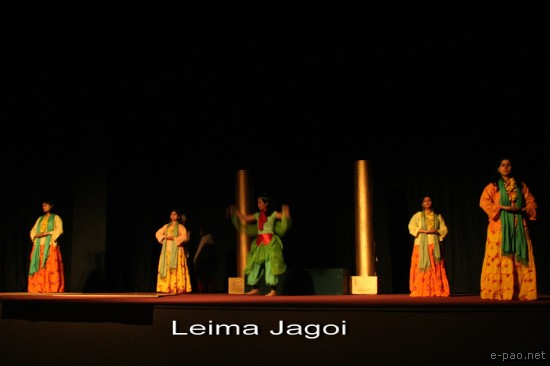
Tagore himself had borrowed a lot from the dance traditions of Manipuri and he had once said that this dance form was the most appropriate one for his dance-dramas.
Keeping this in mind, we began the play with a lilting Leima Jagoi, a Manipuri dance and then shifted to Kabui Naga dance because these dance forms are very close to nature. The dance sequence represents nature in its bounty. Bhangra too was incorporated to celebrate the happy moment of completing education of the parrot.
The fusion of movement, rhythm and harmony created a perfect geometry of lines. The use of space on stage is very important. The outcome of it all was the result of long hours of debate regarding choreography and stylization as what was difficult for the team to come to terms with is the use of non-European styles of performance which we consciously tried to avoid.
Despite technical weaknesses and the fact that most of the actors were first timers, the Jamia Drama Team attracted the attention of the Lahore audience gathered at the Bokhari Auditorium of the GC University.
The second Pak-India inter-collegiate drama festival began at the Bokhari Auditorium of the GCU Lahore. Governor Punjab Lt.Gen. (R) Khalid Maqbool was the chief guest at the opening ceremony.
On the first day of the festival, the GCU Dramatics Club staged Henrik Ibsen's play "A Doll's House". The excellent acting of Musa Abbas, Madiha Gul and the others, the beautiful stage setting are worth remembering. Before the play commenced, students from Pak-Indian universities lit the candles.
Addressing the ceremony the Governor said that the world over intellectual movements have been created by the universities and cultural activities play a pivotal role in fostering peace, love and harmony among the nations of the world. The Governor complimented the Vice Chancellor and Dr. Farhan Yar Ebadat Khan, Dean Students' Welfare and In-charge of the Dramatics Club for arranging the festival in a befitting manner.
Vice Chancellor GCU Lahore, Prof. Dr. Khalid Aftab detailed the academic history of the varsity and informed the audience about the luminaries of show biz of both India and Pakistan who had been associated with this great institution. He said that theatre has always been acknowledged as the premium contrivance of social change and entertainment as it leaves deep imprints on the mind and soul of the theatergoers.
The festival from 3rd – 9th March, 2008 was made successful by witnessing seventeen wonderful plays of young artists from six Indian and ten Pakistani Dramatic teams. But what troubled me is that most of the plays were modeled on European theatrical traditions and was not rooted to the Indian Subcontinent.
However, the performances of teams like the University of Engineering and Technology (UET) Dramatics Society Sooraj Ki Talash was an exciting production with the setting, characters and everything rooted in the Indian subcontinent. Their technical management team was also excellent.
Apart from the festival, what daunted me is the night we spent at Baba Shah Jamal's shrine with some of my new Pakistani friends escaping stealthily from the Amer Hotel where we were hosted. The tomb of the Sufi Saint Baba Shah Jamal is located in Lahore, Pakistan.
There is live music performances there every Thursday - a tradition that has been going on for hundreds of years. Dhol is played with devotees dancing in a trance also known as 'dhamaal'.
This performance, every Thursday, is attended by people from all walks of life - students, government officials, musicians both domestic and international, models, common folk - in short everyone. The environment is very friendly and safe. Women are always respected and I have witnessed it.
Attendees usually smoke hash or ganza, as the tradition has been. Not all attendees smoke and neither are they expected or asked to. However it is tolerated. This tomb is more than a simple shrine, providing shelter, food and solace from the nuances of everyday life.
The famous Pappu Sain is the central attraction and he performs on the dhol at the shrine every Thursday evening. Interestingly he is a deaf man.
|
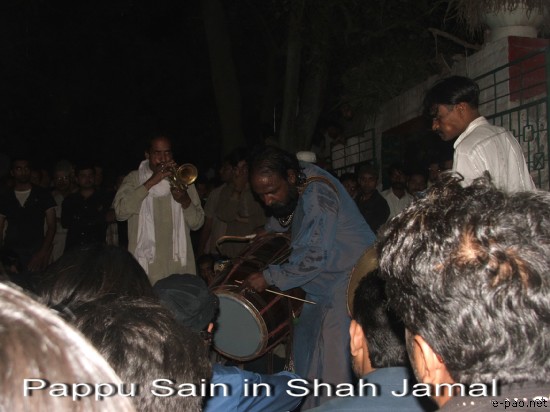
Pilgrims visiting the shrine in large numbers every Thursday can look forward to finding themselves in spruced up surroundings with an ambience promoting spiritual contentment and fulfilling the mystical yearning to find the true purpose of life.
According to me the ecstasy experienced in the 'Shrine' is similar to the Maibi dance in the festival of Lai Haraoba of Manipur. The Maibis dressed in spotless white attire performs this ritual dance (leitai-Nongdai jagoi) invoking the deities from the water in the Lai Haraoba festival.
The dance is performed with the accompaniment of dhol and pena, a folk stringed instrument traditionally linked to the Lai Haraoba festival. Similarly (according to my teacher Dr. Anuradha Ghosh, who went with us on the nightly venture) co-relations with the Baul tradition of Bengal can be made as well as the Vaishnavite cult.
Our interaction with Mr. Abid Hasan Minto, the nephew of Sadat Hasan Manto, President of Pakistan Workers' Party and a renowned human rights lawyer was also a memorable one. The entire team along with our teachers Dr. Anuradha Ghosh and Mr. Adeel Mehdi, met Mr. Minto in his office. Despite his busy schedule he had given us his time and our exchange on the political situation of both the countries was a fruitful one.
Pakistan has a rich and varied tradition of history lying buried. The Mohenjodaro and Harrapa on the bank of the river Indus are considered the world's second oldest rich civilizations after the Egyptian civilization. In the Lahore Museum, very near the GC University, there are different sections dedicated to these civilizations.
If one is unable to go to Harrapa or Mohenjodaro then one must visit the Lahore Museum to learn about this place and their thousand-year old tradition. Seeing the Dumduma canon in front of the Lahore Museum mentioned in Rudyard Kipling's Kim was like fiction coming alive.
|
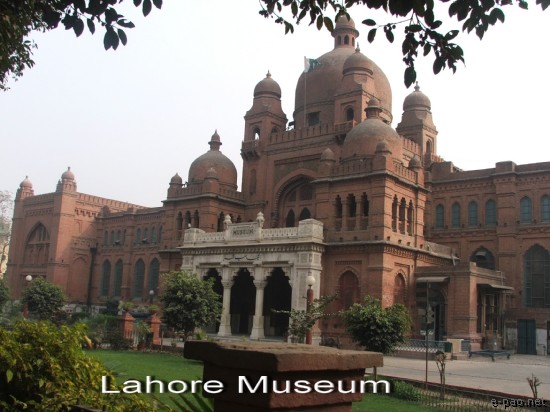
The Lahore Museum exhibits the recorded history of the subcontinent. The Museum has 20 galleries with items dating from the Stone Age to the 20th century. It's famous for its display of Gandhara sculpture (especially the fasting Buddha), manuscripts, calligraphy from West Asia, paintings, carpets and depictions of Islamic art.
An interesting happening in the Museum was that some Pakistani visitors asked me, "Where are you from?" I answered, "Mein India se hun." They were surprised and said, "Urdu bhi bolte ho!" (They thought that I was a Chinese.)
Another incident was when we just crossed the Wagah border and reached what is called Pakistani soil, a bus from GC University was waiting at the border to escort us to the Amer Hotel where we stayed. There were some students and a teacher of the university in the bus.
For security reasons, a student said, "Please ensure that no one discloses that you are from India to a stranger." Jestingly I asked, "Will they believe me to be a Pakistani?" He replied, "Say you are a Chinese."
Much of Lahore's architecture from the Mughal and colonial eras has been preserved. Mughal structures such as the Badshahi Mosque, Ali Hujwiri, Lahore Fort, and Shalimar Garden are popular tourist spots in the city. The Lahore High Court, General Post Office (GPO) and many institutions retain the colonial British structures forming part of the new city while old Lahore still boasts its Mughal-Gothic splendour.
I was moved by the renowned literary figure and writer Bano Qudisa who addressed the concluding ceremony and said that humility should be the mark of every successful person.
We expressed our profound gratitude to the Vice Chancellor and our host, Dr. Farhan Yar Ebadat Khan for providing all the facilities and the kind hospitality with which we were treated during our stay in Pakistan.
Check out a picture gallery on this article here.
* Rojio Usham, M.A. English (Final year) from Jamia Millia Islamia University, New Delhi, writes regularly to e-pao.net. The writer can be contacted at urojio(at)gmail(dot)com . This article was webcasted on June 09, 2008.
* Comments posted by users in this discussion thread and other parts of this site are opinions of the individuals posting them (whose user ID is displayed alongside) and not the views of e-pao.net. We strongly recommend that users exercise responsibility, sensitivity and caution over language while writing your opinions which will be seen and read by other users. Please read a complete Guideline on using comments on this website.


