

Tingkao Ragwang Chapriak
- Part 2 -
Budha Kamei *
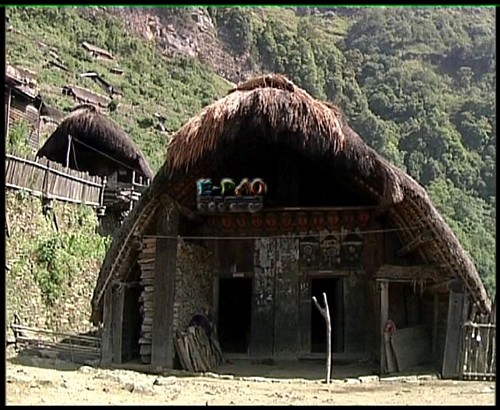
A Scene from The Zeliangrongs :: Pix by Haobam Ronel (Director)
Death is not the end of soul but it is just a change of way of life of the soul. (Budha Kamei 2011:401-402) So, death is the gateway to the next world. No one can say exactly where is Taroilam. It is believed that grave is the residence of the dead so every effort is made to comfort the departed soul. Carl Clemen has rightly stated that the earth is the soul of life, but it is the realm of dead. (1988:5) It is also believed that the soul that has no tomb has no dwelling place and becomes a wondering spirit.
However, the grave has been often thought of as a door to a vast subterranean or underground abode of the dead. Taroilam is believed to be within the bowel of earth. The belief is widely spread and found among the Karens an Asiatic tribe, the land of the dead is held to be below the earth. The Aryan people undoubtedly held the same view and the Roman Orcus and the Greek Hades are underground. The Babylonians placed 'the land whence none return', as it was termed by them, in name both for the grave and for the subterranean abode of the departed. (Frank Byron Jevons 1985:299)
According to the oldest belief of the Italians, the soul did not go into a foreign world to pass its second existence; it remained near men, and continued to live underground. (Bronislaw Malinowski 1982:16) To Emile Durkheim, it is existed side by side in the same society but nobody can see them. (1976:245)
It is believed that Taroilam is ruled by a god named Taroigwang who is assigned by Tingkao Ragwang, the Supreme God to look after the affairs of the kingdom. (Tingkao Ragwang Chapriak 2002:71; Chaoba Kamson 2009) The fate after death would depend on his conduct during his life on earth, and especially on his observance of the moral law and performance of his various duties. (George Rawlinson 1980:42)
Those souls who come to the land of death will face the judgments made by Taroigwang based on their past actions, commitment of sins, worship of Tingkao Ragwang while living in the human world.(Gangmumei Kamei 2005:15) The good, uplifted and holy soul (free from sin) will be sent to heaven. Some who do good and some bad will stay in Taroilam and will be reborn again in the human world to fulfill the duties towards god.
Those who are sinners and evil doers who are born again and again and who die again and again and who are beyond redemption will be sent to Thuntadijang, a stage of degenerated form of life almost equivalent to the extinction of life. It is believed that the soul of a sinner will be sent to the land of Thuntadijang where his soul will transform to a Thunbang plant.
When the Thunbang decays and rots, it converts to a worm. The worm is eaten by a bird and the bird again is eaten by man, only after that the soul may become in the form of human being if Tingkao Ragwang pleases. So, there is no question of extermination of life permanently in the faith of Tingkao Ragwang Chapriak. It is a long process to reincarnate for the soul in the human form from the land of Thuntadijang. [Tingkao Ragwang Chapriak 2002:77] There is no concept of hell and they have faith in Ponthandatmei, rebirth.
In Zeliangrong society, there is Mangtatmei, dream-diviner who may be either sex. The diviner is a person who has many dreams, and is liable to work himself into more or less of a trance, when he is purported to commune with the deities and with the departed souls and to see things not revealed to ordinarily mortals. In time of crisis, he or she is consulted to find out the exact cause of it and its remedy. (Budha Kamei 2012:57) In this way, a relation between the Taroilam and the living world is maintained through the medium of shaman priests and dream diviners. The dead ancestors look after the safety and welfare of their living descendants. In return the living descendants worship their dead ancestors and honour them.
There is a concept of Non, sin in Tingkao Ragwang Chapriak. They observe Nuhmei (taboo) and strictly enforce it. The customs relating to the rites of passage like birth, and birth ceremonies, marriage and marriage ceremonies, festivals and religious ceremonies, death and death ceremonies cannot be violated; it is taboo. One who breaks it commits Non. However, there is a ritual called Thanthingpatmei Thou for attainment of sin and wrong doing by men towards men and god. (Tingkao Ragwang Chapriak 2012:1-2; Gangmumei Kamei 2004:273; Chaoba Kamson 2011:8)
Worship is an act of religious devotion usually directed to one or more deities. Evelyn Underhill writes, "The adoring acknowledgement of all that lies beyond us- the glory that fills heaven and earth. It is the response that conscious beings make to their creator, to the Eternal Reality from which they came forth; to God, however they may think of Him or recognize Him, and whether He be realized through religion, through nature, through history, through science, art, or human life and character."(1946:193) Through worship, man does acknowledge his dependence on God and seeks to do His will, or on a lower level he tries to win God's favour.
An act of worship may be performed individually, in an informal or formal group, or by a priest. Religious worship happens in a wide variety of locations such as in purpose-built places of worship, at home or in the open. Many religious traditions place an emphasis upon regular worship at frequent intervals, often daily or weekly or monthly on full moon day. Expression of worship vary but typically include one or more of the following: prayer, meditation, ritual, scripture, sacrament, sacrifice, sermons, chanting, music or devotional song, dance, religious holidays, festivals, pilgrimage, dining, fasting, temples or shrines, idols, or simply private individual acts of devotion.
The Tingkao Ragwang Chapriak has well formulated system of worship and prayer to god. They follow three modes of worship; Neihmei, Ra-Kalumei and Ra-Khangmei. Neihmei is a short community and individuals prayer to Tingkao Ragwang by abstaining from any physical work on all occasions and activities of the villagers. Neihmei (genna) is strictly observed to avoid the misfortune or natural calamity and to restore prosperity of men. Ra-Kalumei is the worship and prayer to Tingkao Ragwang, the Supreme God, Na-Ragwang Chanaren, the gods of the Zeliangrong pantheon, Bambu, the presiding village deities and Kairao, the ancestors. And the third mode is Ra-Khangmei, meaning propitiation to deities and lower deities not to give trouble to men.
Tingkao Ragwang may be worshipped with and without offering just chanting of His name as "Au Apou Tingkao Ragwang". The mode of worship with offerings and sacrifices includes:
(a) the small offering of water to Him,
(b) the observance of rituals such as
Tingkao Ragwang Jaang Lamei,
Ragaijou-Jangmei,
Pumkanmei (for protection and safety),
Rankaomei (calling the wealth),
Napkaomei (calling the paddy) and
Bukaomei(calling the soul), and
(c) the performance of ceremonies and the great sacrifices like Maku Banru, Bamjou Kimei, Taraangkai etc. by the individuals for their passage to heaven after death.
These great sacrifices are based on the ideal of charity to all, pleasing the people to gain their blessing and to obtain divine blessings from Tingkao Ragwang and to obtain salvation. Following the footsteps of Haipou Jadonnang and Rani Gaidinliu, they constructed Kalum Kai for the purpose of worship of Tingkao Ragwang. The devotees of TRC worship and offer prayer to Tingkao Ragwang, the Almighty God at the Kalum Kai on every full moon day and every Sunday for wellbeing and prosperity.
The seven brother gods are worshipped by performing the Laren Roumei. Laren Roumei, the performance of sacrifices to the eight brother gods including Dimei, the unhatched god is performed in the Rangpatmei day after the end of Gaang-Ngai festival. The individuals who intend to become Shaman priests also perform Laren Roumei. (Tingkao Ragwang Chapriak 2012:75-79)
The worship of Seven Brothers Gods namely; Ragwang, the King of the gods of the earth, Bisnu, the most powerful god on earth who looks after affairs of men, nature and animals and communicate with men, Chonchai, adverse to wine, he looks after the health of men, Napsinmei/Laorang, the god in charge of food grains, Charakilongmei, the god who keeps peace and ward off disturbance on earth, Koklou, the Peipou, the owner of the office of the gods court, Karangong, a god who is a teaser of unruly and misbehaved persons particularly youth, healer of man suffering from dizziness, Dimei, the deity who could not hatch and remains in the earth. (Gangmumei Kamei 2005:21-22)
The Zeliangrong people live in the villages. They worship Bambu, the presiding deities of the village for safety and welfare of the village and villagers. The individual families of the village offer holy wine to Bambu in every religious rite and ceremony.
Ancestor worship is a cult of religion which found in some societies based upon the belief that the spirits of deceased ancestors are immortal and can influence events in the lives of the living. Culturally defined ceremonies and rituals are practiced to honour a family's ancestors (or ancestors of another designated group such as a clan, household, etc.) and to encourage the spirits of the ancestors to protect and help the group or individual. (William P. Scott 1999:11)
"Every man is his own ancestor, and every man is his own heir. He devises his own future, and he inherits his own past."(Tryon Edwards 1999:21) Ancestors worship is an essential feature of Tingkao Ragwang Chapriak. The Zeliangrong people worship the dead ancestors for wellbeing and prosperity. They are not worshipped as gods but honoured as the living deads. No shrine or temple is installed in the family or at the grave. Offering of wine to the ancestors is performed in every religious rite.
Culture and religion are two sides of the same coin. Some say, culture is a vehicle of religion. So, culture and religion are indivisible in Tingkao Ragwang Chapriak. Cultural festivals are times of worship and prayer to God for plenty and welfare and celebration for them. (Julian Jacobs 1990:86) The social and cultural values, the aesthetic and creativity are expressed through dances, songs and music. They celebrate nine festivals like Gaan-Ngai, Nanu-Ngai, Maleng-Ngai, Ginki-Ngai etc. at different stages of agricultural operations according to lunar calendar with festive spirit and prayer.
Each of the festivals is a sweet gift of God which is practiced with true religious faiths which makes human being a superior race and dominant creatures. In the long performance of the ceremony, the participants get opportunity to reinforce their social relations young boys and girls get a chance to express their love and admiration to each other and thus make the whole festival cycle a cohesive unit of integration into the matrix of their culture.
This in course of time dissolves gray differences and establishes an emotional integration and solidarity among themselves participating in this festival. Communal feasting at the males' dormitory (Jeigan Tumei) is a vow they make to stand as one in times of miseries and happiness. Gangmumei Kamei, renowned scholar of North East India writes thus: "The Zeliangrong religion is sustained by their colorful festivals accompanied by religious rites and prayers, dance and music and feasting during different months of a year." [2004:274]
Concluded ...
* Budha Kamei wrote this article for The Sangai Express
This article was posted on December 11, 2012.
* Comments posted by users in this discussion thread and other parts of this site are opinions of the individuals posting them (whose user ID is displayed alongside) and not the views of e-pao.net. We strongly recommend that users exercise responsibility, sensitivity and caution over language while writing your opinions which will be seen and read by other users. Please read a complete Guideline on using comments on this website.


