


Decision making for development
Dr L Krishnamangol Singh *
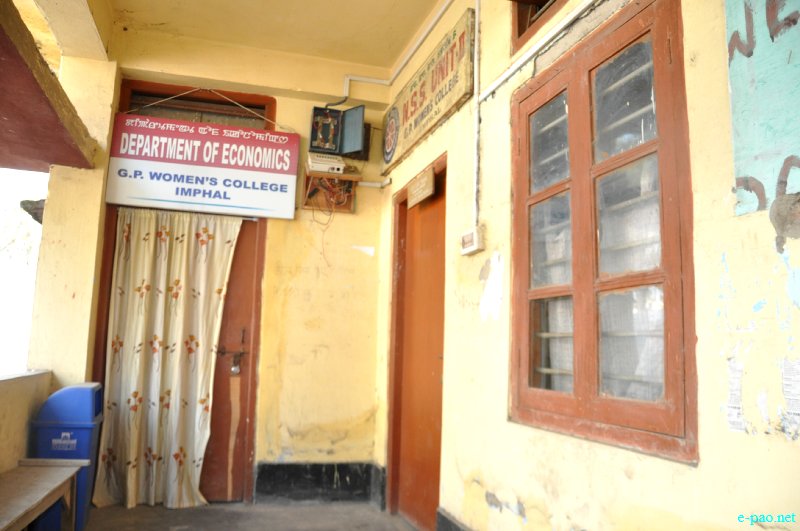
Economics Department of GP Women's College, Imphal in January 2013 :: Pix - Deepak Oinam
Decision making for economic development and public action programmes is a field of study that needs to be handled very cautiously and carefully in order to fulfill the varied objectives of development and promote the state. In fact, the economics of decision making explains that the government plays a crucial role in the management of the economy and society.
Today, the economics of decision making has become a very important branch of economics in terms of both theories and policies. While the traditional decision making theories cannot be easily rejected, the new theory of decision making or economics of decision making is required to address the emerging issues of development and social changes.
Therefore, this short paper seeks to examine some views of the conservative and modern views on the economics of decision making and set out a rational policy for the proper management of the economy and the society. It is well known that the orthodox economic theories and policies were followed to explain the working of the economy and suggest policy measures to address the defects of the economic system.
And, the modern economic theories that developed after traditional theories of macroeconomic system and policy placed exclusive importance on the role of the state in the management of the economic system and economic crisis. In fact, there are many new theories of economic policy which guide the states to address the emerging financial and economic crises.
Therefore, the economics of decision making needs to apply policy priorities to a particular or typical situation for the proper or efficient management of the society and economy. Again, the economics of decision making needs to explore appropriate policies for proper social management within the economic system. Therefore, the new economics of decision making needs to consider the following critical issues.
In the new economics of decision making, it is necessary to choose between coherence and incoherence, and it should avoid myopic views or short-sighted/illogical ideas. In fact, the decision of the government needs to be singularly coherent in order to get people's cooperation and promote welfare of the people.
Here, the term "welfare" refers to not only increase in people's income but also social harmony, and entire upward movement of the society. Therefore, the government needs to provide adequate opportunities for the people in their decision for economic and social arrangement for regeneration of the society and economy. Thus, in this new economics of decision-making, the government can play a pivotal role in choosing between coherent decision, and less interesting ones in order to save the economiy and social disaster.
Again, the new economics of decision needs to explain logically that any decision should be one that is not fanatic or that is not built up on the premise of inconsistencies. Thus, the decision makers have to get a lot of information and reliable data, proper reports and recommendations, etc. that can be used in their exercise for decision-making for socio-economic development and promotion of the state.
In the new exercise or process of economics of decision making, there is also ample scope for public action programmes that can be initiated or implemented in order to address the socio-economic and other issues relating to the state. And ultimately, the government needs to take a rational decision or a rational public action programme that can subserve the general interest of the people or the public interest.
The government is also fully aware that there is the need for promoting the social, cultural, economic and other rights of the people. Therefore, the new economics of decision-making has to consider that the government needs to initiate or care of vast development programmes according to the provisions of the constitution, and legal and policy frameworks or objectives of planning and principles of democracy or democratic institutions. Thus the new economics of decision making needs to help the government in choosing or adopting the best decision or the efficient decision that would promote and maximize the overall development of the state.
Again, in taking economic decision or any other public decision the government can avoid orthodox and conservative view in order to provide economic and social needs of the people. This suggests that there is the urgent need for proper management of the domestic economy (i.e. national economy including state economy) in the context of the global economy.
And, the changing patterns of global economy or globalisation is well known to all. In fact, there can be adjusting mechanism and non-tradeoff policy decisions in the context of liberal economic world view and conservative economic world view. This implies that there can be policy decision that seeks to compromise between the massive programmes of liberalisation and globalisation, and the narrow view of highly protected or protective regime.
Thus, the economics of decision making requires highly analytical and theoretical, and policy frameworks that can consistently explain the existing situation and predict the outcome of a system. Today, it is essential that the best economic system can be combined with the best social, political and administrative, cultural, religious and institutional systems in order to build up the best development system in which all economic variables, and all other economic and social agents or organisations can be placed or can continue to work in a system in which there will be compatible or coherent premises of development.
In fact, economics has a large body of literature and models that can explain the consistency of the economic development system. However, it is high time to develop a separate policy regime or system of policy initiatives within the field of economics in order to explain the complex nature of economic and social system. However, it is high time to develop a separate policy regime or system of policy initiatives within the field of economics in order to explain the complex nature of economic and social systems.
Therefore, it is essential that economic theories and development theories can be combined with institutional economics or institutional theory of economics in explaining and prediction the complex nature or system of the society and economy in any nation or state. In fact, it is high time to develop a new theory of development that needs to explain the economic and social doctrines or principles of the society and formulate or initiate public action programmes for bringing about economic and social changes within the polity.
Thus, the new decision making economics needs to consider many social issues in their analysis for decision-making for transformation of the economy and society, and promoting a sustainable social life within the framework of a sustainable development system. In this new model of economics of decision making there is the role of politics of decision making.
Thus ultimately, the government needs to take their decisions that should be based on rational economic and social choices. In fact, a modern government selects a public choice theory or policy in order to provide general benefits and public goods to the people and promote the state.
Thus, the governments have also introduced and implemented different programmes for welfare and development of the people in order to get cooperation from the people. This is essential for continued political leadership and also for establishing a stable and long-term government in order to fulfill their political ideologies and long-term development programmes and objectives. Thus, the decision of the political leaders has profound impact on the economy and society. Sometimes the decision also becomes critical in view of the steep opposition from the rivals and serious resistance from some sections of the society.
It is, therefore, believed that the new economics of decision making can analyse the complex nature of the economic and development system, and various stages of the evolution and development of the socio-economic formations of a nation or a state. It can also analyse the problems of community development and the society. Thus, the economists and other social scientists have now got a good scope to work in the area or field of the new economics of decision making for the formulation of economic and public policies in order to help the government and address the various development issues.
Again, in the new economics of decision making, there are guiding principles, which help the governments in their decision for welfare of the people and state. And the decisions taken for a planned economy, which works along with market economy are mostly rational and perhaps realistic, and these decisions can provide development benefits to the people. They can also avoid all incoherencies and fanatic ideas. Again, in the new economics of decision, it is necessary to place the people in a mutually compatible position.
And, in most cases the new economics of decision making requires more interesting and intellectually respectable economic policies and development decisions. The new economics of decision making can also have proper linakages or relationships with the politics of decision making. Thus, it is essential that good economics should be combined with good politics. And the rational decisions of the government can maximize the welfare of the people and eliminate the built-in tensions in the society.
In fact, the decision making economics need a lot of rigorous theoretical and policy exercise, which now attracts the attention of the economists and other social scientists. Again, the decision making economics needs to set out or place right decisions of the policy priorities of development. And these policy decisions need to consider development issues and people oriented development priorities along with the programmes for providing vast development opportunities to the people.
Finally, the new economics of decision making attracts the policy makers in order to prove that the "governing institutions" and economics of decision making are significantly interlinked. And the rational politics of decision making or politics of governing institutions cannot succeed without the rational economics of decision making that should set policy priorities in order to get people's support, cooperation and participation in the development process of Manipur.
Thus, in the particular context of Manipur, it is relevant to emphasise that the politics of development needs to have proper relationship with the new economics of decision making for development and policy initiatives or policy options in order to avoid the dissonant views on development. In explaining a particular type of schizophrenia in which somebody simultaneously holds a number of positions, each of them individually totally coherent an each entirely inconsistent with the others, Geoffrey Brennan had clearly pointed out that "it makes it possible to look at the world simultaneously through two or three or more sets of 'windows', and hold the discordant views in a sort of continuously juggled mental balance".
Thus, it is necessary to grasp the whole development issues or the broad dimensions of development in order to apply the skillful judgement in taking any decision for development. In this context, the new economics of decision making for development can help a lot in managing the economy and society of any nation or state. Coming to the current socio-economic and other crisis in Manipur, it can be pointed out that the State Government can now think of establishing a Policy Research Institute for Manipur as a think tank in order to address the various development issues and promote socio-economic changes and development in the state.
I have emphasized and suggested this point/view in many academic forums and publications. In fact, without any personal interest, I believe that the State Government can take the initiative in establishing the said research institute as per the guidelines from the Centre and as per the policy exercise of the State. This step can minimise and eliminate the unfair criticisms relating to development issues and prospects in Manipur.
* Dr L Krishnamangol Singh wrote this article for The Sangai Express
The writer is Associate Professor of Economics, Imphal College, Imphal
This article was posted on July 12, 2013.
* Comments posted by users in this discussion thread and other parts of this site are opinions of the individuals posting them (whose user ID is displayed alongside) and not the views of e-pao.net. We strongly recommend that users exercise responsibility, sensitivity and caution over language while writing your opinions which will be seen and read by other users. Please read a complete Guideline on using comments on this website.


