


A Question to Climate Skeptics
N Munal Meitei *
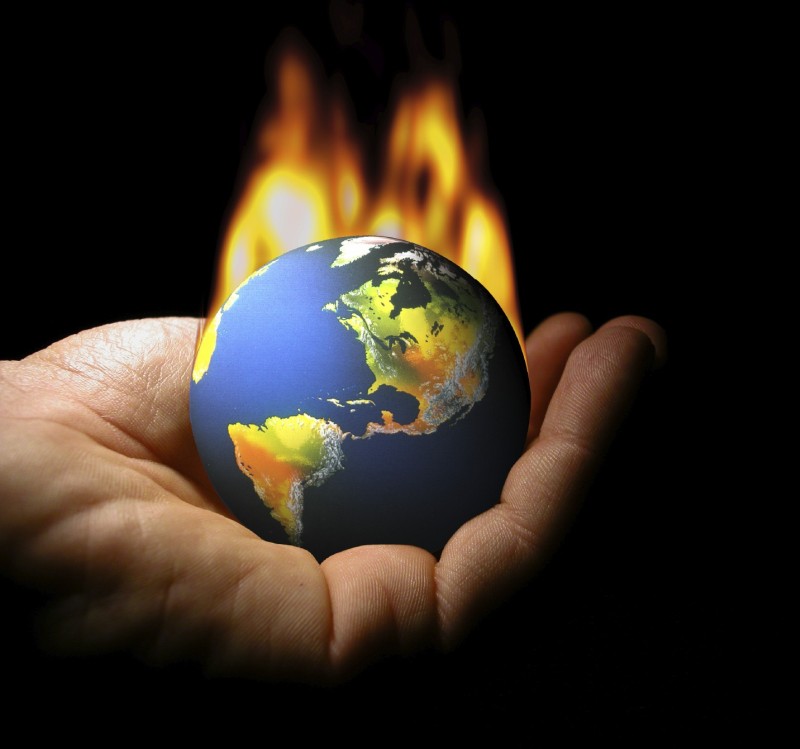
The threat of climate change is an increasingly important environmental issue for the globe. I have been writing some of the article on environmental issues but I doubt whether I am reaching to the point of my destination. But sometime, the views of climate skeptics are scattered widely in blogs, talks, and pamphlets and even in the news papers. Dr. James Hansen who heads NASA's Goddard Institute of Space Studies, and is widely thought to be as "the father of global warming" – his dramatic alert about climate change in US Senate hearings in July 1988, also once echoed that climate skeptics are winning the battle.
The same was also published even in The Wall Street Journal on the 27th January, 2012, by a group of sixteen scientists, entitled "No Need to Panic about Global Warming." This is useful because it contains many of the standard criticisms in a succinct statement. The basic message of the article is that the globe is not warming, that dissident voices are being suppressed, and that delaying policies to slow climate change for fifty years will have no serious economic or environment consequences.
But this response is primarily designed to correct their misleading description from the findings of the various other Researchers and Scientists in many of such related fields; but it is also directed more broadly at their attempt to discredit scientists and scientific research on climate change. Some of the identified six key issues that are raised in the article and for that the commentaries which are submitted about their substance and accuracy. They are:
o Is the planet in fact warming up?
o Are human influences or anthropogenic, an important contributor to warming?
o Is carbon dioxide a pollutant?
o Are we seeing a regime of fear for skeptical climate scientists?
o Are the views of mainstream climate scientists driven primarily by the desire for financial gain?
o Is it true that more carbon dioxide and additional warming will be beneficial?
Rightly saying the sixteen scientists provide vague or misleading answers. At a time when we need to clarify the public about the science of climate change, they have muddied the waters. It is true that nature has a lot of influences on global warming, but what we are discussing is the present day anthropogenic global Warming. We are much feared of our Planet by 2100 A.D. due to such an anthropogenic climate change when the Earth's temperature is predicted to rise about 6°C and population reached about 15 billion with the inhabitable area concentrated only around the poles. Therefore, it will be desirable to describe their mistakes and explain the findings based on various current climate sciences.
1. The first claim is that the planet is not warming up. It is easy to clarify in the tiniest details here. Most people will benefit from stepping back and looking at the record of actual temperature measurements. The figure below shows data from 1880 to 2011 on global mean temperature averaged from three different sources. We do not need any complicated statistical analysis to see that temperatures are rising, and furthermore that they are higher in the last decade than they were in earlier decades.
One of the reasons that drawing conclusions on temperature trends is tricky is that the historical temperature series is highly volatile, as can be seen in the figure. The presence of short-term volatility requires looking at long-term trends. The finding that global temperatures are raising over the last century-plus is one of the most robust findings of climate science and statistics.
2. A second argument is that the anthropogenic warming is smaller than predicted by the models. Statisticians routinely address this kind of question. But we could simply confirm just on judging the present day to day changes on the Environmental problems. The standard approach is to perform an experiment in which (Case 1) modelers put the changes in CO2 concentrations and other climate influences in a climate model and estimate the resulting temperature path, and then (Case 2) modelers calculate what would happen in the counterfactual situation where the only changes were due to natural sources, for example, the sun and volcanoes, with no human-induced changes. They then compare the actual temperature increases of the model predictions for all sources (Case 1) with the predictions for natural sources alone (Case 2). This experiment has been performed many times using climate models. This experiment showed that the projections of climate models are consistent with recorded temperature trends over recent decades only if human impacts are included. The divergent trend is especially pronounced after 1980. By 2005, calculations using natural sources alone underpredict the actual temperature increases by about 0.7°C, while the calculations including human sources track the actual temperature trend higher but closely. In reviewing the results, the IPCC report concluded: "No climate model using natural warming factors alone has reproduced the observed global warming trend in the second half of the twentieth century."
3. The sixteen scientists next attack the idea of CO2 as a pollutant. They write: "The fact is that CO2 is not a pollutant." By this they presumably mean that CO2 is not by itself toxic to humans or other organisms within the range of concentrations that we are likely to encounter, and indeed higher CO2 concentrations may be beneficial. However this is not the meaning of pollution under any law or definitions. The air pollutant is defined as "any air pollution agent or combination of such agents, including any physical, chemical, biological, radioactive…substance or matter which is emitted into or otherwise enters the ambient air." The question here is whether emissions of CO2 and other greenhouse gases will cause net damages, now and in the future. This question has been studied extensively. The most recent thorough survey by the leading scholar in this field, Richard Tol, finds a wide range of damages, particularly if warming is near up to 2°C such as sea-level rise, more intense hurricanes, losses of species and ecosystems, acidification of the oceans, as well as threats to the natural and cultural heritage of the planet. In short, the contention that CO2 is not a pollutant is a rhetorical device and is not supported by any law or theory or studies.
4. The fourth contention by the sixteen scientists is that skeptical climate scientists are living under a reign of terror about their professional and personal livelihoods. They write: Although the number of publicly dissenting scientists is growing, many young scientists furtively say that while they also have serious doubts about the global-warming message, they are afraid to speak up for fear of not being promoted—or worse…. This may not be trued but we have seen it before—for example, in the frightening period when Trofim Lysenko hijacked biology in the Soviet Union. Indeed, the dissenting authors are at the world's greatest universities. There are controversies about many details of climate science. While some claim that skeptics cannot get their papers published, working papers and the Internet are open to all. Hence, it is believed what the sixteen claimed to be not true: dissident voices and new theories are encouraged because they are critical to sharpening any analysis or findings. The idea that climate science is being suppressed by a modern Lysenkoism is pure fiction.
5. A fifth argument is that mainstream climate scientists are benefiting from the clamor about climate change: Why is there so much passion about global warming…? Alarmism over climate is of great benefit to many, providing government funding for academic research and a reason for government bureaucracies to grow. Alarmism also offers an excuse for governments to rise taxes, taxpayer-funded subsidies for businesses that understand how to work the political system, and a lure for big donations to charitable foundations promising to save the planet. There is a suggestion that standard theories about global warming have been put together by the scientific equivalent of Madison Avenue to raise funds from government agencies. The fact is that the first precise calculations about the impact of increased CO2 concentrations on the earth's surface temperature were made by Svante Arrhenius in 1896, many decades before such agencies come up. The skeptics' account also misunderstands the incentives in academic research. IPCC authors are not paid. Academic advancement occurs primarily from publication of original research and contributions to the advancement of knowledge, not from supporting "popular" views.
In fact, the argument about the venality of the academy is largely a diversion. The big money in climate change involves firms, industries, and individuals who worry that their economic interests will be harmed by policies to slow climate change. The attacks on the science of global warming are reminiscent of the well-documented resistance by cigarette companies to scientific findings on the dangers of smoking. Beginning in 1953, the largest tobacco companies launched a public relations campaign to convince the public and the government that there was no sound scientific basis for the claim that cigarette smoking was dangerous. One of the worrisome features of the distortion of climate science is that the stakes are huge here—even larger than the economic stakes for keeping the cigarette industry alive. Restrictions on CO2 emissions large enough to bend downward the temperature curve from its current trajectory to a maximum of 2°C or 3°C would have large environmental effects. Scientists, citizens, and our leaders will need to be extremely vigilant to prevent pollution of the scientific process by the merchants of doubt.
6. A final point concerns economic analysis. The sixteen scientists argued that economics does not support policies to slow climate change in the next half-century. A recent study of a wide variety of policy options by Yale economist William Nordhaus showed that nearly the highest benefit-to-cost ratio is achieved for a policy that allows 50 more years of economic growth unimpeded by greenhouse gas controls. This would be especially beneficial to the less-developed parts of the world that would like to share some of the same advantages of material well-being, health and life expectancy that the fully developed parts of the world enjoy now. Many other policy responses would have a negative return on investment. And it is likely that more CO2 and the modest warming that may come with it will be an overall benefit to the planet. This is naturally the skeptics' summary based on poor analysis and on an incorrect reading of the results.
This study is just one of many studies showing need to reduce CO2 and other greenhouse gas emissions right now, and not to wait for a half-century. Waiting is not only economically costly, but will also make the transition much more costly when it eventually takes place. Current economic studies also suggest that the most efficient policy is to raise the cost of CO2 emissions substantially, either through cap-and-trade or carbon taxes, to provide appropriate incentives for businesses and households to move to low-carbon activities. One might argue that there are many uncertainties here, and we should wait until the uncertainties are resolved. Yes, there are many uncertainties.
That does not imply that action should be delayed. Indeed, we have discovered more puzzles and greater uncertainties as researchers dig deeper into the field. There are continuing major questions about the future of the great ice sheets of Greenland and West Antarctica; the thawing of vast deposits of frozen methane in permafrost; changes in the circulation patterns of the North Atlantic; the potential for runaway warming; and the impacts of ocean carbonization and acidification. Policies implemented today serve as a hedge against unsuspected future dangers that suddenly emerge to threaten our economies or environment.
So, if anything, the uncertainties would point to a more rather than less forceful policy—and one starting sooner rather than later—to slow climate change. In our State like Manipur where there is almost nil industry except a very few brick fields causing anthropogenic agents of Climate Change, it is felt that only the reality of the issue should be surfaced to the public.
The whole world is blaming the leaders only for discussing and discussing without an action in all the summits. Therefore, we need to approach the issues with a cool head and a warm heart and with respect for sound logic and good science.
* N Munal Meitei wrote this article for The Sangai Express
This article was posted on December 18, 2012.
* Comments posted by users in this discussion thread and other parts of this site are opinions of the individuals posting them (whose user ID is displayed alongside) and not the views of e-pao.net. We strongly recommend that users exercise responsibility, sensitivity and caution over language while writing your opinions which will be seen and read by other users. Please read a complete Guideline on using comments on this website.


