


Historical perspective of Sagol-Kangjei
- Part 1 -
Hijam Rajendra *
In fact, "Sagol-Kangjei" or "Polo-Game" was introduced at "Kangleipak" kingdom for the "First time". Hostory prove that the game of polo or Sagol- Horse, Kangjei-Hockey stick was played in Manipur kingdom since time immemorial. It was the game of "Almighty God". It was invented long time back. To recall the history, we can mention the name of king 'Kangba", he was the lover of "Sagol-Kangjei". He tooks special interest in the game of Sagol-Kangjei, Khong-Kangjei, Mukna-unarmed martial arts.
During his period he conferred a Sagei (clan) "Kangujam", to those people who were very skillfull in designing "Kangjei"-hockey stick. They belongs to Mangang Sagei or salai.
The game of polo was a 'Godly game" it is ritual game that was initiated by "Lord Marjing" Godess 'Panthoibi' systematized polo sagol that is exhibited in annual festival, "Lai haraoba" (rejoying of god & goddess).
Now, I like to mention how the game was played for the first time, and who were the players? Well, it is an undisputed fact that "Nongda-Lairen-Pakhangba" who was one of the most powerful as well as mythological ruler of Manipur, took Laisana to be his legal wife; however, the union was not formalized by any solemn ceremony.
So in order for having the union duly recognized by all section of the society; we generally by convention performed a ceremony commonly known as "Loukhatpa" (to accept the bride after performing religious service of the Sagei/clan in presence of some respected members and declaration of husband & wife) which is normally performed after every mutual union of a boy and a girl by elopement in Manipur; such form is still practice today with the assemblance of many distinguish figures who were responsible person.
In a carnival accompanying the "Loukhatpa" ceremony. Polo was played by Lord, Eputhoues, Marjing, Lord Khamlangba, Lord Thangjing, Lord Khoiriphaba and Lord Oknaren etc (how the term/name Oknaren was derived-there was a ledged that Lord Thangjing requested/asked to Lord Khoubru, to gave one of his son in order to assist the administration of Moirang principality-therefore Lord Khoubru sent his son to Moirang and Lord Thangjing and the son of the Lord Koubru meet together at the place called Ningthoukhong.
So, Lord Thangjing confer him as "Oknaren"- Khaba-to meet, so they meet together jointely as such he was confer the name of Oknaren and the areas of his administration is "Moirang Nou" (as per the information given/narrate to me by Pandit Achouba of Manipur Pandit Loisang Ng. Kullachandra Singh) who are of course held at present as only mythological figures because of the death and the re-birth of civilization.
In the said game (a) marjing (b) Khamlangba (c) Trumningthou (d) Ikopningthou (e) Trongningthou (f) Nongshaba (g) Panthoibi played on one side and (a) Thangjing (b) Khoriphaba (c) Wangbrel (d) Yangoiningthou (e) Nambul lakpa (f) Oknarel and (g) Loyarakpa on the other side. So as per the "Kangjeiron Puya". It mention that hockey or polo was played during the reign of Kangba who was said to had reigned much earlier than Nongda Lairen Pakhangba.
It is very interesting to note that such great Sagol-Kangjei game is celebrated in contesting with one another under the name of "Pana-Kangjei" and we also do know that this Olympic game was instated by four lords of north, east, south west, north-west and south east- namely Lord Marjing, Thangjing, Koubru and Wangpuren. For smooth performance of the game, seven horses make a party thus fourteen horses play the game of Sagol Kangjei.
In sweet memory of such godly game, we generally offer "Polo-stick" (Kangjei) and a ball (Kangdrum) to the Lord Marjing, during the Lai- Haroaba, "Thunder Stone" to Lord Thangjing, Goden flower to Lord Koubru, and " a boat to Wangpuren" by the noble king. But it is very unfortunate that some scholars and in some encyclopedias and English dictionaries mention that Polo is oriental origin which is quite baseless. It is a fact that when British allied forces and officers came to Manipur they had never came across any game of polo on their way from England to India, in case if they happen to saw the game they will positively keep in record but such thing never happen.
|
So far history prove that it was during the reign of Maharaja Chandrakirti, the game of Polo went to the adjoining district of Cachar Assam. The British tea planters learnt the game from Manipuris and they first took up the game in Cachar Assam during the 19th century. The "Polo-club" established by the British tea planters in Cachar was the first of its kind in the world.
The Polo was first introduced in India by Major General Sherar in 1863. He took two polo teams from Manipur to Calcutta where they played an exhibition match. An encyclopedia mention that by 1869, such polo game was taken to England by the 10th Hussar and in 1871, the first recorded match took placed, "Hounslow Health" between the 9th Lancer and the 10th Hussars. Following, 1886, John Waston took the first team to USA and the British team won the Westchester Cup.
As such through India the polo of Manipur became known to the world. Those British Political Agents who worked in Manipur, namely Col. J. Johnstone Mr Grimwhood, notable TC Hodson gave us many information to us and their records are the 'testimonies" of "Manipur being the mother of Polo". That, it is gratifying to note that on the occasion of the visit of the "Prince of Wales" who later became Edward VII of England a party of Manipuri Polo players went to Calcutta and again to Delhi to exhibit the game before the human ey in 1901. Hence, it is beyond dispute to say that Polo is originated from Manipur.
Sir Wiston Churchill who was the Prime Minister of United Kingdom had mention in his book, 'My early life" he said, a regiment coming from home was never expected to count in the Indian Polo world for a couple of years. In case, the game had already been known and popular in the western world, Churchill should not have given the above remark. Today, world has accepted that the game of polo originated from Manipur.
The game was so popular and so much of importance was given to it that one king of Manipur even invaded Cachar of Assam to avenge the theft of his favourite polo Pony . In his book, "Report on the Eastern Frontier of British India" which was first published in 1835, Capt. Pemberton, an eminent/anthropologist/administrator who served in Manipur during colonial period writes that the national game of hockey which is played by male of the state of Manipur capable of sitting on a horse, renders them all exgertequestrians and it was by men and not horses to train the Princes of Manipur were able for many years not only to repel the aggressions of the Burmese, but also to occur the whole east of the Ningthi river and plant their banner on the bank of Irrawaddy .
May, I quote what Mrs Ehel St Clair Grimwhood sais in her book, "My here years in Manipur" If anything went amiss with my husband polo ponies the Senapati was quite ready to send him as many as he wanted of his own and he always mounted any visitor who might be staying with us and wish for a game. He was a keen sportsman and a capital shot. She also further mention/remarked in her book page No. 38.
The Maharaja rode a beautiful pony on a gold saddle, with large flaps on each side to protect his legs also gold. The Pony bridle was made of gold cord the balls of cotton are arranged to rotect the pony side from being hit at polo, it was a fine to sight to see the Senapati play polo. He was very strong, the Senapati was a magnificent rider and he was always , the Senapati was a magnificent rider and he was always mounted on beautiful ponies, he wore a very picturesque dress of polo. My husband (Mr Grimwood, (Political Agent) played polo with them and I frequently rode with them.
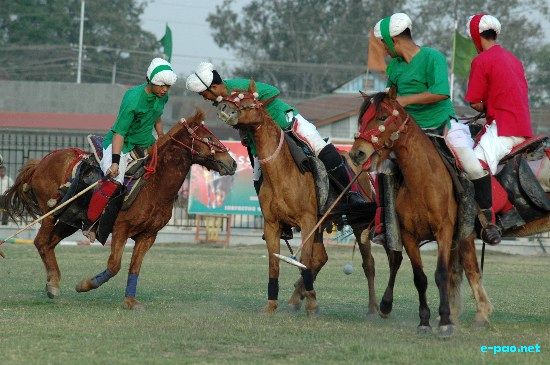
How the polo game was played: Traditionally, the Manipuri polo is played with seven players. Ponies are usually 4/5 feet in height. Each player is fitted with a polo stick made of cane having a narrow angled wooden head fixed at the lower end. The ball 14 inches in circumference is made of bamboo root, the mounted players gallop after the ball to hit it straight into the gold.
The extremely masculine and vigours taxing the exhilarating game. It is heart-cheering to see Manipuri players in their sixties and even seventies riding ponies at full galloping playing 'Sagol-Kangjei' with gusto. The ponies are also decorated fully with various guards for protecting the eyes, forehead and flanks etc.
How the game polo was learnt by the Britisher from Manipur: It is very interesting to note that a notable book entitle Encyclopedia Vol-14 pp 811, clearly mention in such a way which runs as follows, '… the English game of polo was introduced from Manipur, where it form a great national pastime' Further, such game of polo was played by British officers. Sir Maj J Johnstone wrote in his celebrated book, "Manipur and Naga Hill's pp 135"
" ...between the residency ground the Sena Keithel and the great road was the famous Polo ground, where the best play in the world might be seen. There was a grand stand for the Royal family on the western side, and one for myself on the north. Sunday evening was the favourite day and then the Princess appeared and in the earlier days the Maharaja. In my time one of the Maharaja son Pacca Sena and the artillery men were the champion players..."
Prior to this such Polo game was played during the reign of Maharaja Nar Singh, it was during 1838-39, It was mention that on the faithfull day of 18th Kalen all the old members of source,- The Lost kingdom pp 148. Sometime, Manipur Maharaja and Princess play polo game with the Royal British officers, Political Agents, it was remarked in such a way, it was during the days of Maharaja Nar Singh.
"… there was a big Polo between Jubaraj and other princes on one side and the officers on the others. The Jubaraja party won the game…"
From the above accounts we come to know that during the princely state in Manipur, we had all the time played polo game with the British officers in a friendly way. The Britishers learnt the arts and technique of the game from the native Manipuris. The celebrated historical document like "Thaithrol - Kumbaba" chronicle of Manipur mention that the king Kangba who ruled much earlier than Nongda Lairen Pakhangba (33 AD) introduced 'Sagol Kangjei', however regular plying of this game commenced in 1606, during the reign of the king "Khagemba" under newly framed ruled of the game.
Dress of the Meiteis 'Sagol-Kangjei': The modality of the traditional polo-players are quite distinct from others. The customs of the polo-players are more practical and consists of a short jacket of dark velvet worn even in hot weather. A dhoti generally serviceable nature. The Pagri is fastened in such a way as to protect the ears and side of the hands, head from blows and if not particularly picturesque, is at any rate of great use for in the heat and furry of the game the players become excited and some people think that if they cannot hit the bail, they may as well hit the man.
Material use in the game (Sagol Kangjei): Meiteis pony has an unique quality and it play an important role in the polo-game, without it the game cannot be play. English author also in Political Agent/Officers describe about the special quality of Meiteis pony, Col RB Pemberton (1835) describe in his celebrated book.
"The Eastern Frontier of India, Muneerur pp 33 and Dr R Brown (1975) in his book", "Statistical Account of Manipur Domestic animals page no 84-85 and Allen CGR Challen book," Gazetter of Bengal and North East India, livestock of Manipur page 619-620 had written about the unique extra-ordinary quality of Meiteis pony and they mention that Manipur pony has a special quality.
TC Hodson also mention in his book, the Meiteis page No. 49 as such, " Manipur pony are strong wiry creatures rarely more than twelve hands in height, and are fed on grass, the saddle is large, it peaked both in front and banning the most curious feature about the saddle is the addition to it of a pair of leather flags which project around the legs of the rider and afford some protection from a blow. These flaps are made of enameled leather and are fastened underneath the strop irons. The bit is heavy mass of iron in two places are joined in the middle.
to be continued....
* Hijam Rajendra wrote the article for Huieyen Lanpao (English Edition)
This article was webcasted on August 24 2010.
* Comments posted by users in this discussion thread and other parts of this site are opinions of the individuals posting them (whose user ID is displayed alongside) and not the views of e-pao.net. We strongly recommend that users exercise responsibility, sensitivity and caution over language while writing your opinions which will be seen and read by other users. Please read a complete Guideline on using comments on this website.


