


Rani Gaidinliu: A Forgotten Patriot
Gairiangmei Maringmei *
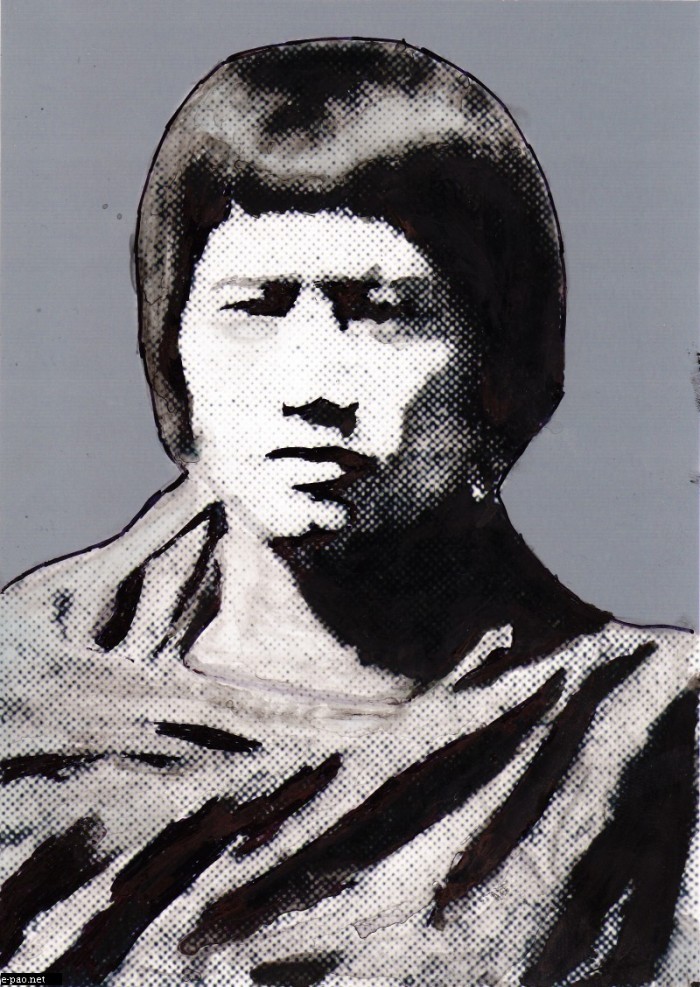
Rani Gaidinliu :: Pix Courtesy- Dr. Heera Marangmei
"She dreamed of freedom for her people… and she raised the banner of independence and called her people to rally round it. India does not even know of this brave child of her hills…" Jawaharlal Nehru
Pritam Sengupta wrote in the Outlook, magazine dated 22nd August, 2005 that 99% of 1 billion Indians; even the Northeasterners had a faint memory of Rani Gaidinliu if not Hindu Brigade. Pandit Nehru called her "Rani of the Nagas", and the "Daughter of the Hills" and compared her with Joan-De-Arch of France and Rani Luxmi Bai of Jhansi, he quoted and lamented that Rani Gaidinliu was a forgotten patriot. Sengupta also said that it was an insult to confine Rani Gaidinliu to any particular camp or ideology while the masses remain quite unaware.
Gaidinliu was born to Lothonang Pamei and Kachotlenliu (her father and mother) on January 26, 1915 at Longkao village in the western part of the then colonial Manipur. She was the third daughter of eight children (five sons and three daughters). From her childhood days, she was affectionate, sincere, obedient, hardworking, talented and always curious to learn from all corners. She was a pious and spiritual girl, and also known for her moral integrity, stubbornness, bravery, and strong sense of conviction and commitment. When she attained the age of 13, joined Jadonang's "Nagaraj Movement". By the tender age of 16, she became the lieutenant of Jadonang, fighting against the British rule. She was a spiritual leader, reformer, guerrilla warrior, political prisoner, and freedom fighter.
Gaidinliu, took up the leadership of the "Nagaraj Movement" after her cousin, Jadonang, the revolutionary leader was executed by the British rulers on 29th August, 1931. Jadonang's movement was the counter product of British colonial rule and their ruthless suppression to his people and the Kuki rebellion (1917-19). The movement was concentrated on the western part of the then colonial Manipur and the then Naga Hills and surrounding areas.
The main objectives of the movement were:
a) to fight against British rule and to restore the past glory.
b) to protect people and their land;
c) to unite the Zeliangrong Naga tribes to remove inter-village and inter-tribal feuds in order to survive at the hostile surrounding to them; and
d) to preserve the culture, custom, and traditional religions.
To achieve the objectives of the movement, Gaidinliu mobilized her people from village to village to direct, organize, and collected funds. She explained to her people the idea of freedom and the independent kingdom and exhorted the warriors to fight against the British rulers' suppressions and exploitations. "We, Nagas were and are free people, the white, the British has no right to rule over us, so we should not recognize their sovereignty over us and will not pay house tax to the British Government and unjust laws like forced labour and compulsory porter subscription," Gaidinliu declared. She also preached to the people to disobey the British oppressive laws, not to pay house tax, and to refuse to carry the luggages of the touring British officials without remuneration.
Gaidinliu received respect, cooperation, moral and financial support from the people to carry out the well-trained guerilla movement. The activities of her political and religious cult were wide-spread across the present day Tamenglong district, southern Naga Hills, and North Cachar Hills of Assam. Peoples admired her, believed her, even worship her as a goddess. Her movement became successful and popular among the people. Gradually, her movement gained momentum and became a grave threat to the British administration.
Alarmed by her growing defiance, the British authorities reported on 2.3.1932 as follows: "The cult which Gaidinliu has revived has clearly spread over a large area of Naga Hills, Manipur, and the North Cachar Hills, and unless Gaidinliu and her party are captured, there is a grave danger of serious outbreak." In June 1932, J.P. Mills, the then Deputy Commissioner, Naga Hills, stated that: "The real danger of the movement is the spirit of defiance."
The British authority was determined to take stern actions against Gaidinliu's anti-imperialistic policies and order came out to capture her. J. P. Mills ordered and sent a large force to conduct the long and difficult operations to arrest her. Knowing the grave situation, Gaidinliu and her forces prepared to face any eventuality. Gaidinliu with her forces attacked the Assam Rifles patrols in North Cachar Hills in February, 1932 and in the following month, she once again attacked Assam Rifles outpost at the Zemi village of Hungrum, in which some of her forces were shot down by the Assam Rifles. The British authority was so angry over the attack and retaliated by burning down many villages including the village of Bopungwemi, the Naga Hills.
Gaidinliu expanded her area of operations and shifted to the eastern part of the Naga Hills, in the meanwhile Mr. Harvey, the then President of Manipur State Darbar, had offered attractive reward of Rs 200/-, later raised to Rs 500/-, and exemption of house tax for 10 years for anybody or any village for giving information leading to her arrest. But no one came forward to provide the information.
In October 1932, Gaidinliu entered into Polumi village to construct her second army head quarters, a huge fortress. When she was supervising the construction of the fortress, Captain Mcdonand of Assam Rifles, and Hari Blah, EAC, North Cachar Hills with a force of 100 Rifle men, made a surprise attack, there captured her along with her forces in the early morning (pre-dawn). Most of her forces were either executed or jailed.
Handcuffed and humiliated, she was brought with her younger brother Chingkhuisinnang to Kohima via Khonoma on foot and put in Kohima jail. After the imprisonment for two months, J. P Mills sent her to Imphal for criminal trials. She spent more than 10 months in Kohima and Imphal jails during the investigations and trials period. As a result of the trials, she was convicted at the charge of murder and abetment of murder, and sentenced her for life imprisonment in 1933.
The British ruler put her in different jails:
(i) 1 year in Gauhati jail (1933);
(ii) 6 years in Shillong jail (1934-39);
(iii) 3 years in Aizawl jail (1940-42); and
(iv) 4 years in Tura jail (1943-47).
Gaidinliu spent her youthful life in different jail of British India, she was the lone Freedom Fighter who spent the longest years (1933 to 1947) in the prisons in the history of India's Freedom Movement.
In 1937, Jawaharlal Nehru became the president of Congress party; he undertook a tour in many parts of Assam to acquaint with the people and problems of the region. During the tour in Assam, he learnt about the Jadonang "Nagaraj Movement" and his execution by the British ruler and also came to know about Gaidinliu's and her imprisonment in Shillong jail. Gaidinliu was merely 22 years old, spending her life in the prison. Later, Nehru personally went to meet Gaidinliu in Shillong jail, on seeing her in the prison, he felt shock and highly praised her for her brave fighting against the mighty British rulers.
In an article carried by The Hindustan Times on 18 December 1937, Nehru wrote: "News of Gandhi and the Congress reached her and her hills abode… She dreamed of freedom for her people… and she raised the banner of independence and called her people to rally round it… India does not even know of this brave child of her hills…" He further wrote that a day would come when she would be released from her prison cell, and free India would remember and cherish her. Recognizing her heroic deed who dreamed of freedom, Nehru conferred the title of "Queen" or "Rani of the Nagas", and assured her that he would move the British Government to release her from the jail.
As he promised earlier, Nehru tried to secure her from the prison with the help of Lady Nancy Astor, Member of British Parliament and other British MPs but turn down by Secretary of State for British India because the Britishers felt that her movement would break out if she were released. Soon after India became independent in 1947, Nehru personally interfered to secure her release from the prison, against the advice of Assam Government. Rani Gaidinliu was released after 15 years on 14.10.1947 from Tura Jail (now Mehgalaya). However, many restrictions were imposed on her free movements when she had chosen to live with her younger brother, Marang in Vimrap village, Tuensang for 6 years. She was granted a section of soldiers, a tin roofed house as well as Freedom Fighter's Pension of Nagaland & Manipur.
Thereafter, the Government of India officially recognized Rani Gaidinliu as the legendary freedom fighter of India. The restrictions imposed on her free movements were lifted later and she was allowed to visit her people in Imphal, and her native village, Longkao in 1952. In 1953, Jawaharlal Nehru, the then Prime Minister of India came to visit Imphal where she met him. Afterwards, Rani Gaidinliu went to New Delhi to meet Nehru and talked about the development and welfare of her people.
Rani Gaidinliu once again started her movement in 1960. She organized a private army of about 1000 men equipped with 400/500 rifles and working for revival movement of the traditional religion of animism i.e., Heraka. In 1964, the Zeliangrong leaders in consultation with the Zeliangrong people led by Rani Gaidinliu demanded "a separate Zeliangrong Administrative Unit" within the Union of India.
There was a misunderstanding between Rani Gaidinliu and the NNC leaders the latter severely criticized the Rani Gaidinliu's activities. The Naga National Council (NNC) leaders considered the demand for a "separate Zeliangrong Administrative Unit" as a big obstacle to the Naga independence struggle. Naga church leaders also felt that the Gaidinliu revival movement of Heraka was anti-Christianity. So, she was warned by the underground Naga leaders as well as the Church leaders that she would face serious consequences if she did not change her stand.
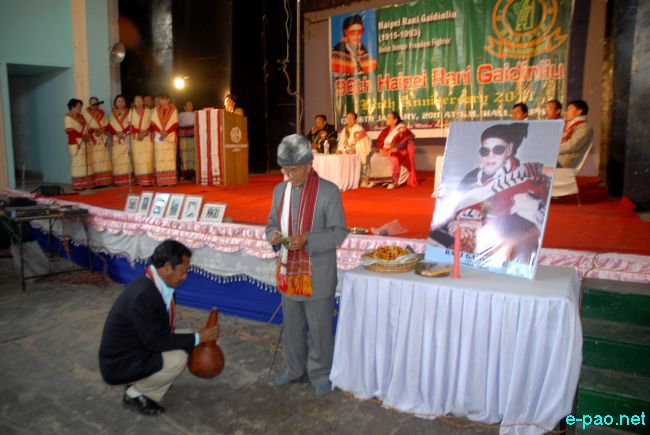
96th Birth Anniversary of Rani Gaidinliu :: 26 January 2011
The Government of India (GoI) came to know about the Rani Gaidinliu's underground activities, the former closely monitored. When the GoI realized that Rani Gaidinliu and Naga underground leaders were having indifferent and fighting each other, taking full advantage of this situation, a vigorous attempt was made to find out her in 1966. And after great persuasion, a settlement to lay down arms and ammunition was arrived at the meeting between Rani Gaidinliu and Subodh Chandra Dev, D. C of Kohima, on behalf of GoI. On 5th January, 1966 after many years of rigorous underground jungle life in an old age, Rani Gaidinliu came out from the jungle hideout to work for betterment of her people through democratic, non-violent and peaceful means. Most of her followers were absorbed in the Nagaland Armed Forces.
Indira Gandhi like her father Jawaharlal Nehru, showed respect and love for Rani Gaidinliu. As Rani Gaidinliu could no longer bear to see her people segregated, indefinite disintegration, and scattered living in different areas of Assam, Manipur and Nagaland, she went to meet Indira Gandhi in New Delhi on 22 February, 1966 and submitted a memorandum demanding a separate Zeliangrong Administrative Unit for Zeliangrong people in India. Indira Gandhi assured her fullest support to the demand of Rani Gaidinliu. When Indira Gandhi became the Prime Minister of India, she acknowledged Rani Gaidinliu's social and political works. The Government of India conferred Tamra Patra, the freedom fighter award upon Rani Gaidinliu as a distinguished guest of freedom fighter on the occasion of the Silver Jubilee of the Independence of India on 15th August 1972.
Rani Gaidinliu met again Indira Gandhi, the then Prime Minister of India on 18th August 1972 and pressed her demand for the formation of separate Zeliangrong Administrative Unit. Pursuing her cause ceaselessly, Rani Gaidinliu led Zeliangrong delegation to Delhi, met Indira Gandhi on 1st February 1973 and urged her to integrate the Zeliangrong people into one administrative unit. She took another round of trip to press her long demand and met Morarji Desai, the then Prime Minister of India at his office in New Delhi on 3rd September 1977.
The same day after meeting with Morarji Desai, she went to meet Indira Gandhi at her residence in New Delhi. Indira Gandhi called upon her son Sanjay Gandhi, daughter in law Meneka Gandhi and her grandsons to come and meet the legendary freedom fighter, Rani Gaidinliu. In this way, the meeting renewed the bond of love and friendship fostered between her and Nehru family members for years. Indira Gandhi came to Manipur and inaugurated the Jawaharlal Bal Bhavan at Awangkhul village, Tamenglong, Manipur on 12th April 1981. She remarked about Rani Gaidinliu and said, "One of our veteran freedom fighters about whom my father told me when I was a small girl and whom I have honoured ever since is Rani Gaidinliu. I am glad to regard her as a friend".
The Zeliangrong People's Convention (ZPC) under the charismatic leadership of Rani Gaidinliu launched a mass movement for the creation of a separate state/homeland for the Zeliangrong people in the Union of India. The ZPC was formed in 1980 at Tamenglong, Manipur, and Rani Gaidinliu was unanimously elected as the President of the organization. The main objective of the organization was to demand a separate state for Zeliangrong people.
In 1982, Rani Gaidinliu led ZPC delegations went to meet Indira Gandhi, the then Prime Minister of India, at her official residence in New Delhi, and submitted a memorandum along with map indicating the areas where Zeliangrong people lived for centuries, demanding for the integration of the same people i.e., Zeme, Liangmai, and Rongmei inhabiting administratively scattered in the North Cachar Hills of Assam, Manipur, and Nagaland.
Since then, several ZPC leaders discussed the matter and raised the demand for the Zeliangrong people with the then Prime Ministers of India: Indira Gandhi, Rajiv Gandhi and officials of the Ministry of Home Affairs. As a partial fulfillment of the demand of ZPC, the GoI sent the expert of the Anthropological Survey of India to examine the "Zeliangrong as a same ethnic group". After the study of ethnic and culture of Zeliangrong people, the Anthropological Survey of India report to the Prime Minister Office stated that "Zeliangrong as an ethnic-culture entity is a valid concepts". In 1992, Rani Gaidinliu reiterated the demand of the ZPC in a memorandum submitted to the then Prime Minister, Narasimha Rao for the recognition of the Zeliangrong community as a Scheduled Tribe.
In recognition of Rani Gaidinliu selfless service towards the country, she was conferred a number of awards and she was also honoured by the Government of India, as given in the order manner below:
(i) The Tamra Patra, Freedom Fighter Award (1972).
(ii) The Padma Bhusan (1981).
(iii) The Vivekananda Sewa Summan (1983).
(iv) The Birasha Munda Award (1994).
(v) The Government of India released a One Rupee Postage Stamp of Rani Gaidinliu (1996).
(vi) The Government of India instituted an award called Stri Shakti Puraskar Award in honour of five eminent women in the Indian history, viz., Devi Ahillya Bai Holkar, Rani Luxmi Bai, Mata Jijabai, Rani Gaidinliu and Kanungi. The award of Rupees one lakh and a citation is given every year on the 8th of March that falls on International Women Day to every veteran women social worker in recognition of their sacrifices for the society (2000).
(vii) The Navy Vessal "Rani Gaidinliu" (2010).
(viii) The massive Dharmasala Guest House (Rani Gaidinliu Bhavan) in Mumbai (2000).
Rani Gaidinliu had been away from her native village for many decades, and had sacrificed all her dynamism for the cause of her people without expecting anything in return. As she had grown old, she wanted to spend her life with the members of her family, relatives and friends. In 1992, she returned to her native village Longkao in Manipur to spend her last days. In her village, after spending some months of her last worldly days along with the villagers, elders and leaders, she breathed her last and left for her heavenly abode on 17th February 1993.
On the demise of Rani Gaidinliu, her people and whole nation of India including Narasimha Rao, the then Prime Minister of India mourned. Chintamani Panigrahi, the then Governor of Manipur, public leaders, villages headmen, and thousands of her admirers had thronged to pay last respect to the departed leader on her funeral ceremony on 20.02.1993 at Longkao village, Tamenglong district. And also a Full General Holiday in Manipur was given by R K Dorendra Singh, the then Chief Minister of Manipur, later he attended the Condolence Service at Majorkhul, Imphal. Rani Gaidinliu was buried at the courtyard of her house as per the customs and rites of the Zeliangrong people with the highest honour that her people could ever give.
The supreme sacrifices made by Rani Gaidinliiu have not been rewarded in the true sense till today. Her struggle against all odds were for freedom of her people and to restore the glory past, not for personal benefits; the money, fame, awards etc. As the passage of time, she too had grown old but her spirit and determination was never fading and her last wish was to integrate into "one administrative unit" of all the Zeliangrong people scattered in different states of Assam, Manipur and Nagaland.
It is so painful to say that Rani Gaidinliu, who had bravely fought against the mighty British Empire and spent her young womanhood in the dark cell of British India, could not see the fruits of what she was fought for in her life time. Her contributions towards the cause of nation and Zeliangrong people as a whole remain a symbol of hopes, and inspirations to the struggling people.
* Gairiangmei Maringmei wrote this article for The Sangai Express
The writer is a former student of Jawaharlal Nehru University, New Delhi and can be contacted at gairiangmei(at)gmail(dot)com
This article was posted on May 04 , 2014.
* Comments posted by users in this discussion thread and other parts of this site are opinions of the individuals posting them (whose user ID is displayed alongside) and not the views of e-pao.net. We strongly recommend that users exercise responsibility, sensitivity and caution over language while writing your opinions which will be seen and read by other users. Please read a complete Guideline on using comments on this website.


