TODAY -

E-Pao! Manipur - The Route of Nagas Migration

The Route of Nagas Migration
By:- R.B. Thohe Pou *


Many scholars had attempted to study on Naga culture and customs, their origin, etymology of the word 'NAGA'. They also believed that Nagas came from Asiatic land or Mainland China or from Myanmar. However not one has attempted to study the route of Nagas migration exhaustively. This is the first time, the author attempt to study exhaustively the possible route of Nagas migration from Mainland China to Naga Hills.

The Route of Nagas Migration

The route of migration is difficult to delineate but it may be possible to trace through the study of folksongs, folktale and legends of different tribes of Nagas. According to the folktale, folksong, folklore etc, they did not migrate from Brahmaputra valley (Assam) to the Naga Hills. However, the myths of origin traced the route of migration to Southeast. In ancient time, the migration took place mainly along the rivers and corridors. Therefore, it is quite possible that they migrated from mainland of China, followed the route along the rivers to Myanmar, and retreated to Naga Hills.

According to Keane, the migration of the people undoubtedly first took southward from the Asiatic mainland, then from the Archipelago eastward to the pacific. Contrary to eastward movement to pacific, the Nagas followed the southward movements from the Asiatic mainland. And after reaching the Moulmein Sea coast (Myanmar) they migrated northwestward direction and lived in Irrawaddy and Chindwin Valley for some periods and finally migrated to the present Naga Hills.

Kaith Buchanan also writes that over hundreds of years the pre-Chinese people of central Asia were displaced into the upland areas of Indo-Chinese lands far to the south. It is possible that Nagas were one of the groups who were displaced from central Asia and migrated to the Southeast Asia.

The route of Southward movements from China by the Nagas would be difficult to delineate due to lack of written history. However, geographically and from a geographical perspective, the Southward movement (migration) from main land China is possible following along the three rivers like Salween (Nu-Jiang), Mekong and Irrawaddy River.

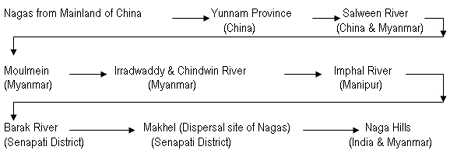
Diagram 1.1 Route of Nagas Migration
(Diagrammatical Representation)


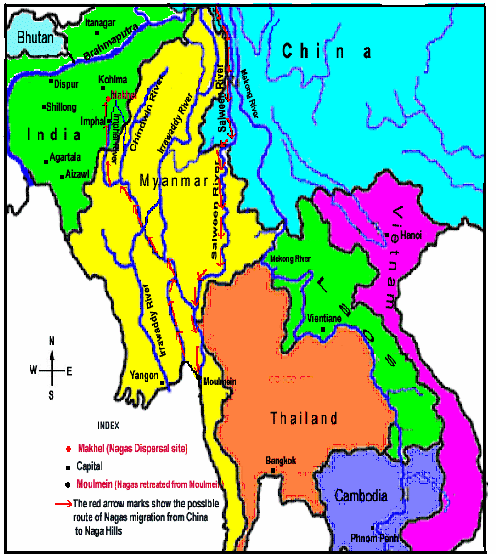
It is believe that the Nagas migrated from Mainland China and follow the southward movement along the route of Salween River and eventually reached the Southern Seas in Moulmein (Myanmar). It is because the Salween River originated from the mainland of China near Tanglha Range and flow to Southern Seas in Moulmein (southern Myanmar) and other tributaries near Bangkok. The Irrawaddy River and Chindwin River do not originate from mainland of China.

The Mekong River originated from mainland of China but it runs through Laos, Cambodia and eventually to the Southern Seas in Mytho City in Vietnam. It is not convinced by the historical facts that the Nagas took the route of migration along the Mekong River. The custom and tradition of Nagas are more resemble to the Tribes of Thailand, Myanmar, Indonesia, Philippines and Malaysia than to the tribal people in Laos, Cambodia and Vietnam. Perhaps the Nagas took the route of migration along the Salween River to reach the southern seas of Moulmein (Myanmar).

It is supported by historical facts that once the Nagas lived in Irrawaddy valley in the periphery of Salween River. One of the tributaries of Irrawaddy River from Mandalay, (Myanmar) also confluence with Salween River near Loi-Kaw (Myanmar), and it is possible to migrate through this river.

Map 1.1 Showing the route of Nagas migration from China to Naga Hills

The majority of the authorities on Nagas were convinced that once the Nagas lived near the Seas, most probably in Moulmein Sea (Myanmar). It is also supported by their (Nagas) fondness of marine shells in decorating their dresses and the marine shells used by the Nagas for decorating their dresses (Kilt) are not found in the hills.

However, they were very familiar with the cowries and conches since time immemorial. The Nagas are basically from the mainland of China. They took southward migration along the Salween River to the south of Moulmein (Myanmar) and lived there for some period of years. It is also believe that some of their (Naga) clans (brothers) left in Moulmein and they retreated to Irrawaddy Valley.

The other Naga groups who were left in the vicinity of seas coast continued to press further southward through the south of Myanmar to Malaysia, Indonesia and Philippines. Some of the tribes in Malaysia (Iban, Kayans), Indonesia (Dayaks), Sumatra (Battack) and Philippines (Igorots) are very similar to Naga tribes in their culture and social life. Once the Naga believed to live near the seas but why they migrated to the Hills?

It is difficult to ponder on this matter and give a reasonable reason. The reason of their migration from the Southern Seas to the Nagas Hills is still obscured. Some of the probable reasons for their retreating may be mentioned as-
i) The plain people who were more civilized with better equipment in warfare in Moulmein or near the seas coast might have pressed the Nagas to push up to Irrawaddy Valley.
ii) There may be frequents waves, tornadoes and pestilence living near the seacoast.
iii) Another reason may be, they were safer from their enemies' attacks living in the hills than living in the plain, where there is no much protection.
iv) As they are basically from the mainland, they may not be acclimatized near the seacoast and wanting to have other occupations like hunting, gathering fruits, cultivation etc they might shift to the hills.

There was not historical record like - when did they reach the southern seas? How long they lived there? When did they live near the seacoast? When did they migrate to the Naga Hills? One of the Naga writer R.R. Shimray suggested that Nagas lived near the seas coast during the Neolithic Age, and migrated to the hills during the Bronze Age or early Iron Age.

Thus he writes,
"There is a legend of a huge tiger which had blocked the gate way and with great difficulty they could cross it after having the tiger by adopting various ingenuities. This ingenuity of killing the said tiger includes use of arrows. It, therefore, appears that after roaming in the Irrawadi valley and the south East Asian countries in the Neolithic Age, the Naga group had reached the hole in the Bronze Age (3100-2000BC) or early Iron Age (1200BC)."1

Some of the authorities on Nagas like Hutton; Pearl; Capt. Steel etc showed the evidence of Neolithic culture in Nagaland with the studied of those smooth stones found in Nagaland, which is still preserved in Oxford University. The recent discoveries of pebble chopper in Maring Naga village and the Khangkhui cave materials at Ukhrul by an Archaeologist O.K. Singh proved the evidence of Paleolithic culture in Naga country.

However according to S.K. Chatterjee, the presence of the Nagas in the Naga Hills was felt by the 8th century B.C (700 BC).2 The Nagas after they lived near the Seas Coast for generations, they retreated north-west from Moulmein along the Irrawaddy River to the confluence of Chindwin and Irrawaddy River near Monywa (Myanmar).

It is believe that once the Nagas lived in Irrawaddy and Chindwin Valley for some generations. But why they left the beautiful valley of Irrawaddy valley? The reason why they left the valley is obscure. According to some stories, the valley was too warm for permanent settlement also there was too much mosquitoes so they left the valley.

However, most probably the aboriginal settlers in Irrawaddy valley might have pressed the Nagas to the Hills where they are occupying now. In ancient time, the more powerful races in warfare usually drive out the weaker races. For instance, the Dravidians were suppose to be the first settler in Indian Gangetic plain, but later the Aryans drove them from the valley and migrated to the south.

One of the Naga writer Mr. Shimray believed that the Nagas lived in Irrawaddy in the Neolithic age and then they moved up along the Chindwin River and finally reached Thaungdut (north-west Myanmar). However, it is more possible that the Nagas took the route to Manipur along the Imphal River, which links to Irrawaddy River.

The northwestern part of Myanmar around Thaungdut is mountainous and it is no possible or difficult to go through that corridor to reach Manipur. In ancient time, the migration generally took along the rivers and corridors and the Nagas probably took the route along the Imphal River.

Our understanding of the route of migration is base entirely from folktale, folklore, legends and presumptions. The Nagas lived for some generations in Irrawaddy and Chindwin valley before they migrated to Manipur. The wave of migration from Irrawaddy valley took along the Imphal River and corridor of Indo-Myanmar to reach Manipur. As the Manipur valley was swampy and filled with water in those days, they moved to the hills.

One of the Manipur historians J. Roy wrote, "Though the sea receded from that area, the valley portion of Manipur remained under the water for a long time. The Manipuri Purans also refer to this fact. There, it is found that in the beginning everything was under the water."3

From Imphal River, (which is linked to Irrawaddy River) they moved further to the north of Kangpokpi (Imphal River rises from Kangpokpi) and then to Karong (Senapati District). From Karong, most probably they took the route along the Barak River and eventually settled at Makhel (near Nagaland border) Senapati District Manipur, which the Nagas consider to be the cradle of dispersion. In ancient time, the people from Makhel go to Imphal along the Barak River, which is rise from the periphery of Makhel.

The Nagas are convinced and accepted that "MAKHEL" as the place of origin from where they were dispersed to other Naga Hills. There are ample of historical facts showing as the evidence of Makhel as their place of origin and dispersal. At Makhel, there are Stone of dispersal, departure tree (a wild Pear Tree), three Stone Monoliths representing God, Man and Tiger, a sacred Shield and small Stones kept with Chief of Makhel since their dispersal.

The monolith representing Tiger had fallen and the other two stones are still standing. According to the prediction and legend of the Nagas - all the Nagas will come to unite and live together under one administration before the monolith- representing man is fall and the monolith representing God will fall when the end of the world comes. One can still see all the above facts visiting to that place of dispersal.

Thus we may conclude that Nagas hailed from mainland of China, took the southward migration to Southern Seas of Moulmein (Myanmar) and lived there for some period of time and retreated north-west direction to Irrawaddy and Chindwin Valley along the Salween river and lived another some period of time. And from there they ultimately migrated along the Imphal River and Barak River to their present Naga Hills.

References

1. R.R. Shimray (1985), Origin and Culture of Nagas, New Delhi: Somsok Publications, pp-18
2. Vashum R., (2000), Nagas' Right to Self Determination-An Anthropological Historical
Perspective, Delhi: Mittal Publications, pp-22 (cf. Raising et al 1994:1)
3. Op. Cit. Shimray, pp-24


* R.B. Thohe Pou, a Ph.D. Research Scholar, contributes regularly to e-pao.net
He can be contacted at [email protected]
This article was webcasted on 19th April 2006.


* Comments posted by users in this discussion thread and other parts of this site are opinions of the individuals posting them (whose user ID is displayed alongside) and not the views of e-pao.net. We strongly recommend that users exercise responsibility, sensitivity and caution over language while writing your opinions which will be seen and read by other users. Please read a complete Guideline on using comments on this website.


LATEST IN E-PAO.NET
  • Kang Chingba @Govindajee Temple : Gallery
  • Violence in Manipur 2023-2026 : Timeline
  • Kanto Sabal & security questions
  • Rights of Freedom of religions & beliefs
  • Lord Jagannatha's processional chariot fest
  • Condemns Kanto Sabal Arson Attack
  • Love Will Find a Way :: Poem
  • Naga Peace Process: Indo-Naga Talk: Timeline
  • The killing and anti-AFSPA stand
  • 77th Republic Day @ Kangla #3: Gallery
  • 2004 Kangla Protest: Anti-Repression Day
  • Make every effort to do what leads to peace
  • 'Trust Deficit Towards Govt of India'
  • On the grand road of Puri
  • Day 2: Hands On Training- Yelhou Hidak 2026
  • 23rd Technothlon at Techniche IIT Guwahati
  • Playing the victim card will not do
  • 63rd Mr Manipur @ MU #5 : Gallery
  • Thotmungam, Taibanganba, Reichan : Eming
  • Thank you, Cristiano Ronaldo
  • Ethics of financing armed groups in Manipur
  • Dylan Thokchom @ Badminton Asia C'Ship II
  • What do recent initiatives of young people say?
  • Day 1: Hands On Training- Yelhou Hidak 2026
  • Of health, water & power supply
  • Cultural @ Beating of Retreat #3 : Gallery
  • Underpaid nurses : A look at pathetic salaries
  • Manipur : Living under shadow of violence
  • Wild Nature :: Poem
  • Fulfil the 2027 #EndTB commitments
  • Walking Lens 3.0 concluded
  • Up in flames since May of 2023
  • Seasonal Fishes @Ima Keithel #3: Gallery
  • Meetei Mayek High School : Subroto Cup
  • Trend of mislabelling in recent times
  • AI revolutionize early disease detection in crop
  • Khemchand the Sardar Patel
  • 4-year integrated teacher education (ITEP)
  • Fibre Economy: India's next big opportunity
  • Right under the nose of Army : Leimakhong
  • Exploring The Vanishing Self #1
  • The names behind the arrest
  • 2026 FIFA World Cup - new global standard
  • 10th NE Int'l Fashion Week 2026 announced
  • A girl in the temple :: Poem
  • 'Overwhelming Meetei Support For ST Status'
  • Oncology OPD Services launched
  • 77th Republic Day @ Kangla #2: Gallery
  • National Drone Innovation Challenge 2025-26
  • The Next Market Day :: Poem
  • Manipur airfare crisis: Way out is beyond reach
  • Posts @ Dept of Art & Culture, Manipur
  • Monsoons beauty
  • Transformative journey on Reform Express
  • Reading the stand of the Kuki CSO leader
  • Early History of Manipuri Sahitya Parishad #2
  • 35th NAMA Annual Convention at New Jersey
  • British Coin Puzzle
  • The story of Citrus
  • Pride Ride 2026 Pedals in Agartala
  • BRICS & the New Geography of Agri-Trade
  • Seeing, treating all as equals
  • Unravelling the knot: Reclaiming Thaksi-Khasi
  • The making of a Social Worker
  • Enough is Enough :: Poem
  • Online submission- Class XI & XII to COHSEM
  • Rising above HIV diagnosis
  • 12 years of Science in service of India
  • Six Naga men : The hurt, pain still lingers
  • Solo Dance: Wahengbam Debina #2: Gallery
  • Dylan Thokchom @ Badminton Asia C'Ship
  • 'Imp-Jiri Highway to Be Ready by Dec 2026'
  • Reassessing Manipur's geopolitical conflict
  • A Walking Life :: Poem
  • Something on Scrub Typhus
  • Making it to the news for right reasons
  • Yumjao Lairembi Haraoba #2 : Gallery
  • Border Flames: CoBRA, Crisis in Kamjong
  • A Fool's Cry :: Poem
  • Manipur Displacement Crisis- Security Failure
  • Why are we still not on track to end TB
  • Development Vision for Assam & North-East
  • Delhi: Noting new area of conflict
  • 63rd Mr Manipur @ MU #4 : Gallery
  • Hundred Flowers Institute of Medical Sciences
  • 3rd 'Ningol Van' Tree Plantation at Kongba
  • Possible way out of festering conflict
  • Draft Electoral Rolls for Imphal West
  • 3 ACs - Draft Electoral Rolls for Senapati
  • Draft Electoral Rolls for Imphal East
  • The sunshine of civilization :: Poem
  • Working on a Saturday
  • Present signature for February 30 !
  • Boy Who Dredged the Rivers: Taothingmang
  • Day 3 : Yaoshang Festivities : Gallery
  • Golden Jubilee of JNMDA (Prod Unit)
  • The failure of selective liberalism
  • Apatani's Next Top Model 2026 : Grand Finale
  • The Faithful Pen :: Poem
  • Obesity - Mother of many lifestyle disorders
  • Fuzzy Clearances in Mapithel Project
  • E20 Petrol in India: Controversy Behind Biofuel
  • Ratify UN Convention Against Torture
  • When Manipur University says No to Drugs
  • Teaching : The most judged profession
  • Cloud of Death: Tobacco's Global Shadow
  • Time to show there is a Govt in place
  • World Environment @Lamdeng #2 : Gallery
  • Why Kuki failed to co-exist with communities
  • Apatani Fashion Week 2026 at Hija
  • Admission Notice : Dhanamanjuri University
  • 41 yrs of healing lives & strengthening Manipur
  • Smart protected cultivation : For climate smart
  • Heatwave makeup guide
  • Call for conscientious voting
  • Ningol Phida @Shumang Leela #1 : Gallery
  • Two civil society reports on violence in Manipur
  • Influenza : A potential for another pandemic ?
  • Who Shapes Whom ? :: Poem
  • Rejects KZC's June 25 Press Conference
  • Science behind the RSS Shakha
  • Paradox of devotion, power of babas & justice
  • Impact of inter-district blockade
  • Day 3 : Yaoshang Sports : Gallery
  • World Motor Cycle Day @Andro : Gallery
  • SoO & selective law application
  • New thaw of Indo-Myanmar relationship ?
  • Transparency in rehabilitation centre evaluation
  • Mother Earth :: Poem
  • Patriarchal resistance in Africa- gender equality
  • After Sharda who, is the question
  • Sillam Sintha Jagoi @ATINGA : Gallery
  • Featured Front Page Photo 2026 #3: Gallery
  • Constitutional and federal discourses
  • Guru Shishya Parampara Scheme 2026-2027
  • The Personal MBA is no less than an MBA
  • A surge of love :: Poem
  • Walking Lens - 3rd Edition
  • Selling false sense of normalcy
  • Ethnic conflicts & effects on local fisheries
  • July Calendar for Year 2026 : Tools
  • Seminar: NE Traditional Knowledge System
  • Youth, Education & the Road to Peace
  • I Will Not Be a Footnote :: Poem
  • Rejects KZC's Contradictory Statements
  • Being Indian/Manipuri citizens
  • The politics of shutdown & blockade
  • 360° panoramic view of spots in Manipur
  • Tangkhul Meiphung: The wounds of Time
  • Arambai Tenggol & the law of defence
  • SWC Khongman Mourns Demise of Founder
  • A New Skyline for Imphal
  • Legal for Inmates of Manipur Central Jail
  • Demands Abrogation of SoO
  • How Football Connects Us Across Generations
  • Homecoming @ Washington DC : Gallery
  • BSc (Horticulture) State Govt Nominee
  • The World Drug Problem
  • Senior Media Delegation Visits Karkinos
  • Why is interest on education high ?
  • Guwahati Airport Emergency Response
  • Admission without a shred of guilt
  • ANSAM Rally demanding justice : Gallery
  • Imokanta's Shumang Lila of Manipur : Review
  • Drug addiction is a disease that can be beaten
  • KZC's 25 June PR Exposes Brutality
  • Awareness Programme on Drug Abuse
  • Three-day Rise Up Summer Camp 2026
  • Tips for healthy & beautiful nails in summer
  • The yarn about return of peace
  • Workshop- 'AI in Journalism' : Gallery
  • Exploring The Vanishing Self - Book Launch
  • The Great Regression of Manipuri Cinema
  • A venture on culinary enterpreneurs
  • A convoy that deepened fears of proxy war
  • Offering :: Poem
  • Forgotten dialogues convened at Delhi
  • 25th The Great June Uprising #2 : Gallery
  • Day 2 : Yaoshang Mei Loukhatpa : Gallery
  • How Manipuri Cinema is Reimagining Future
  • A Dime A Dozen # 1 : Author's Warning Note
  • 3 yrs on, Manipur demand an honest reckoning
  • Financial traps you should avoid
  • NE India Infrastructure Summit 2026
  • Stand to contest coming Assembly polls
  • Manipuris (Meitei) and Bishnupriyas
  • Kamesh Salam Recognized by Business Today
  • Manipur's children are watching
  • Nungshiba Leinamna : Weaves Love & Legacy
  • The albatross of mid-June :: Poem
  • On Working Committee, NNPG's statement
  • Workshop : Application of AI in Journalism
  • Emergency shutdown politics of CoTU
  • 26th Death Anniv : Arambam Somorendra
  • Yaoshang Pechakari @ Govindaji: Gallery
  • Understanding infertility in a changing world
  • The Cry of My Six Brothers :: Poem
  • International Day of Yoga @ MU
  • International Day of Yoga @ IBSD
  • RSS is already registered
  • People returning again on wooden cots
  • ANSAM rally at Imphal : Call of indigenes
  • Candle Light Vigil @ New Checkon : Gallery
  • Youth & Politics: When Are We Addressing
  • Hostage crisis
  • B.Sc @ CMC College of Nursing, Koirengei
  • Seasons of a Lie :: Poem
  • Textile Designers @ Directorate of Handloom
  • Footpath parking at Zudio, Thangal Bazar
  • Cultural @ Beating of Retreat #2 : Gallery
  • Tree Plantation Drive @ Mekola : Gallery
  • Girls' Hostel at Heikakpokpi, Tengnoupal
  • Burden of NCD among women in Manipur
  • 35th State Thang-ta Championship 2026
  • Congratulatory Message : PhD Degree @ MU
  • Life as it floats down :: Poem
  • Advanced Botulinum Toxin Therapy
  • A three way conflict situation
  • 25th The Great June Uprising #1 : Gallery
  • The Foundational Question & Its Evasions
  • The necessity of peace in Manipur
  • AMD Academic Accelerator Program, Pune
  • Question KIM-CM Meet amid Kuki Crimes
  • Public Welfare Camp kicks off in Senapati
  • Yoga for beauty
  • Time for Imphal to assert its position
  • Manipuri and Bishnupriya Manipuri
  • June 18 : A Day of Unity, Sacrifice
  • A region on edge for 3 years on the trot
  • Cry Mother Cry :: Poem
  • Movement of half the population is in trouble
  • Building future or destroying generation ?
  • NEET Examination, 2026 : Noney District
  • June of 2001 and the reality of today
  • Protest erupted @RIMS [15 Jun] : Gallery
  • Massacres perpetrated by Kukis during British
  • Political neglect of PhD graduates
  • The fate of Ophelia :: Poem
  • RACTION 2026 - Residency & Film Challenge
  • Monetary worth of a homemaker unpaid work
  • Guwahati Airport Among World Beautiful
  • Khuiyoi Tompok & Sound of the Drum
  • 28th Meira Paibee Numit @Khurai : Gallery
  • BMSA Annual Multi-Sports Tournament 2026
  • The Real Subject of Priyakanta's 'I Am Special'
  • 3rd anniv- Khamenlok 'massacre' : Gallery
  • Manipur and settler colonialism
  • Beyond the Failure of Regional Parties
  • Healthcare for Manipuris in Bangalore
  • 'Ningol Van' Tree Plantation at Mekola
  • A battle :: Poem
  • The Cockroaches are Knocking
  • Reflecting on the reality here
  • AI : Explore 25+ yrs of Manipur archives
  • Why reform never comes : Political economy
  • Solo Dance: Wahengbam Debina #1: Gallery
  • Why the crisis demands a National strategy
  • Remains of 6 Naga hostages @JNIMS: Gallery
  • The Lost Paradise
  • Art Exhibition by G Krishnadas: Gallery
  • Moirangthem Chandra's collection of Puyas
  • What Manipur conflict reveal about oppression
  • 'No NRC Update No Census' Rally : Gallery
  • Price of a vote: How debt drives election
  • Yaoshang Mei Loukhatpa #3 : Gallery
  • Showcasing Manipur @Switzerland : Gallery
  • Criticism Without an Alternative is Not Enough
  • The Lament of a Silent Tree
  • Behavior, Psychology & Society
  • 1st Peaceful Coexistence Award 2026
  • Events- Kuki militant & Naga village volunteer
  • World Environment @Lamdeng #1 : Gallery
  • Ahingee Laan : Dance-drama #2 : Gallery
  • Abdul Hafiz graveyard at Imphal War Cemetery
  • Martyrs' Day @ Cheiraoching #3 : Gallery
  • The King Who Came from the Sky: Pakhangpa
  • Chakan Gang-Ngai 2026 : Ooba Video
  • Unfinished requiem- Linthoingambi & Hemanjit
  • How to Break Manipur w/o Breaking Any Laws
  • 17th Manipur State Film Awards (MSFA), 2025
  • Eid-Ul-Zuha @Sangaiyumpham : Gallery
  • 16th Manipur State Film Awards (MSFA), 2024
  • Lhangpat Mei @Keishamthong #2: Gallery
  • Radio E-pao: 5 new songs updated
  • Cheirao-chingkaba on Cheiraoba #2: Gallery
  • Anoi Group Art Exhibition 2026 : Download
  • Yaoshang - Cooking Competition : Gallery
  • Manipur State Award for Literature 2024
  • Manipur in India Constitutional Transition #3
  • Lamjen @ Thangjing Haraoba #1: Gallery
  • HSLC Exam 2026 : Full Result
  • HSLC Exam 2026 : Pass % : Govt Schools
  • HSLC Exam 2026 : Pass % : Aided Schools
  • HSLC Exam 2026 : Pass % : Private Schools
  • HSLC Exam 2026 : Withheld-students
  • HSLC Exam 2026 : Compartmental candidates
  • HSLC Exam 2026 : Statistical Abstract
  • HSLC Exam 2026 : Important Information
  • Indigenous Leaders Call for Global Recognition
  • Tronglaobi: 2 children laid to rest : Gallery
  • Free Online access to 'Asangba Nongjabi
  • Candlelight vigil: Killing at TM Kasom : Gallery
  • Fractured sovereignty : Proxy war
  • Final Merit List : Manipur Civil Services 2022
  • Most Heinous Murder: Derailing Normalisation
  • Killing of 2 children @ Tronglaobi : Gallery
  • Boong: India's 1st BAFTA in children's cinema
  • PUCL Tribunal report: A shadow of partiality #3
  • PUCL Tribunal report: A shadow of partiality #2
  • PUCL Tribunal report: A shadow of partiality #1