TODAY -


E-Pao! Film Review - Has Amitabh Bachhan left Manipur?

Imphalwood: Digital revolution and the Death of Celluloid

By: Ranjan Yumnam *


A word before I go on further: Other than the movie culture, I will be even more delighted if I succeed in giving you new insights into the society, culture, politics and economy of Manipur. This is hoped to be achieved by juxtaposing the Manipuri cinema against the larger mainstream media. The mainstream media are either ignorant of the North-East of India or they choose to ignore/ downplay news and views emanating from it for reasons best known to themselves.

As much as most will consider this a clichéd refrain of the Manipuris and for that matter people of the North-East in general, the harsh truth is: the impression in the North-East is that a pothole in a Delhi road merits much more extensive coverage by the Delhi-centric media than the parliamentary elections in the regions do.

Media bias

At rare times when the region grabs the attention of the news editors, it is inevitably the news of bomb blasts, ethnic clashes and counter-insurgency operations that get disproportionately played up. There is an unspoken rule- of- thumb that gatekeepers of the Indian media follow when selecting news from the NE.

The first one is, if the news is not about violence, then throw it to the dustbin. The second rule is, if the copy is not laced with bloodshed, it should tell exotic facts (mostly narratives remotely related to reality) about the bewildered region and its people.

It's not uncommon to find features on the North-East in the Indian media that reek of condescension and stupidity (most of the times) on the part of the writer. Features with headlines like "Nagas eat dogs", "Is casual sex a way of life in Mizoram?" and myriad such tasteless fictions of mind of lazy reporters find their way in print.

What's worse, editors seem to prefer these drivels over the more pressing issues of the region like insurgency, underdevelopment, corruption, education and many others. And this in turn creates a further incentive for the dumbos to write more of the same, because they sell.

Media like any industry is a commercial entity that is hypersensitive to the market. Feel pity for those people who still believe that journalism has a mission and responsibility towards society.

Then imagine the frustration that people of Manipur might face when they seek to let out their genuine concerns and voices in the media. Sharmila Irom had to be on fast for six years to demand the scrapping of the draconian Armed Forces Special Powers Act before the media felt its conscience pricked.

Her supporters say, and with much truth, that Medha Patkar or a Arundhati Roy or for that matter Mamata Bannerjee or Narendra Modi would have taken just two hours at the Jantar Mantar to create a media storm more effective than six years of Irom's agony for justice could ever achieve.

And you thought Indian media was skin blind. People of the North-East are not black, but they are Blacks of India. So don't be surprised when some brave Manipuri women had to take the desperate step of baring themselves in full glare of the cameras to attract the mercy of the Indian media. They knew that the only means of getting coverage is by playing to the gallery of stereotypes held by the Indian media.

The utter lack of knowledge about the region might also have fuelled the secessionist movement in the region and feelings of alienation. There is also some truth in the criticism that Indian education selectively promotes the ideologies, history and moorings of the dominant groups while failing to educate the masses about its other citizens living in the moffusil areas.

So what do you do?

Here comes cinema

Cinema is a powerful tool that marginalized people can employ to counter the mainstream historical narrative and reorient the incumbent political, socio-economic and cultural order and discourse.


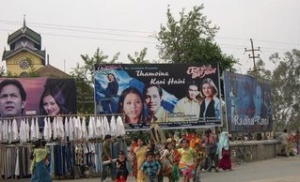
Ubiquitous cinema poster in Imphal city


Conversely, it is one of the most effective means of getting to know a society in an entertaining and sometimes provocative manner. For instance, if you have watched some of the Manipuri films, by any chance, then you have known more about the aspirations, conflicts and tensions of the small state more than you would have ever gleaned from reading ten books on the state.

Before giving a chronological introduction on the Manipuri cinema, here are some FAQs. They are intended to prepare you, the distant readers, (figuratively and literally) to a journey of discovery of the Manipur film industry.

How many Manipuri films are produced in a year?
Not 5 or 10. A conservative estimate is 70-80. Not bad for a young industry.

Have any Manipuri films won National and International awards?
Most of the films made on celluloid before the advent of the digital facilities were either award winners or award nominees though they were fewer in number compared to the current output of digital films.

Why are Manipuri films not much heard about nowadays or screened at film festivals?
Blame the entry rule of most of the popular film festivals which allows only movies made on film. No one in Manipur is interested in using celluloid medium because of its prohibitive cost. As these festivals are set to open to digital films in the future, one will get to see a surfeit of Manipuri films in the near future. And hopefully winning accolades as well.

Are there songs and dances in the Manipuri films?
Yes, they form an important ingredient of popular films in Manipuri films. But they are more realistic and devoid of melodrama overdose, unlike the Bollywood. Item numbers have not made an appearance in these films.

Are there playback singers?
Besides the homegrown singers, Bollywood artistes like Lata Mangeshkar, Kumar Shanu, Shaan, Kavita Krishnamurthi, Alka Yagnik, Anuradha Paudwal and many others have sung for the Manipuri film background scores.

What is the average cost of making a Manipuri digital film?
Anything between 2-20 lakhs. Some films have shooting done outside the state or in foreign locations in which case the budget can almost quadruple. Popular Mumbai based TV actors are paid to make guest appearances ala Bollywood item numbers.

Is Bollywood popular in Manipur?
It used to be but after the ban imposed by the militants on all Hindi movies and channels, Manipuris have started turning their gaze elsewhere. South Korean movies and soaps which are beamed through cable are lapped up like the Indian Saas bahu serials. DVDs of South Korean movies flood the market and they are qualitatively better than most of the Bollywood potboilers (sorry to say this). One can see some influence of the Korean films on the narrative and production values of the Manipuri cinema.

Are there adequate post production facilities in Manipur?
Earlier post production work used to be done at Kolkata, Mumbai, Bhubaneswar, Guwahati and Delhi . With digitalization, pop-and-mom studios have sprung up giving the sophisticated big studios a run for their money. With nothing more than a few desktops and a clutch of editing softwares, local talent has bloomed in these small facilities enabling the filmmakers to cut costs.

Why is Manipur film Industry called Imphalwood, not Manipurwood or Mollywood?
Imphal is the nerve centre --or Mumbai-- of filmmaking in Manipur. In fact, the films are made by the valley based Meiteis (non-tribe Hindu population) for the Meiteis in Manipuri language. Meiteis are the Kapoors, Khans, Bachhans, Ram Gopal Vermas and Ajai Bijlis all rolled into one.

Is there a market for Manipuri films outside the state?
There are already ambitious filmmakers in Manipur who are trying to carve out a niche for themselves as crossover filmmakers. South Korean films are a great inspiration as they echo the realism of the earlier celluloid Manipuri films. Subtitling film dialogues is being considered as one of the techniques to expand the audience base across the boundaries of Manipur.

Baring Assam, other northeastern states do not have as robust filmmaking tradition as the Manipuris do, a fact that is being seen with great commercial interest. Manipuri diaspora in Bangladesh and Assam, filmmakers contend, could become consumers of the Manipuri films in the years to come if helped by a little promotional blitz. After sports and theatre, movies are billed as the next big export from Manipur. Quite a possibility.

Which is the first state in India (perhaps in the world) to fully digitalize film production, post production, distribution and exhibition?
Manipur. It has never been highlighted in the mainstream media. While the Hollywood talks about the Grand Digital Future where all films can be viewed in any platforms--iPods, mobile phones, internet, multiplex, home theatres--as the YouTube generation has increasingly become 'platform agnostic', that scenario is already unfolding in Manipur.

Music video and movie clips are swapped religiously among the tech-savvy teenagers. Trailers are uploaded on the internet. There is no costly format conversion to be made, as everything is in bits and bytes and they are convenient for distribution and sharing.

Is piracy an issue?
Definitely. Digital format is the most fertile creature that can reproduce its own clones at a neck breaking speed. They spread faster among the cinema loving populace of Manipur more than the other formidable contender: HIV/AIDS. In response to this menace, producers have innovated local mechanisms to curb it. And they are effective.


It would be an understatement to say that Manipur has a rich tradition of film appreciation and filmmaking which dates back to the dawn of the last century. The first cinema screening in Manipur took place in the year 1920, only about two decades after the first world screening at Paris by the Lumiere brothers.

The films shown were mainly the foreign films as during this period, any organized effort to make films in Manipur was absent. It was only after the World War II that the Manipur's first film company, Shree Govindajee Film Company, was established. Its first attempted feature film was Mainu Pemcha in 1948.

However, the first full-fledged feature film Matamgee Manipur (Today's Manipur) was screened on 9th April, 1972 at Usha Cinema, Friends Talkies in Imphal and Azad Cinema. Post independence, the cinema movement got strengthened further with the establishment of Film Society in 1966, Imphal Cine Club in 1979 and Manipur Film Development Council in 1980.

The big moment for the Manipuri cinema came in 1982 when Aribam Shyam Sharma's Imagee Ningthem (My Child, My Precious) won the GRAND PRIX at the NANTE INTERNATIONAL FILM FESTIVAL, the first Indian film to achieve the distinction. Since then many Manipuri films have won National Film awards, and of late a trend is emerging of young filmmakers fresh out of the filmmaking schools who have gone on to make experimental, yet hugely popular, films and documentaries.

Last year, Pavan Kumar, an AAFT graduate won the applause of the audience and jury with his heart wrenching and brutally honest documentary that brought to the screen images of paramilitary forces' excesses perpetrated on civilians in Manipur under the shield of Armed Forces Special Powers Act (AFSPA). The documentary won the Critic's award at the Mumbai International Film Festival and was also critically acclaimed at the Toronto Film Festival, Karachi Film Festival and a slew of other international platforms.

Technology has a big role in giving a big boost to the Manipur film industry. The digital format is a boon for the filmmakers in the state which has a tiny market that is confined in the valley. The film production cost has drastically gone down and as a result Manipur churns out more films in a year than it used to produce in decades before the turn of the 21st century.

Though the audience is small, the returns on investment are almost assured, albeit over a long period of time, due to the digitalization of the post production, distribution and exhibition. Very few people know that Manipur is the first state in India to go the whole hog in digitalization of all the stages of filmmaking right to the exhibition.

In fact there is no hall in Manipur any more that screen celluloid movies. The old film projectors have become an antique piece destined to land up in museums, and owners have replaced them with digital projectors.

This writer proposes to study how this transformation from the analog to the digital format has affected the content and form of the Manipuri films. Has it encouraged the producers, directors, cinematographers and writers to take risks and experiment with new forms of storytelling and visual language?

Most importantly, is there a distinctive cinema called Manipuri Cinema in the sense of a unique theme, form and content?

If Hollywood can be identified with big budget, technical wizardry and studio-cum-star driven industry, Bollywood with song and dance extravaganza, Bhojpuri cinema with vulgarity and songs, songs and songs, Italian cinema with neo-realism and French cinema with New Wave cinema, what is Manipuri Cinema then?

That's a question that this study seeks to explore, with spotlights trained on other aspects of the Manipur cinema as well--its inspirations, prospects, economics, the cultural impact and its place in the pantheon of world cinema.

Which I will attempt to elaborate in my forthcoming postings with empirical data and extensive interviews with the film fraternity in Manipur.

Comments, questions, suggestions, brickbats and bouquets are welcome any time.

Cross-posted at Imphalwood Blog


* Ranjan Yumnam, contributes regularly to e-pao.net . Potential stars can write to him at http://manipuri-cinema.blogspot.com
This article was webcasted on April 04th, 2007


* Comments posted by users in this discussion thread and other parts of this site are opinions of the individuals posting them (whose user ID is displayed alongside) and not the views of e-pao.net. We strongly recommend that users exercise responsibility, sensitivity and caution over language while writing your opinions which will be seen and read by other users. Please read a complete Guideline on using comments on this website.


LATEST IN E-PAO.NET
  • Abdul Hafiz graveyard at Imphal War Cemetery
  • Violence in Manipur 2023-2026 : Timeline
  • Homecoming : Exhibition at Washington DC
  • Why NSCN-IM & ZUF must preserve Naga
  • The Funeral of Kindness :: Poem
  • Dignified menstruation for gender equality
  • World Environment Day 2026
  • Welcomes New DGP
  • Coming together of the indigenes
  • Martyrs' Day @ Cheiraoching #3 : Gallery
  • Showcasing product from IDPs at Switzerland
  • The abduction & 'murder' of 6 Naga civilians
  • Why keep returning to Regional Politics ?
  • One missed coffee & a full existential crisis
  • Trekking, Camping banned in Nongmaiching
  • Avocados Cultivation Programme at Pangin
  • Guwahati Open PWR 200 concluded
  • Focus on flip flop stand of the UNC
  • The King Who Came from the Sky: Pakhangpa
  • SoO : An assault on native people of Manipur
  • Manipur - Example of Underdevelopment
  • Cries in Agony :: Poem
  • 'CCpur & Kpi Road no longer safe'
  • Home Ground: Meghalaya Future of Tourism
  • Burnout healthcare staff & patient safety
  • Fate of hostages : Flip of the coin ?
  • Chakan Gang-Ngai 2026 : Ooba Video
  • Unfinished requiem- Linthoingambi & Hemanjit
  • "Ningol Van" Launched at Taobungkhok
  • Calm reflection vis a vis brute violence : Poem
  • Foundation Days of States/UT
  • World No Tobacco Day 2026
  • Breast Cancer Awareness in Guwahati
  • Licensed to create mayhem ?
  • How to Break Manipur w/o Breaking Any Laws
  • 17th Manipur State Film Awards (MSFA), 2025
  • World We Make, World That Makes Us : Poem
  • Counting Right, Voting Right: What SIR means
  • Calls on Indonesia to ratify tobacco treaty
  • Honourable exit for Ashutosh & Kailun
  • Police Museum at 1st Manipur Rifles
  • Eid-Ul-Zuha @Sangaiyumpham : Gallery
  • June Calendar for Year 2026 : Tools
  • 16th Manipur State Film Awards (MSFA), 2024
  • KIM's proposed rally must be called off
  • International Menstrual Hygiene Day
  • Plants : The force that engineered Earth
  • AC: How does it affect the skin ?
  • Onslaughts at Ukhrul district
  • Lhangpat Mei @Keishamthong #2: Gallery
  • Anthem of Switland :: Poem
  • CM visits Makhan Naga Village
  • Manipur University needs fresh air
  • False Narrative on Killing of Thadou Christian
  • Summer Coaching Camp 2026 @NSU
  • Tribute to Pu Mangvung Paokholun Haokip
  • Incursion from across the border
  • Radio E-pao: 5 new songs updated
  • Manipuri Community in Assam Calls for Vision
  • School dropouts & never-enrolled children
  • M. Tech at Assam University
  • Under One Sky or Leased ? :: Poem
  • When AI speaks in tribal languages
  • 'The Unbecoming' makes Northeast debut
  • After crossing the three year mark
  • Cheirao-chingkaba on Cheiraoba #2: Gallery
  • Anoi Group Art Exhibition 2026 : Download
  • Exploring Hyderabad's Museums #1
  • Maharaja Garib Niwaz : Manipuri civilisation #4
  • IEC Campaign at Willong Khullen
  • World Emergency Medicine Day 2026
  • Liver & GI super-speciality clinic
  • Adding more muscle to State Police
  • Rally at New Checkon- May 25 : Gallery
  • Hritwika Majumder at Miss Grand India 2026
  • How social media fuels division & ethnic tension
  • Saving Manipur's vanishing paddy & wetland
  • Helpline for Thadou people
  • 477 new Manipur Police Vehicles
  • NDPP-NPF merger accepted by ECI
  • Seeking to pitch Nagas against Meiteis
  • 63rd Mr. Manipur #3 : Gallery
  • Why CJP resonates with Manipur's youth
  • A moral, humanitarian reflection on violence
  • Financial assistance to IDPs
  • Legally binding treaty for older persons
  • Zoonotic Disease : Link animal & human
  • Jealous of Meloni
  • Making the bodies disappear !
  • Yaoshang - Cooking Competition : Gallery
  • Manipur State Award for Literature 2024
  • Manipur's unresolved Political Journey
  • 'Kuki is not an ethnic name'
  • Miyawaki Plantation Experiment at Langol
  • A Ploy to Keep the Chasm Wide Open : Poem
  • 45th Water India Expo 2026
  • Beating of the Retreat #1: Gallery
  • Martyred Rev Dr Vumthang Sitlhou
  • When Ima Weeps in Silence :: Poem
  • International Eld's Deer Day
  • Sticking to a consistent narrative
  • Arms recovered from Lamdeng: Gallery
  • Khatingla, Sumpa, Gaikhuluanlung : Eming
  • Exploring Kolkata: College Street #1
  • Wetland grabbing, hydropower, & ecologies
  • Condoles Demise of Khangembam Kuleswar
  • Upgradation of Imp-Jiri road: Poor planning
  • IEC Campaign at Phaibung, Senapati
  • In a mess for over 3 years now
  • The King Who Built a Golden Bridge : Kyampa
  • Mother's Day at Pukhao : Gallery
  • Manipur in India Constitutional Transition #3
  • Satyajit Ray's universal language
  • Decoding MLR & LR Act, 1960 & Article 371C
  • National Endangered Species Day 2026
  • India-New Zealand step into a new eco league
  • Posers over fate of abducted 6 Naga men
  • Sit-in protest @Kanglatongbi [May 18]: Gallery
  • Why communities must abandon hostility
  • Apatani's Next Top Model @Arunachal
  • The Fog of Uncertainty :: Poem
  • IEC Campaign at Song Song, Senapati
  • Supports TIM Proposal for Thadou-Naga
  • NE's Largest Psychiatric Hospital
  • Triangular clash underway in Manipur
  • Lamjen @ Thangjing Haraoba #1: Gallery
  • From Sympathy to Supremacy :: Poem
  • History repeats itself
  • Church Teams to visit Kangpokpi & Senapati
  • Workshop on Analytical Chromatography
  • Criminal Neglect, Terror Shielding
  • Summer make-up tricks to beat the heat
  • Pulling the strings to block the highways
  • Manipur Art Festival 2025 #3: Gallery
  • Manipur fermented food & scientific recognition
  • Seminar : Development of NE Region
  • World Hypertension Day 2026
  • Demands NIA Probe into Killing of Thadous
  • Suspected cases of Ranikhet Disease
  • PM's prescriptions & we
  • Flexing muscle on the roads of Imphal
  • Cheiraoba Chak Katpa #2: Gallery
  • Maharaja Garib Niwaz : Manipuri civilisation #3
  • The Dreamer's Dilemma :: Poem
  • Calls for Community Understanding
  • CM visits National Sports University
  • Condemns malicious press release
  • Reconnecting with our cultural roots
  • Condoles Death of Thadou Church Leaders
  • Yumjao Lairembi Haraoba #1 : Gallery
  • Manipur in India Constitutional Transition #2
  • Chronicle of princes & people's long defeat
  • SIR of Electoral Roll-Phase III
  • Program on New Income Tax Act, 2025
  • Book on Information, Reality, Life
  • 'Unfortunate incident at Zero Point'
  • Where is the Government poser
  • Sit-in protest @Kanglatongbi [May 14]: Gallery
  • 3 years on : Manipur's long road to peace
  • Int'l Triathlon Yengkhom Suraj felicitated
  • Ethniciity of Thadou Martyr Church Leaders
  • Colonial Knowledge Production in NE #22
  • Condemns Killing of Thadou Church Leaders
  • Condemns Attack on Thadou Church Leaders
  • Peace will Outlive Violence
  • Indo-Naga Talks (From 2012) :: Timeline
  • Bloody Night
  • Good girls first take care of themselves
  • Candlelight Vigil @ Bangalore #2 : Gallery
  • Maharaja Garib Niwaz : Manipuri civilisation #2
  • The Green Foundation recognised as a SIRO
  • Waithou Rally condemn civilian killing: Gallery
  • Manipur in India Constitutional Transition #1
  • Chahi Taret Khuntakpa
  • HSLC Exam 2026 : Full Result
  • HSLC Exam 2026 : Pass % : Govt Schools
  • HSLC Exam 2026 : Pass % : Aided Schools
  • HSLC Exam 2026 : Pass % : Private Schools
  • HSLC Exam 2026 : Withheld-students
  • HSLC Exam 2026 : Compartmental candidates
  • HSLC Exam 2026 : Statistical Abstract
  • HSLC Exam 2026 : Important Information
  • Cheirao-chingkaba on Cheiraoba #1: Gallery
  • Chandel District Head Quarters : Gallery
  • Indigenous Leaders Call for Global Recognition
  • International Women's Day : Gallery
  • Subika Art Exhibition @Washington : Gallery
  • Candlelight Vigil @ Bangalore #1 : Gallery
  • Vegetables @ Waithou Keithel #2 : Gallery
  • Conflict, Displacement in Manipur (2023-2026)
  • Tronglaobi: 2 children laid to rest : Gallery
  • Leingakta Wahang Khongchat #2 : Gallery
  • Martyrs' Day @ Cheiraoching #2 : Gallery
  • Featured Front Page Photo 2026 #2: Gallery
  • Free Online access to 'Asangba Nongjabi
  • Lhangpat Mei @Keishamthong #1 : Gallery
  • Candlelight vigil: Killing at TM Kasom : Gallery
  • Fractured sovereignty : Proxy war
  • Mama, I love you- Then the world went silent
  • Khongjom Day @ Khebaching : Gallery
  • Tronglaobi: Meira Rally #2 [16 Apr]: Gallery
  • Final Merit List : Manipur Civil Services 2022
  • HSE : Pushpa K, H Keniya, P Taibangnganba
  • Yohen Longjam : HSE 2026 : Science Topper
  • Sarangthem Ayingbi : HSE 2026 : Arts Topper
  • Thoihenba Thongam : HSE 2026: Commerce
  • HSE 2026: Science Full Result
  • HSE 2026: Arts Full Result
  • HSE 2026: Commerce Full Result
  • HSE 2026: Pass % - Govt / Non Govt
  • HSE 2026: Pass % - District Institutes
  • HSE 2026: Subject-wise Pass %
  • HSE 2026: Candidates securing Highest Mark
  • HSE 2026: Science Topper List
  • HSE 2026: Arts Topper List
  • HSE 2026: Commerce Topper List
  • Tronglaobi: Clashes @Lamlong 17 Apr: Gallery
  • The great Manipur betrayal
  • Tronglaobi: Meira Rally #1 [16 Apr]: Gallery
  • MoU between Nouwa Marup Pune & IBI
  • Tronglaobi: Meira Rally [15 Apr]: Gallery
  • Most Heinous Murder: Derailing Normalisation
  • Martyrs' Day @ Cheiraoching #1 : Gallery
  • Tronglaobi : Rally @ Uripok [12 Apr]: Gallery
  • Killing of 2 children @ Tronglaobi : Gallery
  • Yaoshang Thabal Chongba #2: Gallery
  • Of 'Boong', BAFTA, Bharat & Manipur
  • Boong & the Long Road of Regional Cinema
  • Boong: India's 1st BAFTA in children's cinema
  • PUCL Tribunal report: A shadow of partiality #3
  • PUCL Tribunal report: A shadow of partiality #2
  • PUCL Tribunal report: A shadow of partiality #1