


Origin of the Meiteis
- Part 3 -
* Dr J Rimai
The Coming of Hinduism and its Impact on the Meiteis
The Coming of Hinduism
As discussed earlier, the Meiteis were not Hindus until the early part of the 18th century when they were forcibly converted to Hinduism. Hindu Brahmins started coming to Manipur during the reign of King Kyamba, which was in the latter part of the 15th century and the early part of the 16th century.
Jhalajit states that King Kyamba received a gift from Choupha Khekkhomba of Pong (Shan Kingdom in Burma), a little image of Vishnu. During his sickness he offered sacrifice to this image and was cured. He then constructed a temple at Bishnupur and Vishnu worship was started (Jhalajit 1992, 94). Kumar also believes that Vishnu worship in Manipur started sometime in 1470 (Kumar 2001, 35).
However, Vishnu worship was confined to the royal family and no Meitei was formally initiated into the Vaishnava form of Hinduism (Kumar 2001, 36). According to Kumar, "It was King Charairongba, who was formally initiated into Vaishnavism in April, 1704 (5th of Sajibu, Wednesday) by a Brahmin named Krishna-charya, alias Rai Vanamali, from Shweta Ganga, Puri" (Kumar 2001, 36).
Though there are traces of Hinduism in Manipur as early as the 15th century, Hinduism became the dominant religion of the State during the reign of King Pamheiba whose Hindunised name was Garibniwaz in the early part of the 18th century (1709-1748). According to Ratan Kumar, the conversion of the Meiteis was not through their own belief and choice, but was forced upon them by king Pamheiba, son of Charairongba (Kumar 2001, 37).
According to Nipamacha, 15 Hinduism came to Manipur from the blood of a Hindu Brahmin named Vishnu Goshai who came from Bengal. Goshai came to Manipur as a Hindu priest and met King Charairongba. The king had no child so Vishnu told the king that he would get a son if he let his wife worship with the priest for three months covered by seven rounds of clothes without letting anyone know the worship. The king agreed, and the priest stayed with the queen for three months. The queen then conceived with the son, possibly from the Hindu priest.
The Meitei priest prophesied and told the king that if the child was a daughter, nothing would happen, but if it was a son, there would be much trouble in the land. The king ordered the child be killed if it was a boy. But Nungthilchaibi, the queen and the mother of the boy child, did not want to kill him and told the king that the child was stillborn. She entrusted a tribal parent to take care of the child and offered a big reward. He was later called Pamheiba.
After the child grew up to boyhood, the story was narrated, and the king was old and he accepted him as his own son since he did not have a son. He was later called Garibniwaz, a Hindunised name, when he became the king of Manipur. By then Vishnu Goshai had returned to Bengal where he was originally from. He told his son, Sandidas Goshai, about his stepbrother in Manipur who by then had become the king of Manipur. Sandidas Goshai went to Manipur and with the help of his stepbrother, Garibniwaz, the King, Hinduism took its root in Manipur.
This theory is supported by the fact that the descendents of Pamheiba have the title "Shai" in their names. There is the possibility of taking this word from the suspected blood-father, Vishnu Goshai.
The eighteen names of the descendents of Pamheiba listed by Singh in Appendix IV are: Shyam shai, Murari shai, Jitshai, Nandashai, Dangko shai, Sheibya Shadhi shai, Bharat shai, Shatrughna shai, Hiracharan shai, Gadadhar shai, Dullove shai, Dhara shai, Hari shai, Ngawbram shai, Anatashai, Tulsi shai, Meghashai, and Kishoreshai (Singh 1987, 212).
Unlike his predecessors, Pamheiba became a religious fanatic and launched an onslaught against the traditional Meitei religion (Kumar 2001, 37). He punished those who violated Hindu laws, such as consumption of any type of meat, and rearing of pigs and chicken. Those who did not want to accept the new religion were faced with severe punishment. The Lois and Yaithibis are an example of the punishment meted by the king. Cremation was made the compulsory method for disposal of the dead. He also destroyed many Umanglai temples, and ordered to destroy and burn the Puyas, holy scripture of the Meiteis. A new name "Manipur" was given to the land. The Meiteis to this day observe the day of burning of the Puyas as "Puya Meithaba", to commemorate the unfortunate act of King Pamheiba (H. Bhuban Singh, in The Sangai Express).
The Meiteis know that Hinduism is not a religion born in their land, yet they continue to follow this religion because of the striking similarities between the two (Rimai 1993, 11). According to Singh, both Hinduism and traditional Meitei religion claim to have grown out of divine tradition. He says that the Meitei theory of creation as presented in the Puyas bears, resembles the doctrine of creation depicted in the Nasadiya Hymn of Hinduism. In both traditions, man is understood as the cream of creation.
The plurality of deities is found in both religions (Singh 1975, 89-90). According to Singh, another reason why the Meiteis follow Hinduism is that they are allowed to continue the worship of their local deities, where each individual, as well as their family, is responsible for the worship ceremony (Singh 1991, 26-27).
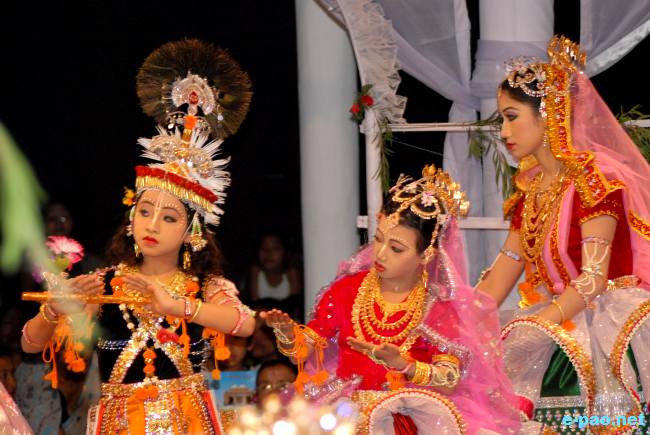
"Nitya Ras" performed by Manipuri Jagoi Marup of Imphal on 9th April 2010
Picture Courtesy - E-pao Photo
Browse Photo Gallery on Ras Leela - Manipuri Classical Dance here
The Impact of Hinduism on the Meiteis
Hinduism has had a great impact upon the life of the Meiteis. It is not too much to say that Hinduism has become the culture of the Meiteis, or at least made them feel that way. Their worldview, way of life, dress, and food has been greatly influenced by Hinduism. As discussed before, they were like the heathen tribal people before they became Hindus, eating meat, drinking rice beer, did not look down on tribals, and so on.
But when the Meiteis became Hindus they adopted the concept of "touch me not" attitude. They treated the hill people as untouchables and called them "Hao", which is a derogatory meaning for "uncivilized". This led to the creation of a gigantic barrier between the Meiteis and the hill people.
Within the Meitei community, there are Lois and Yaithibis who were driven out of the Meitei community as untouchables for not accepting Hinduism. They live in the outskirts of the mainline Manipuri people.
Hinduism has had a great impact in the life of the Meiteis, both socially and religiously. They are briefly discussed below in separate sections.
Social Life
Singh (2004), in "The Kingdom of Manipur" in The Sangai Express, says that "with the adoption of Hinduism in the kingdom of Kangleipak, the Meiteis took the word "Singh" very importantly and seriously instead of using their own Salais, Sakeis and Yumnaks." The Meiteis started using the word 'Singh' after their personal names as an imitation of the Mayang's (mainline Indian) custom. The Meiteis not only gave up their original religion, but also their own original name system. The last names such as Singh, Kumar, Kumari, Sharma, Devi, and so on, are not the names of the Meiteis but adopted from the Mayangs.
Singh (2004) also says that with the adoption of Hinduism, the king accepted the word 'Raja' as the title of kings "instead of using their unique paragon title called 'Meitingngu' or 'Meidingngu' and their descendents are still borrowing so-called Rajkumar as a respectable title" (Singh 2004).
According to Kumar, the Meiteis were allotted gotras for the seven salais, namely, Sandilya for Ningthouja, Kaushik for Angoms, Bharatwaj for Chenglei (Sarang-leishangthem), Kashyap for Luwang, Madhukalya for Khuman, Atreya for Moirang and Gautam for Phantek. (Kumar 2001, 38)
With the coming of Hinduism in the State, a caste system was introduced in the Meitei society. During the reign of Pamheiba, Hinduism was forced upon the people as the state religion. Anyone who did not accept the new religion was considered unclean and out caste. They were sometimes hanged or chased away from the land. The Lois and the Yaithibis are two of the people groups who did not accept Hinduism. Today they are considered lower or out caste people in the Meitei society.
On the other hand, those who embrace Hinduism are told that they are holier than the rest of the people, including the tribals. They have stopped eating any type of meat, stopped drinking rice beer, stopped rearing pigs, and even stopped burial of dead bodies, and started cremating their dead. According to Singh, he (Garibniwaz) was the first Manipuri king to introduce the practice of burning the dead bodies according to the chronicle. And the bone gathering ceremony was also introduced after some days. On 20th February-March, Sunday, 1724, Garibniwaz had the ceremony of burning the bones of his forefathers with great éclat on the bank of the Ningthi River. (Singh 1980, 125. within bracket added).
Singh writes, they (Hindu gurus) also married Meetei's girls. Pamheiba and his Guru Santidash substituted Meeties script by Bengali script and changed the original or personal name of Meetei into a Hindu's name (eg the Meetei name of 'Pamheiba' was changed into a Hindu name 'Garibniwaz' and 'Kangleipak' into 'Manipur' etc). Morever, his (Pamheiba) scholars were advised forcefully to write many 'Sanggai Phamang Puyas' (ie Mix and wrong Puyas).
Those new Puyas were intercourse by Hindu's literatures, ideas, philosophy, history, culture and religion. ...And his Mayang Gurus forcibly offered to drink their Khongbi Machum (the water after sinking their big toe) to Meeteis in the name of purification and conversion into Hinduism.
Till now, the descendants of some Meeteis who are following Hindu customs are consuming Choronamitra of the Guru who is baptising at the event of 'Laiming Louba' (baptism). (Singh 2004, The Sangai Express, the spelling mistakes are from original script)
With the introduction of Hinduism as superior religion to the original Meitei religion, the Meitei Mayek (Script) was also burnt and replaced by Bengali script (Singh 1980, 130). Singh continues to say that the king was against the use of the Meitei script, songs and prayers. It is believed that many of the history of the people were re-written by the Bengali Brahmins. This is the reason why the accuracy of the history of the Meiteis, especially their Aryan origin, is questioned by modern scholars.
Religious Life
When it comes to the religious life of the people, there has been a significant change. With the exception of small Umanglai temples in the woods, there were no permanent temples erected for the deities. The religious practices of the Meiteis were more of animism, which is the worship of natural objects. Today, there are many temples in the city including some huge Umanglai temples. The Meitei original religion worship emphasised more on household worship, but they have adopted the corporate worship.
The women folk go to the Govindajee Temple everyday for worship. All Hindu religious festivals and rituals are followed by the Meiteis along with the traditional rituals and festivals. According to Kumar, under the policy of King Pamheiba, "the social, cultural and religious life of the Meitei was drastically transformed" (Kumar 2001, 37). He continues to say that several abodes of traditional deities were destroyed, including nine Umanglai whose images were buried, seven deities were destroyed (Singh 1980, 129-130). The Meitei festivals were changed or renamed after Hindu festivals.
Kumar writes, "New names of the Meitei festivals were given Hindu names. For example, Heikru Hitongba festival was renamed as Jal Jatra; Ayang Yoiren Iruppa was changed into an annual 'Snan' at Lilong Sahoupat. The Waira Tenkap festival was replaced by a Kirtan of Lord Rama. The festival of Poirei Apanba was changed to Loipan festival. ...The Wakambung Chingnu Nongombi was substituted by Dasana Kwatanba of Burga Puja or Dusserah." (Kumar 2001, 38).
Conclusion
Scholars such as Iboongohal Singh argue that Manipur was part of India from ancient times. But it is found that Manipur was never part of India in ancient times. She was an independent nation ruled by kings at different times. Some even argue that she is the Manipur found in Mahabharata, where Babhruvahana, the son of Arjuna, ruled. However, from the literature available, the name Manipur was not the name of the present Manipur State in ancient times. This name was given when the State was Hindunised during the reign of Pamheiba.
When it comes to the origin of the Meiteis, scholars differ in their views. Some advocate that they are Aryan in origin, whereas others see them as Mongoloids, and many scholars agree that the Meitei people have no racial purity. Konghar has stated that it is "more accurate to say that the Meitei people have no racial purity, but they are a mixture of both Indo-Aryan and Mongoloid blood" (Konghar 1996, 36).
However, from the arguments brought by different scholars, based on their appearance, physical stature, and linguistic structure, it is beyond doubt that the native Meiteis were Mongoloids, and not Aryans. In the words of Singh,
Meiteis are generally classified as a pro-Mongoloid group of people. While Meiteis without a doubt are mongoloid in origin, in the modern global view, Meiteis are seen as Aryan descendants because of wearing the Aryan mask ('Singh' and 'Devi') (Singh 2004).
Regarding the socio-cultural practices, though Meiteis have their own rich culture, they are amalgamated with the Hindu culture. The caste system has been introduced in the society, and the tribals are considered unclean by the Meiteis. The daily bath ritual gives them a "holier than thou" attitude to the Meiteis.
References:
- "Kang" is a traditional indoor game played by both male and female. It is believed to have been played by deity Panthoibi.
- Horam is a professor of history at Manipur University.
- Jonathan H. Thumra was the principal of Eastern Theological College, Jorhat, Assam, under Serampore University.
- This word should be spelled as 'Sanskritization'.
- The spelling of this word differs from one to another. Konghar has spelled this as "Ningthouchas," but it seems more appropriate and agreeable to spell it as "Ningthouja."
- Nagas are the second largest people group in the State who live in the hills, surrounding the plain on all sides.
- Lai Haraoba literally means the merry-making of the deities. It is a religious festival of the Meiteis. This will be dealt with later at length.
- The Tangkhuls are a people group within the Naga community who live in the Northeastern hills of Manipur.
- Jhum cultivation is also called shifting cultivation practiced only by the hill people group of Manipur State. The Meiteis, being in the valley, did not practice jhum cultivation.
- The word Loi means degraded. They were so called because of their refusal to become Hindus during the reign of Pamheiba. Today they are considered as lower outcast by the Hindu Meiteis. They are the people from Awang Sekmai, Andro, Leimaram Khunou, Koutruk, Kwatha, Khurkhul, and Phayeng.
- This god is also called "Atiya Maru Shidaba" which means Immortal Seed in the sky. Some called him 'Atingkok Shidaba'. In this writing, the name Atiya Maru Shidaba has been used more frequently. This is because this is the most common name used by the people.
- The Meiteis called human beings as Mee or Mee-oiba.
- This very word 'Lainingthou' was attributed to him when the Meiteis consider him as deity. Laining-thou literally means King of the gods.
- This is an oral tradition preserved by the people. It was narrated to the writer by Doren, an interviewee.
- Nipamacha is a respondent of the interview.
- The writer personally experienced this while he was young. His family has a very close Hindu family. Whenever the writer visited the house of the Hindu, he was not permitted inside the house. As a child he remembers sitting in the courtyard of the Hindu family.
Concluded ...
* Dr J Rimai wrote this article for The Sangai Express
This article was webcasted on April 28, 2011.
* Comments posted by users in this discussion thread and other parts of this site are opinions of the individuals posting them (whose user ID is displayed alongside) and not the views of e-pao.net. We strongly recommend that users exercise responsibility, sensitivity and caution over language while writing your opinions which will be seen and read by other users. Please read a complete Guideline on using comments on this website.


