


Traditional Meetei Naming Convention
Meeteis' Surname
Thokchom Angouyaima (Doren) *
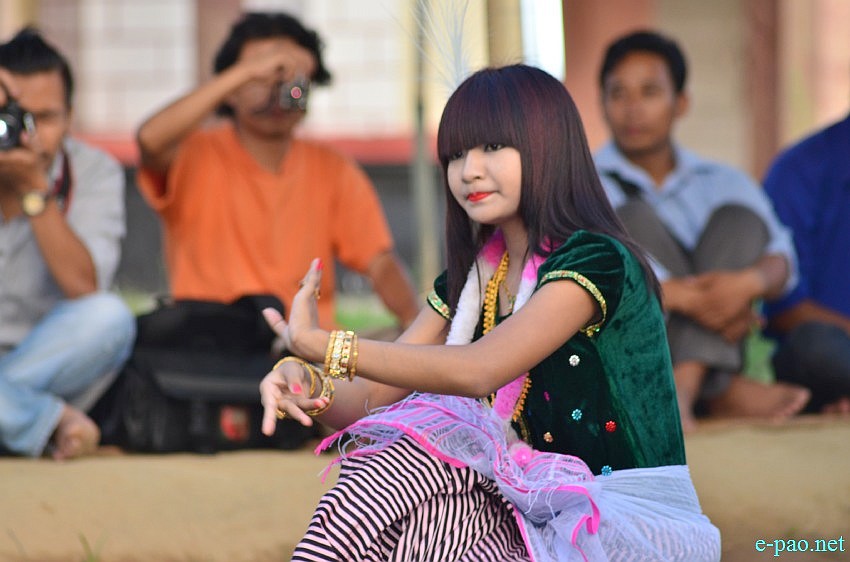
A traditional Meitei Jagoi at Festival of Lai Haraoba Dances and Kanglei Haraoba of Manipur at Ibudhou Marongkhong Chingdrensana Pakhangba Laibung, Palace Compound on 11 June 2014 :: Pix - Shanker Khangembam
The beautiful kingdom of Kangleipak, now known as Manipur, was rich in original culture, religion, customs, traditions and literature - everything needed to make a nation. This state has been called by a variety of names at various periods in its history: Kangleipak, Tilli-Koktong, Poilei Lamtam, Munnipore etc. In Rennell's Memoir and maps of India it bears the name of Meckley. In Michael Symes's Narrative, and in maps of that period, it is Cassay, names that have long disappeared and are no longer seen on any modern maps.
This state is the ancestral territory of tribes of Mongoloid stock. All the indigenous ethnic groups have very close similarities in their customs, cultures, traditional habits and life styles. The Meetei ethnic group form the majority of the population within Manipur, thus they frequently are called "Manipuri" by outsiders. The Meetei community is made up of seven clans:
o Mangang,
o Luwang,
o Khuman,
o Angom,
o Moilang,
o Khapa Nganpa and
o Salai Leisangthem (Chenglei).
The vernacular name for these ethnic groups is Salai. According to the ancient traditions of the Meeteis, it is permitted for someone from one of the Salais to marry a person from any of the other six Salais, but it is strictly forbidden to marry a person within the same Salai. To marry within the same Salai is known as yek-thokpa.
In past times, the Meeteis had their own unique style of naming convention. The ancient custom of naming people used the name of their particular Salai (clan) along with their personal names such as Khapa Sokchlongpa. The Salai name was placed before the given name. For further information anyone interested may refer to the Puya (Sacred writings) such as "Panthoipi Khongkul".
Each of these Salais (clans) consists of a number of sub-clans called Sakeis, also known as Imnaks. The Sakeis are derived from some unique trait of the individual who first bore them. The meaning of 'Sa' is animal or body, but in this case 'Sa' means his own body and the meaning of 'Kei' is warehouse, godown, store etc. (refer to Meetei's common words: - puk-kei, fou-kei, lan-kei, seeng-kei etc.). In this case, the Sakei is a group of families who are descended from a common ancestor. In the time period that followed, they started using the name of their particular Sakei, along with their personal names such as Asangpam Laipa who was the eminent scholar (Maichou) during the reign of King Naophangpa (428-518 AD).
The Sakei name was placed in front of the personal name. Before the Christian era (BC), the stories of Ningthou Kangpa, his father and his descendents were written down in a Meetei script called "Ningthou Kangpalon" by one Maichou (Meetei scholar) named Thongak Kulumpa during the reign of King Khuiyoi Tompok (154-264 AD), which was transliterated into Bengali script by Nongthombamcha Angou Luwang and published by Thokchomcha Ibotombi in 1976. In this sacred Puya, the Maichou mentioned the beginning of some Sakeis, therefore, it's clear that the introduction of Sakeis took place before the Christian era.
King Loiyumpa (1074-1122 AD) reorganized the seven Salais into Imnaks (family names or surnames or prefix to names) according to their specific nature of work or occupation. It is known as "LOIYUMPA-SINYEN" (a Meetei's customary Law book by Loiyumpa). It was also known as "Division of Labour system" in Meetei Society. Later on, some Meeteis started using their specific occupation as a family name or surname along with their personal names such as Thangcham (black-smith) Angou, Potsangpam (store-keeper) Tompok etc. The family name is regularly put in front of the given name. At a later date they omitted Salais name and tried to use only the occupational names before the personal names. Thus, it became confusing to identify which Salai they belonged to. Also, the same occupation or family name (e.g. Thangcham - a common type of occupation) was given to different Salais.
Thangcham may be a Luwang or a Khuman or a Moilang or a Salai Leisangthem. Aheipam may belong to Khuman clan or Moilang clan or Khapa Nganpa clan. The people who belong to a family name or surname which was given by King Loiyumpa according to their occupation might not originate from a common ancestor, they might belong to different Salais, and simply their occupations were similar. So, similar family names will be found, which belong to different Salais, Family names which are derived from some unique characteristic of the original founder of the family are still being used in spite of the strong reformation of King Loiyumpa. Sometimes, the two words Imnak and Sakei are used collectively as 'Imnak-Sakei'. Furthermore, all the surnames are indicating either some peculiarity of its original holder or the ancestor's occupation.
Later, the introduction of Imnak became even more obscure with regard to the original Salais. There was an influx of 'eastern' and 'western' outsiders (Nongpok-haram and Nongchup-haram) into these sub-clans of seven Salais especially in Mangang Salai. Many of these outsiders wanted to join the Mangang Salai because they held a high position and had societal superiority at that time. The alternation of Sakeis or Imnaks was also widely practiced. Here, some family names or surnames, which do not belong to any Salais, are known as 'westerner' or 'easterner' in Meetei Society (refer to the Bamon-Khunthoklon, origin of Kshetrimayum, Lairikyengbam-Roy etc.). Those groups who assimilated into Meetei Society possessed their own Imnak-Sakei. Even though Meetei-Pangals do not use their Imnak in their names, they know which Imnak they belong to.
With the adoption of Hinduism, Meeteis took the word Singh as their title very importantly and seriously. In order to imitate Hindu custom, they started to borrow Mayang (in this case Hindu Indian) names by using the word Singh in place of using Salais/Sakeis/lmnaks names, so now they had names such as Jay Singh, Marjeet Singh, Gumbheer Singh, Nara Singh etc. The Meeteis with mongoloid ancestry instead professed themselves Aryan descents and to be of Hindu heritage by using the titles such as Singh and Devi. Here, it is appropriate to mention a key Meetei belief, and that is that "ideal persons are those who know themselves and their forefathers".
Unfortunately, by trying to exchange their ancestral religion for Hinduism, Meeteis abandoned their own original naming system - the use of their own Salais/Sakeis/lmnaks. At the same time, the King accepted the word Raja as his title of King in place of using the unique Meetei title of Meetingu. The descendents of the royal family are still using Raj Kumar to denote their special place in society. Some of the Kings used the word Maharaja (great king) to title themselves without any reason. The letters "RK" and "MK" are being used as an abbreviation for the Hindi words Raj Kumar/Kumari and Maharaj Kumar/Kumari respectively by their descendents as their surname or prefix to their names.
Every Meetei still kept track of their Imnak-Sakei, in spite of the many changes brought to Meetei society by the effort to convert everyone to Hinduism. Meeteis continued to practice their ancestral religion "Sanamahi Laining" (Sanamahism) in spite of the strong influence of Hinduism. To understand Salai/Sakei is very precious to Meetei Society; it indicates own identity, their ancestors and the genetic heritage. Meetei people have a tradition of respect for elders. To preserve their own Salai/Sakei is the unique way of remembering and showing respect to their ancestors. They can refer to their ritual ceremony Salai-Apokpa Khurumbu (Worshipping of the Clan's Progenitor) and Sakei-Apokpa Khurumba (Worshipping of the Sub-Clan's Progenitor). Meetei believe in the worship of their ancestors. The person who knows about his own clan (Salai/Sakei) is the person who knows his origin. Later on, the words Sakei and Imnak evolved into the words Sagei and Yumnak respectively.
Many Meeteis now use the words Singh and Devi to designate gender (masculine and feminine respectively), in name of Meetei-Bamons - Sharma for masculine gender and Devi for feminine gender, while Meetei-Roy's names are followed by the word Roy for both genders. Meeteis who reside outside Manipur State (in Assam, Bangladesh, and Tripura etc.) still use the word Singha for both genders without any name of Salais, Sakeis and Imnaks because of the fact that they fled frorn Manipur when the Devastations happened, just after converting to Hinduism. The use of the Salais and Imnak-Sakeis went out of favour and instead at that time the adding of the title Singh was in fashion. At the same time, Meetei-Bamons residing outside Manipur use the word Sharma for both genders without any surname. Recently some of them who have close relations with Meeteis in Manipur have started to include their family name or surname in front of their personal names, followed by the word Singha or Singh for both genders.
The two Devastations (Khuntakpa) happened during the reign of king Gourshyam (1753-1759 AD) in 1755 and 1758 AD. The Manipuri call this 'The first devastation'. And the three Devastations were during the reign of King Jay Singh aka Bhagyachandra Singh (1764-1798 AD) in 1764, 1769 and 1772 A.D. After these 5 Devastations, the "Seven Years Devastation" (Chahi Taret Khuntakpa) happened ending the reign of king Marjeet (1813-1819 AD). The country Kangleipak was fully deserted by its people for 7 years completely from 1819 AD to 1825 AD. Most of the Meeteis outside Manipur now, especially in Bangladesh, Assam and Tripura are descendants of the Meeteis who left Kangleipak during the 7 years devastation from fear of the Ava army.
Now many Meeteis believe that the use of the words Singh and Devi should be compulsory as their names. Apparently they forgot that Pamheipa aka Garibaniwaz/Gharib-nawaz (1709-1748 AD) had forced the Hindu religion upon the Meeteis according to the advice of his Mayang Gurus. Pamheipa's Hindu Gurus were Gopal Das and Shantidash Goshai. Shantidash/Santadas tried to abolish Sanamahism during the reign of Garibaniwaz and much destruction occurred. It was a 'reign of terror' in the history of this beautiful tiny kingdom. At the insistence of Garibniwaz's notorious guru Shantidas, all the available Meetei books were destroyed on Sunday, 17th of Mera (September/October) in the year 1732 AD (as per record of Cheithalon Kumpapa). Ancient literature and sacred Puyas written by Maichous (Scholars)/Pipas etc. in the Meetei script were collected by order of King Garibinwaz and burnt to ashes in front of Utla in the Kangla. It is commonly known as "Puya Meithaba".
The Meeteis lost much of their historical identity because of the terrible event. All literature written in the ancient Meetei alphabet was banned, and the original Meetei script was changed to Bengali script. In lieu of the traditional deities and place names, he put Hindu gods and names such as Mongpahanpa Laisang to Mahabali Mandir (temple of Hanuman Thakur), Emoinu Ahongpi to Laxmi etc. He changed the names of places such as Kangleipak to Manipur. Even his own name of Pamheipa also was changed to Garibniwaz. In order to enjoy their lives and so as to speed the process of change, the Hindu gurus married Meetei girls. Moreover, his (Pamheipa) Scholars were forced to write many "Sanggai-Phamang Puyas" (i.e. Mixed and false Puyas).
Those new Puyas were transcribed by mixing in Hindu literature, ideas, philosophy, history, culture and religion to the ancient Meetei cultural heritage. Garibniwaz tortured and gave severe punishment (even hanging by the neck until death) to many eminent Meetei people of that era (e.g. Moilang Lalhanpa) who refused to convert to Hinduism. Tradition says that his Mayang Gurus forced Meeteis to drink "CHORON AMITRA" their Khongpi Machum (the water after sinking the big toe or pouring the water on the big toe) in the name of purification and conversion into Hinduism. Garibniwaz tortured the Pipas of seven Salais who refused to drink his Mayang Gurus' Khongpi MachumlKhongchum to purify in order to convert to Hinduism.
Meeteis are not forced to put the words 'Singh' and 'Devi' in their names by any law, but it is difficult for many to give up these culturally-meaningless suffixes easily because the concept was ingrained very deeply and thoroughly. Even today, Meeteis seem to be hypnotized by Hinduism. The Meeteis who are still disoriented by Hinduism are proud of these culturally-meaningless suffixes such as Singh and Devi. Some people now use the word Meetei/Meitei along with their names. In recent times, some Meetei people have emulated Western culture by simply reversing the traditional "surname - personal name" order to "personal name – surname" (e.g. Tombi Wangkhem), since in most Western countries, the family name is given last.
Additionally, they often transliterate their family names into Roman script and use the initial letter in place of the family name as an abbreviation. It makes more confusion to specify which clan or sub clan they belong to. All are against the ancestral customs and traditions of the Meetei people.
The order "Surname - personal name - gender identifier" is not Meetei Naming convention e.g. Yumnam Tomba Singh. This sequence came with the adoption of Hinduism, when the Meeteis were changed to become Manipuri. For example, if this format is imitated by substituting the word 'Cha' in place of the word 'Singh', it has to be written as Yumnam Tomba Cha (if Singh or Cha be taken as a gender identifier). It doesn't make good or complete sense when trying to keep or restore Meetei customs.
If the gender identification (i.e. cha/chanu) is inevitable, it should be a suffix of the surname or should be placed just after the surname to specify belonging to and followed by the personal name such as Luwangchanu Piyainu or Luwang chanu Piyainu (refer to the story of Khuman Kwakpa's wife). Luwangchanu means Luwanggi chanu (chanu of Luwang); the word 'gi' (of) is omitted.
According to Meetei puwari (history), in their culture, the family name traditionally is placed before the given names, in which the family name becomes a possessive: Asangpam Laipa, for example, would be Laipa of the Asangpam family. Thus, the family name of Asangpam Laipa is Asangpam, and his given name is Laipa. Apparently, a family name or surname is the part of a person's name that indicates to what family he or she belongs. Chinese names are written with the family names (surnames) first and the given names next. For instance, the family name of Mao Zedong is Mao, and his given name is Zedong.
Prior to the adoption of Hinduism, according to Meetei puwari (history), the unique Meetei style of naming people was the following formats.
(1) Surname - personal name
e.g. Tekcham Tompi
(2) Surname - gender identifier (or suffix to the surname) - personal name
*If the gender identification (i.e. cha/chanu) is inevitable.
e.g. Tekcham chanu Tompi
or,
Tekchamchanu Tompi
In today's world, many Meeteis who are aware of their puwari (history), original customs, and traditions, no longer use the culturally-meaningless words such as Singh and Devi in their names.
Now many Meeteis are working hard to preserve their ancestral traditions and return to their own original cultural identity instead of the foreign concepts that were forced upon them. Meeteis are once again claiming for themselves their historical traditions and written language and are regenerating a sense of pride in their unique heritage, while abandoning the foreign concepts that were forced upon their ancestors by outsiders.
This is an edited version from the original article "Meeteis' Surname" by the same writer
* Thokchom Angouyaima (Doren) wrote this article for e-pao.net
The writer is with Saatchi & Saatchi Adverting at Dubai, UAE and can be contacted at thokchomdoren(at)yahoo(dot)com
This article was posted on June 24, 2014.
* Comments posted by users in this discussion thread and other parts of this site are opinions of the individuals posting them (whose user ID is displayed alongside) and not the views of e-pao.net. We strongly recommend that users exercise responsibility, sensitivity and caution over language while writing your opinions which will be seen and read by other users. Please read a complete Guideline on using comments on this website.


