TODAY -


E-Pao! Essay - Gandhism: Its relevance

Gandhism: Its relevance

By: Dr M Horam *


Many scholars, politicians and even the religious men all over the world have written and discussed on Gandhi’s teachings and his philosophy. To write and discuss on Gandhi is a difficult task.

People write on the life of Gandhi, they discuss and criticize him and his ideas and theories. Pandit Nehru, late Prime Minister of India once said; and I quote: “No one can write a real life of Gandhi, unless he is as big as Gandhi.”

Mohandas Karamchan Gandhi was born on October 2nd, 1869 in the city of Porbandar. Mohandas’s father, Karamchan Gandhi had been three times a widower before he married his last wife - Putlibai aged fifteen when he was forty. Putlibai bore him a daughter and three sons, Mohandas being the youngest. She was an extremely religious person. Mohandas imbibed his intense attitude from his mother.

At the age of twelve, Mohandas (Gandhi) was married to Kasturbai; they were of about the same age. Kasturbai was never at school. The custom of early marriage was prevalent in India at that time. At the age of twelve he entered the Alfred High School at Rajkot. Mohandas was never a brilliant, student but would do his lesson diligently to avoid the teachers’ scolding.

Mohandas appeared matriculation examination from the Ahmadabad Centre and passed. Subsequently he joined the Samaldas College at Bhavanagar but found the studies difficult and at the end of the first term he returned home.

A certain family friend suggested that Mohandas should go to England and become a barrister. Mohandas jumped at the idea of going abroad but his mother objected to it and opposed. However, Mohandas was allowed to proceed on the conditions that he would not touch meat, wine and women.

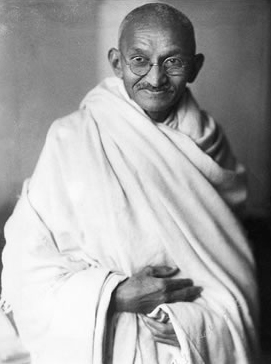
A rare studio photograph of Gandhi taken in London at the request of Lord Irwin, 1931
Source [from Wiki]: http://www.photokunst.com/art/gandhi_big.jpg


His going to England was vehemently opposed by his caste people and Mohandas Gandhi was summoned to appear before them. They warned him saying: “In the opinion of the caste, your proposal to go to England is not proper.” Gandhi replied: “I think the caste should not interfere in the matter”. So, off he went to England.

Mohandas Gandhi was born a common man and he grew to be a superman. He gathered his greatness not by accumulating wealth but by renouncing it; not by propounding any new philosophies but by practicing old ones; not by being ministered unto, but by ministering unto man on earth. After nearly four years, he completed his barrister in London, was called to Bar, and returned to India. He set up practice in Rajkot, but met with indifferent success. Gandhi was invited to go to South Africa.

In April, 1893, Gandhi went to South Africa for one year; but he stayed there for over twenty. Almost immediately on his arrival in Natal, political consciousness was awakened in him by a series of humiliating shocks.

So far he had only encountered race prejudice in the rudeness of an official in Kathiawar. In Natal it appeared everywhere in the most degraded insults, social and political, heaped on the Indian Community individually and collectively.

On the day after his arrival, Gandhi attended the magistrate’s court of Durban. The magistrate stared at him for sometime, then ordered him to remove his turban. Rather to do so he left the court room. A few days later he took a train to Pretoria.

This humiliating and hazardous journey fully showed him the abject social position of his fellow Indians in South Africa. Although he had a first class ticket he was ejected by force from the first class compartment, and on that part of the journey which in those days was completed by coach, he was forced to sit outside with the driver and later, he was even assaulted and beaten by the conductor.

He was addressed by railway officials by the name of Sammy - the contemptuous nickname given by the Europeans to all Indians just as they referred to all Indians as “Coolies”. Gandhi was thus called “Coolies” barrister.

Mohandas Gandhi became a new man after this humiliating incident. He began his mission and political movement. In September, 1906, a momentous mass meeting of Indians was held at Johannesburg. The three thousand Indians present took oath to resist the “Black Act” as it was dubbed to the last, but by non-violent means.

Thus the Indian passive resistance weapon was forged. Gandhi had no name for this new movement and he coined the movement name as Satyagraha. So the great movement was born. He returned to India as a bitter man and preached Satyagraha and Ahimsa (Non-Violence) as means to throw the British Imperialism from India.

When asked about the meaning and importance of Satyagraha he explained: “For the past thirty years I have been preaching and practicing Satyagraha. The principles of Satyagraha, as I know it today, constitute gradual evolution.

The term Satyagraha was coined by me in South Africa to express the force that the Indians there used for full eight years, and it was coined in order to distinguish it from the movement then going on in the United Kingdom and South Africa under the name of Passive Resistance.

The root meaning is “Holding on to Truth”, hence, truth-force. I have also called it Love-force or Soulforce. In the application of Satyagraha I discovered in the earliest stages that pursuit of truth did not admit of violence being inflicted on one’s opponent, but that he must be weaned from error to the other. And patience means self-suffering. So the doctrine came to mean vindication of truth, not by inflicting of suffering on the opponent, but one’s own self’.

According to him, therefore, a Satyagrahi has no enemies. The way to discover Truth is by fasting and prayer. Gandhi believed in an all pervading God. His God was Truth (Sat), his truth was knowledge (Chit) and where there was true knowledge there was bliss (Anand). It was thus Gandhi knew his God as Sat-Chit-Anand.

He also preached Ahimsa - Non-violence. To him non-violence meant love to all living beings. Without Ahimsa - non-violence, to him it was not possible to seek and find truth. He once said that ‘untouchability’ among Hindu society is a form of violence.

Thus, he advocated the abolition of untouchability of Hindu Society. Ahimsa or non-violence according to Gandhi “is no wooden or lifeless dogma, but a living and life giving force. It is an attribute of the brave, in fact, it is their all. It is the special attribute of the soul. That is why it has been described as the highest dharma”.

Because of his complex nature, people have called him, off and on, a mystic or a statesman, a pacifist or a democrat, a social revolutionary or a reactionary conservative, a moral quack or a perverse crank, a saint or a savage or a Messiah etc.

But whatever he was or was not, the fact of the matter is that in an age tom as under by war and bloodshed, in a world where the rule of the jungle has prevailed and violence has been enthroned as the basis of internal order as well as the arbiter of internal disputes, in a form of a society where law has superseded public opinion and conscience as the supreme sanction, and installed brute-force as the foundation of all order, Gandhi’s ideas have helped to restore faith once again, in a sense, inner voice in men through the doctrine of love and service, of suffering and sacrifice.

Mahatma Gandhi lived to see his great ambition for free India realized, but strife between Muslims and Hindus was intensified by the division of the continent in 1947.

Early in 1948 Gandhi, in further effort to bring peace to his country, he entered on another fast. After five days it was ended amid the rejoicing of the people-rejoicing that turned to mourning when, on January 30, 1948, Mahatma Gandhi, while on his way to prayer-meeting, was shot dead by a fanatical young Hindu. Ironically, thus, a man who preached love and non-violence met with a violent death.

Are Gandhian Ideas relevant to modem times? That is the question. It is a difficult question to answer.

Therefore, I would like to end my contention by quoting what Jawaharlal Nehru said about Gandhi. Because it speaks volumes and I quote: “We live today in a world tom with hatred and violence and fear and passion, and the shadow of war hangs heavily over us all.

Gandhi told us to cast away your fear and passion and to keep away from hatred and violence. His voice may not be heard by many in the tumult and shouting of today, but it will have to be heard and understood sometime or other, if this world is to survive in any civilized forms”.

I have briefly stated Gandhi in outline. We may now examine Gandhi or Gandhism taking a few principles laid down by him. “Ism” means a name.

Gandhism then means the name of Gandhi and Gandhi and his name stand for nothing, if they do not stand for definite principles and policies. The term Gandhism is controversial. We do not know exactly who coined the word.

Gandhi himself told his followers that “There is no such thing as “Gandhism”, and I do not want to leave any sect after me. I do claim to have originated any new principle or doctrine, I have simply tried in my own way to apply the eternal truth to our daily life and problem...”

Indeed, before him, there were many great men and teachers that taught and preached Non-violence (Love), truth, justice, and equality etc. by persons like Buddha, Mahavir, Krishna, Jesus, Muhammad, Guru Nanak, Leo Tolstoy and Thoreau, just to cite a few.

The term “Gandhism” has become widely popular. the first time the term was used was on the occasion of the address by Gandhi at Karachi at a public meeting which had taken place when Gandhi made a remarkable statement that “Gandhi may die but Gandhism will live for ever”.

Apparently he then and there coined the term Gandhism as an expression which, succinctly but comprehensively, summarize the philosophy that underlies his cult of Truth and Non-violence.

Gandhism is not a set of doctrines of dogmas, rule of regulations, injunctions or inhibitions, but it is a way of life. It indicates a new attitude or restates an old one towards life’s issues and offers “ancient solutions for modern problem”. Gandhi lives for others. Society is Gandhi’s temple, service is his sole form of worship, humanity is his single passion.

Truth is his one God and non-violence is his only means of attaining it. To study Gandhi, therefore, we must study his life and achievements of Gandhi, understand his doubts and difficulties, appreciate his outlook and points of view.

Cardinal principles of Gandhi are: Devotion to life of service; Possession of stern character and purpose; Self-control and discipline and aversion to life of frivolity and pleasure seeking; greatest simplicity, poverty and hardship and readiness for physical exertion.

Gandhi’s philosophy is mainly based on Non-violence and Satyagraha. To him, Ahimsa or nonviolence is no wooden or lifeless dogma, but a living force. Non-violence is love to all living beings.

Gandhi said India attained freedom through Non-violence, therefore, she must be able to maintain it through that very force. His simple theme is that instead of war-armies wedded to violence and bloodshed, there should be peace-armies, which should be prepared to throw themselves between the invading army and their own country.

Gandhi recognizes no enemy and lays down that Satyagrahi should love his so-called enemy ever as his friend.


* Dr M Horam wrote this article for The Sangai Express . This article was webcasted on August 10th, 2007 .


* Comments posted by users in this discussion thread and other parts of this site are opinions of the individuals posting them (whose user ID is displayed alongside) and not the views of e-pao.net. We strongly recommend that users exercise responsibility, sensitivity and caution over language while writing your opinions which will be seen and read by other users. Please read a complete Guideline on using comments on this website.


LATEST IN E-PAO.NET
  • Abdul Hafiz graveyard at Imphal War Cemetery
  • Violence in Manipur 2023-2026 : Timeline
  • Homecoming : Exhibition at Washington DC
  • Why NSCN-IM & ZUF must preserve Naga
  • The Funeral of Kindness :: Poem
  • Dignified menstruation for gender equality
  • World Environment Day 2026
  • Welcomes New DGP
  • Coming together of the indigenes
  • Martyrs' Day @ Cheiraoching #3 : Gallery
  • Showcasing product from IDPs at Switzerland
  • The abduction & 'murder' of 6 Naga civilians
  • Why keep returning to Regional Politics ?
  • One missed coffee & a full existential crisis
  • Trekking, Camping banned in Nongmaiching
  • Avocados Cultivation Programme at Pangin
  • Guwahati Open PWR 200 concluded
  • Focus on flip flop stand of the UNC
  • The King Who Came from the Sky: Pakhangpa
  • SoO : An assault on native people of Manipur
  • Manipur - Example of Underdevelopment
  • Cries in Agony :: Poem
  • 'CCpur & Kpi Road no longer safe'
  • Home Ground: Meghalaya Future of Tourism
  • Burnout healthcare staff & patient safety
  • Fate of hostages : Flip of the coin ?
  • Chakan Gang-Ngai 2026 : Ooba Video
  • Unfinished requiem- Linthoingambi & Hemanjit
  • "Ningol Van" Launched at Taobungkhok
  • Calm reflection vis a vis brute violence : Poem
  • Foundation Days of States/UT
  • World No Tobacco Day 2026
  • Breast Cancer Awareness in Guwahati
  • Licensed to create mayhem ?
  • How to Break Manipur w/o Breaking Any Laws
  • 17th Manipur State Film Awards (MSFA), 2025
  • World We Make, World That Makes Us : Poem
  • Counting Right, Voting Right: What SIR means
  • Calls on Indonesia to ratify tobacco treaty
  • Honourable exit for Ashutosh & Kailun
  • Police Museum at 1st Manipur Rifles
  • Eid-Ul-Zuha @Sangaiyumpham : Gallery
  • June Calendar for Year 2026 : Tools
  • 16th Manipur State Film Awards (MSFA), 2024
  • KIM's proposed rally must be called off
  • International Menstrual Hygiene Day
  • Plants : The force that engineered Earth
  • AC: How does it affect the skin ?
  • Onslaughts at Ukhrul district
  • Lhangpat Mei @Keishamthong #2: Gallery
  • Anthem of Switland :: Poem
  • CM visits Makhan Naga Village
  • Manipur University needs fresh air
  • False Narrative on Killing of Thadou Christian
  • Summer Coaching Camp 2026 @NSU
  • Tribute to Pu Mangvung Paokholun Haokip
  • Incursion from across the border
  • Radio E-pao: 5 new songs updated
  • Manipuri Community in Assam Calls for Vision
  • School dropouts & never-enrolled children
  • M. Tech at Assam University
  • Under One Sky or Leased ? :: Poem
  • When AI speaks in tribal languages
  • 'The Unbecoming' makes Northeast debut
  • After crossing the three year mark
  • Cheirao-chingkaba on Cheiraoba #2: Gallery
  • Anoi Group Art Exhibition 2026 : Download
  • Exploring Hyderabad's Museums #1
  • Maharaja Garib Niwaz : Manipuri civilisation #4
  • IEC Campaign at Willong Khullen
  • World Emergency Medicine Day 2026
  • Liver & GI super-speciality clinic
  • Adding more muscle to State Police
  • Rally at New Checkon- May 25 : Gallery
  • Hritwika Majumder at Miss Grand India 2026
  • How social media fuels division & ethnic tension
  • Saving Manipur's vanishing paddy & wetland
  • Helpline for Thadou people
  • 477 new Manipur Police Vehicles
  • NDPP-NPF merger accepted by ECI
  • Seeking to pitch Nagas against Meiteis
  • 63rd Mr. Manipur #3 : Gallery
  • Why CJP resonates with Manipur's youth
  • A moral, humanitarian reflection on violence
  • Financial assistance to IDPs
  • Legally binding treaty for older persons
  • Zoonotic Disease : Link animal & human
  • Jealous of Meloni
  • Making the bodies disappear !
  • Yaoshang - Cooking Competition : Gallery
  • Manipur State Award for Literature 2024
  • Manipur's unresolved Political Journey
  • 'Kuki is not an ethnic name'
  • Miyawaki Plantation Experiment at Langol
  • A Ploy to Keep the Chasm Wide Open : Poem
  • 45th Water India Expo 2026
  • Beating of the Retreat #1: Gallery
  • Martyred Rev Dr Vumthang Sitlhou
  • When Ima Weeps in Silence :: Poem
  • International Eld's Deer Day
  • Sticking to a consistent narrative
  • Arms recovered from Lamdeng: Gallery
  • Khatingla, Sumpa, Gaikhuluanlung : Eming
  • Exploring Kolkata: College Street #1
  • Wetland grabbing, hydropower, & ecologies
  • Condoles Demise of Khangembam Kuleswar
  • Upgradation of Imp-Jiri road: Poor planning
  • IEC Campaign at Phaibung, Senapati
  • In a mess for over 3 years now
  • The King Who Built a Golden Bridge : Kyampa
  • Mother's Day at Pukhao : Gallery
  • Manipur in India Constitutional Transition #3
  • Satyajit Ray's universal language
  • Decoding MLR & LR Act, 1960 & Article 371C
  • National Endangered Species Day 2026
  • India-New Zealand step into a new eco league
  • Posers over fate of abducted 6 Naga men
  • Sit-in protest @Kanglatongbi [May 18]: Gallery
  • Why communities must abandon hostility
  • Apatani's Next Top Model @Arunachal
  • The Fog of Uncertainty :: Poem
  • IEC Campaign at Song Song, Senapati
  • Supports TIM Proposal for Thadou-Naga
  • NE's Largest Psychiatric Hospital
  • Triangular clash underway in Manipur
  • Lamjen @ Thangjing Haraoba #1: Gallery
  • From Sympathy to Supremacy :: Poem
  • History repeats itself
  • Church Teams to visit Kangpokpi & Senapati
  • Workshop on Analytical Chromatography
  • Criminal Neglect, Terror Shielding
  • Summer make-up tricks to beat the heat
  • Pulling the strings to block the highways
  • Manipur Art Festival 2025 #3: Gallery
  • Manipur fermented food & scientific recognition
  • Seminar : Development of NE Region
  • World Hypertension Day 2026
  • Demands NIA Probe into Killing of Thadous
  • Suspected cases of Ranikhet Disease
  • PM's prescriptions & we
  • Flexing muscle on the roads of Imphal
  • Cheiraoba Chak Katpa #2: Gallery
  • Maharaja Garib Niwaz : Manipuri civilisation #3
  • The Dreamer's Dilemma :: Poem
  • Calls for Community Understanding
  • CM visits National Sports University
  • Condemns malicious press release
  • Reconnecting with our cultural roots
  • Condoles Death of Thadou Church Leaders
  • Yumjao Lairembi Haraoba #1 : Gallery
  • Manipur in India Constitutional Transition #2
  • Chronicle of princes & people's long defeat
  • SIR of Electoral Roll-Phase III
  • Program on New Income Tax Act, 2025
  • Book on Information, Reality, Life
  • 'Unfortunate incident at Zero Point'
  • Where is the Government poser
  • Sit-in protest @Kanglatongbi [May 14]: Gallery
  • 3 years on : Manipur's long road to peace
  • Int'l Triathlon Yengkhom Suraj felicitated
  • Ethniciity of Thadou Martyr Church Leaders
  • Colonial Knowledge Production in NE #22
  • Condemns Killing of Thadou Church Leaders
  • Condemns Attack on Thadou Church Leaders
  • Peace will Outlive Violence
  • Indo-Naga Talks (From 2012) :: Timeline
  • Bloody Night
  • Good girls first take care of themselves
  • Candlelight Vigil @ Bangalore #2 : Gallery
  • Maharaja Garib Niwaz : Manipuri civilisation #2
  • The Green Foundation recognised as a SIRO
  • Waithou Rally condemn civilian killing: Gallery
  • Manipur in India Constitutional Transition #1
  • Chahi Taret Khuntakpa
  • HSLC Exam 2026 : Full Result
  • HSLC Exam 2026 : Pass % : Govt Schools
  • HSLC Exam 2026 : Pass % : Aided Schools
  • HSLC Exam 2026 : Pass % : Private Schools
  • HSLC Exam 2026 : Withheld-students
  • HSLC Exam 2026 : Compartmental candidates
  • HSLC Exam 2026 : Statistical Abstract
  • HSLC Exam 2026 : Important Information
  • Cheirao-chingkaba on Cheiraoba #1: Gallery
  • Chandel District Head Quarters : Gallery
  • Indigenous Leaders Call for Global Recognition
  • International Women's Day : Gallery
  • Subika Art Exhibition @Washington : Gallery
  • Candlelight Vigil @ Bangalore #1 : Gallery
  • Vegetables @ Waithou Keithel #2 : Gallery
  • Conflict, Displacement in Manipur (2023-2026)
  • Tronglaobi: 2 children laid to rest : Gallery
  • Leingakta Wahang Khongchat #2 : Gallery
  • Martyrs' Day @ Cheiraoching #2 : Gallery
  • Featured Front Page Photo 2026 #2: Gallery
  • Free Online access to 'Asangba Nongjabi
  • Lhangpat Mei @Keishamthong #1 : Gallery
  • Candlelight vigil: Killing at TM Kasom : Gallery
  • Fractured sovereignty : Proxy war
  • Mama, I love you- Then the world went silent
  • Khongjom Day @ Khebaching : Gallery
  • Tronglaobi: Meira Rally #2 [16 Apr]: Gallery
  • Final Merit List : Manipur Civil Services 2022
  • HSE : Pushpa K, H Keniya, P Taibangnganba
  • Yohen Longjam : HSE 2026 : Science Topper
  • Sarangthem Ayingbi : HSE 2026 : Arts Topper
  • Thoihenba Thongam : HSE 2026: Commerce
  • HSE 2026: Science Full Result
  • HSE 2026: Arts Full Result
  • HSE 2026: Commerce Full Result
  • HSE 2026: Pass % - Govt / Non Govt
  • HSE 2026: Pass % - District Institutes
  • HSE 2026: Subject-wise Pass %
  • HSE 2026: Candidates securing Highest Mark
  • HSE 2026: Science Topper List
  • HSE 2026: Arts Topper List
  • HSE 2026: Commerce Topper List
  • Tronglaobi: Clashes @Lamlong 17 Apr: Gallery
  • The great Manipur betrayal
  • Tronglaobi: Meira Rally #1 [16 Apr]: Gallery
  • MoU between Nouwa Marup Pune & IBI
  • Tronglaobi: Meira Rally [15 Apr]: Gallery
  • Most Heinous Murder: Derailing Normalisation
  • Martyrs' Day @ Cheiraoching #1 : Gallery
  • Tronglaobi : Rally @ Uripok [12 Apr]: Gallery
  • Killing of 2 children @ Tronglaobi : Gallery
  • Yaoshang Thabal Chongba #2: Gallery
  • Of 'Boong', BAFTA, Bharat & Manipur
  • Boong & the Long Road of Regional Cinema
  • Boong: India's 1st BAFTA in children's cinema
  • PUCL Tribunal report: A shadow of partiality #3
  • PUCL Tribunal report: A shadow of partiality #2
  • PUCL Tribunal report: A shadow of partiality #1