

Discovery of Kangleipak
- Part 7
- The snake culture of the World vis-a-vis Kangleipak
Wangkhemcha Chingtamlen *
In the article of the writer in the matter, Pakhangba, a Snake as the Progenitor of the Kangleicha Meetei Race (It is an improper concept, created and born during Hindu rule in Kangleipak), the writer had showed the unacceptability of the concept that Pakhangba, a snake as the Progenitor of the Kangleicha Meetei Race, scientifically and historically.
Now the writer will show the snake culture of the world vis-a-vis Kangleipak in order to strengthen and confirm the blunder and unacceptability of the concept of Pakhangba as a snake as a Progenitor of the Meetei Race.
The Celtic symbols of serpent (Xerox from the originals)
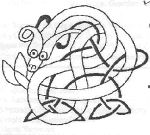
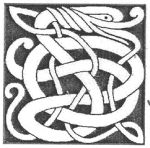
'Every ancient mythology has some form of world serpent.'
'The serpent represent the cyclic nature of life.'
'Thus, many ancient people believed snakes are immortal.'
'The serpent also is a phallic symbol, but ironically, serpents also are one of the older symbols of female power in the celtic religion.'
'The coiled snake with its tail in its mouth is some times known as Ouroboros, and is thought to represent the circle of the continuity of life.'
From an article, the serpent (An Nathair) by Michealin Daugherty. (Source: irelandsown.net/serpent.html)
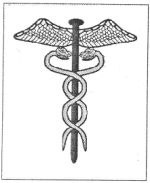
OUROBOROS (Xerox from the originals)
(From Wikipedia, the free encyclopedia)
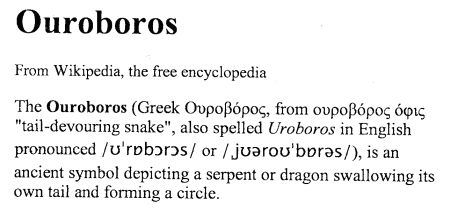
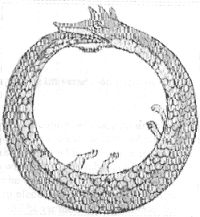
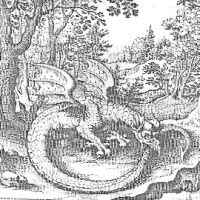
'The Ouroboros often represents self reflexivity or cyclicality, specially in the sense of something constantly recreating itself, the eternal return, and other things perceived as cycles that begin anew as soon as they end (see Phoenix). It can also represent the idea of Primordial unity ......"
HISTORICAL REPRESENTATIONS.
ANTIQUITY
'Plato described a self eating, circular being as the first living thing in the universe' an immortal, perfectly constructed animal.'
'The notion of the serpent or dragon eating its own tail can be traced back to ancient Egypt, circa 1600 B.C. From ancient Egypt it passed to phoenicia and then to the Greek philosophers, who gave it the name Ouroboros (tail devourer).'
Non-western traditions
'It is also present in some Hindu folk-myths, as a snake (Adisesha) circling the tortoise Maha Kurma that supports eight elephants which support the world on their back.'
'Snakes are sacred animals in many west African religions.'
Modern
'The flag of the short lived Italian Regency of Carnaro featured the Ouroboros on it. The Ouroboros has been incorporated into the crests of the Hungarians and Roman unitarian churches.'
From what the writer has quoted above from the article, the serpent (An Nathair) by Michealin Daugherty and from the article, Ouroboros from Wikipedia, the free encyclopedia, the esteemed readers might have understood that the snake culture was associated with the western and middle east countries (peoples) since B.C. Not only the western and middle east countries the snake culture was associated with the African and Indian peoples also since early times.
THE PRESENT INDIAN PEOPLE CAME TO
THE INDIAN SUB-CONTINENT WITH SNAKE CULTURE
On page 11 of the 'kirata-jana-krti' by Sunity Kumar Chatterji, under the heading '13. The Aryan Nordics : Their Advent Into India' Mr. Chatterji writes
'They spread west and south and east, and a branch of them, the Aryans, crossed the Caucasus Mountains into Northern Mesopotamia by 2200 B.C., whence some of their tribes after wanderings spread over several countries in Iraq, Iran and North western Frontier of India, finally came into India at a period not earlier than 1500 B.C.' probably nearer to 1200 B.C. than 1500. They brought with them their own culture and religion, .........................'
'So, when the Indus Valley Civilisation was discovered all scholars were puzzled. They could not term the civilisation as Aryan since they already established the theory that Aryans entered India not earlier than 1500 B.C..'
'A peace treaty of about 1400 B.C. between the Hittites and the Mattani Rulers of the Mattani, reveals the names of the Vedic Gods Indra, Varuna and Nasatya. Ghosh thus concluded that about the middle of the second millennium B.C. the forefathers of the Indo Aryans still in the western Asia on their way to India from a European home.'
These two quotations above are from 'The Aryan Hoax by Paramesh Choudhury (1995)' pages 20, 375.
V.D. Mahajan in his history book, Ancient India on page 850 says that Aryan kings were still in the west Asia in their way to India in 1435 B.C.
An advanced History of India by R.C. Majumdar etc. on page 25 says 'In the Chaotic State of early Aryan Chronology, it is a welcome relief to turn to Asia Minor or other countries in west Asia and find in certain tablets of the 14 century B.C., discovered at Boghaz Keui and other places, references to kings who bore Aryan names and invoke the Gods Indra, Mitra, Varuna ......'
From the above quotations from some of the reputed writers and historians of present India, the esteemed readers might have understood that the present Hindu people were part and parcel of Europe and west Asia people, sharing their culture, including that of snake culture and way of life upto most probably 1200 B.C.
After about 3000 years on the Indian soil, some Hindu Indians came to Kangleipak and a Hindu decent Pamheiba Garivaniwaz became king of Kangleipak in 18th century A.D., but actual ruler was one Santi Das Gosai, a Hindu religious preacher, the Dharma Guru of king Pamheiba.
Before the advent of Hinduism, the people of Kangleipak and Kangleichas Meetei Race had nothing to do with snake culture and snake in their religion. Even to day some of the Kangleichas eat big snakes called Pythons. Every thing connected with the snake culture and snakes was brought and imposed by the Hindu kings upon the indigenous Kangleichas during their rules since 18th century A.D.
Tradition of rebirth and cyclic nature of life of the Kangleicha Meetei Race.
The Kangleicha Meetei Race is a Race having extreme belief in the rebirth of human soul. During the time of Kanglei Monarchs, when a person is convicted of a serious crime, like treason, he was killed by the state executioner. The highest court, the king with seven Maichous, will say to the executioner 'Angang Olhanlo' = 'Change him to child' meaning 'the man will be born as child' after his death by gallows.
Everybody upto this day a man or a woman born as a Meetei knows very well that when a person is about to die, he/she is put over a Changpi banana tree leave using a part of the Changpi banana tree as pillow inside a Khangpokshang in the Sumang (like courtyard) of the Meetei home. Khangpokshang is a compound word.
Khangpokshang = Khang + pok + shang = Khang means Khangpa (Khangba), further means to endure the pains and suffering prior to death + Pok means Pokpa, further means to be born + Shang means hut. Therefore, Khangpokshang, for the Meetei Race, is a hut in which a dying person waiting his/her rebirth self controlling his/her sufferings and pains just before death. Every body must know that a Meetei person lies inside the Khangpokshang just before death facing up the sky. An example of extreme belief in the rebirth process of life.
'Khamchinkon' is a word/concept very frequently used in the scripture called 'Kham-oi Yang-oi Sekning', a Puya in which the life, birth-death-birth, is discussed in details.
'Khamchinkon' = Kham + chin + kon = Kham means khampa = khamba means end ( end of life) + chin means machin further means beginning + kon means konnachak further means coiled position of a child before birth in the mother's womb. Therefore khamchinkon means the process of life (soul), death > birth > death ..... unending circle of life (soul).
There are two words/concepts, chakpalon and chakoi, which are discussed in details in two Puyas called Wakoklon Heelel Thilel Salai Ama-Ilon Pukok and Polpilang. Polpilang = Polpi + lang = Polpi means life (soul) + lang means body. Therefore Polpilang means soul and body (soul body).
There are four chaks in the Meetei mythology' Hei chak, Ha chak, Kona' chak, Langpa chak. Hei chak means (time) of the father in which the soul (thouwai) of human beings resides in the father, in Ha chak and Kona chak the soul resides in the mother, and Langba chak means human life time as man and woman. After human beings lived for a time as man and woman, they die and the souls return to the human father, and repeat the 4 chak process of human life.
The mythology of the Meetei Race, chakpalon and chakoi, is studied in the above mentioned two Puyas. Chakpalon = Chakpa + lon = chakpa means chak further means 4 stages (times) of life cycle + Lon means study and results thereof. Chakoi = chak + koi = chak means chak (time) + koi means round (circle).
Therefore, chakpalon and chakoi means life and death and their cyclic nature in the universal process ordained by the universal father, the God creator.
Inspite of the extreme belief of the Meetei Race in the cyclic process of life and soul, there is not a single instance of symbolic representation like Ouroboros in traditions, Mythologies and Puyas or otherwise in ancient times of Kangleipak.
When the Hindu comes
In 1834 A.D. when king Gambhir Singh was ill, he started worshipping Pakhangba in a Kufa for his long life at Langthabal hill. During the worship the king had an earnest desire to see ancestor Pakhangba in the shape of swallowing its tail in the mouth (like Ouroboros) once he saw in a worship in 'Nungjeng Pukhri.'
" Mana ukhiba Mabudhou Pakhangbagi murti adu ningsinglaktuna makhudombina leipakta yekle.(page 35 of Meitei Ningthourol by Sarangthem Bormani Singh). King Gambhir Singh died in this way.
Leimaida yekliba Mabudhougi murti aduda mapukning changna mityeng tabada khanghoudana
Mabudhougi murti adu thangeisengba Pakhangba ollaktuna
mameibu mayana chiklambadu thadoklaga chongkhatlaktuna
maharajgi maraibakta chiklamlaga leimaida murti oina amuk hanjinkhi."
"Gambhir Singh Maharajabu chikpa Pakhangba(page 38 of Meitei Ningthourol by Sarangthem Bormani Singh).
adu Pebra panditna mingkhei sonduna lupagi komfuda
haplaga waithou mathak tangjeng patta thadokkhi,
mapham aduda tangjeng pakhangba oina leikhi."
There is a confusion to the readers of page 35, 38 of the Meitei Ningthourol by Sarangthem Bormani that the snake Pakhangba that was set free by Pebra Pandit at Tangjeng Pat was a live snake Pakhangba or the drawn Pakhangba murti on the ground.
Regarding the death of king Gambhir Singh, the 'Manipur and the Naga hills' by Major General Sir James Johnstone says on page 87 'The Kubo Valley was handed over to the Burmese on the 9th of January, 1834, and on that day Ghumbeer Singh died in Manipur of Cholera."
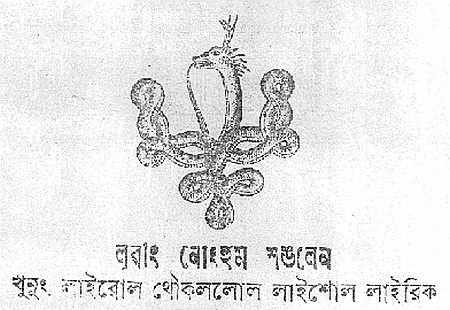
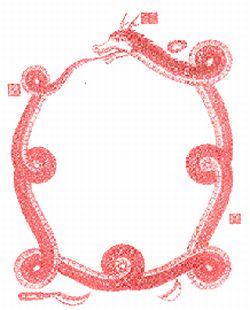
The above two xerox copies are from two books, Luwang Nonghum Sanglen and Pakhangba Naoyom by Shri Hijam Ibobi and his relative, Hijam Phajabi of Singjamei Waikhom Leikai. Shri Hijam Ibobi was head Pandit Achouba of Royal Palace before the merger of Manipur to India in 1949.
This Ouroboros type symbols of Pakhangba is said 'Paphan' or 'Pakhangba Paphan' in Manipur now.
The names of the above symbols as 'Paphan' or 'Pakhangba Paphan' are wrong and conceptually very misleading.
"Talang Eepung Loinapa Apakpa Masana Oipa Mihun, Sam, Tu, Khuchinnachingpa Singli Paphan 108, Mihun 84, Tangsamli 27, Thapung 10 ki Eepha Eemenpham, Thonglon 9, Pankhei 8, Eelam 7, ............"
The above quotation is from the scripture, Puya Wakoklon Heelel Thilel Salai Ama-Ilon Pukok. Please see the underlined words. The words/concepts in the quotation cannot be deciphered fully by the writer till now. Mihun = Pulse, Sam = Hair, Tu = Hair all over the body, Khuchin = Nail, Singli = Nerve, Vein, Paphan = Pa + Phan = Pa means Paba further means very finely, Phan means Phandokpa further means spread over wide areas.
We know very crudely that the Singli (Probably nerves and veins) spreads very finely through out the body as Cobweb or spider net. We call this generally 'Singli Paphan'.
This 'Singli paphan' is/was never connected with the present snake Pakhangba or ancient Lailel Pakhangba in any way or in any sense.
The above quotation from the Puya seems to express Physiological scientific findings in the ancient Kangleipak, but is never expressed any where or any time in the Past Kangleipak in symbols like Ouroboros or otherwise.
Therefore, from the reasons given above by the writer in this article, please know for certain that the symbolic representations of snake Pakhangba or ancient Lailel Pakhangpa or Paphan or Pakhangba Paphan as Ouroboros or a snake swallowing its tail or any other snake symbols are since the advent of Hinduism, not of ancient Kangleipak.
to be continued...
* Wangkhemcha Chingtamlen contributes regularly to e-pao.net . The writer is President, Kangleipak Historical and Cultural Research Centre, Sagolband Thangjam Leirak, Imphal, Kangleipak (Manipur). The writer can be contacted at chingtamlen(at)gmail(dot)com
This article was webcasted on July 21st, 2009.
* Comments posted by users in this discussion thread and other parts of this site are opinions of the individuals posting them (whose user ID is displayed alongside) and not the views of e-pao.net. We strongly recommend that users exercise responsibility, sensitivity and caution over language while writing your opinions which will be seen and read by other users. Please read a complete Guideline on using comments on this website.


