

Oral tradition as material source for social research
Rajendra Kshetri *
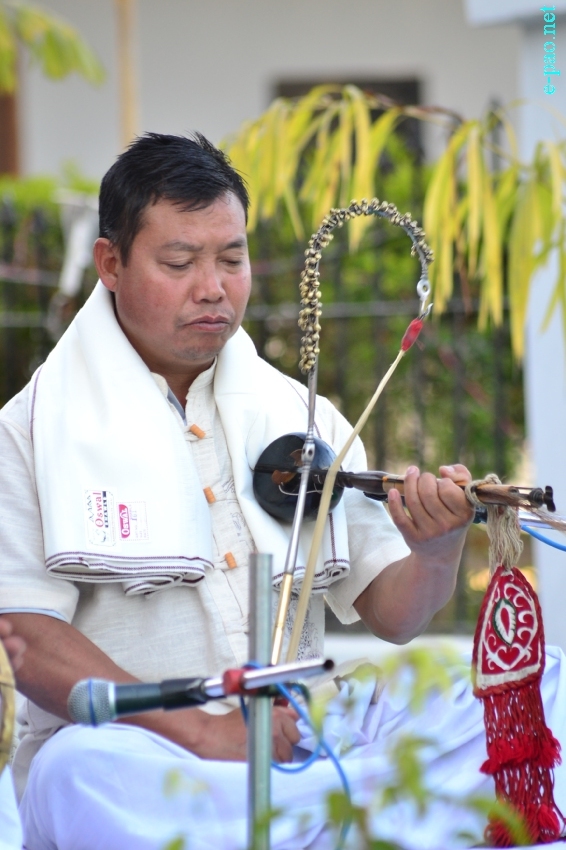
A pena Player at a 'Moirang Sai' performance at Maharaja Chandrakriti Auditorium on 21st January 2014 as part of 3rd Khundongbam Brojendro Theatre Festival 2014
Pix - Ashok Ningthoujam
(The following is the full text of the Invited Lecture delivered on 2nd January 2014 at the one week Short Term Course in Oral Traditions of Ethnic Communities of the North East conducted by the UGC-Academic Staff College , Manipur University , Canchipur).
My Dear Participants
Though it is no longer morning in the technical sense of the term, I still would like to wish you all "Good Morning "and, of course, a Happy and Peaceful New Year 2014. It is always a pleasure to accept Letter of Academic Invitations from Manipur University and I must therefore thank Dr.Aheibam Koireng , Assistant Professor , Centre for Manipur Studies and coordinator of the short term course on "Oral Traditions of Ethnic Communities of the North East "for giving me the opportunity to interact with some of the best minds of the state .
Before I set the ball rolling for kick-starting the interaction, let me place before you two personal perceptions of mine, or if I may call them my "Social Perceptions ". In the first place, I am not basically one of those who believe in formalities. But, years of experience and exposure, interactions with people of different communities at various levels of academic hierarchies over the last three decades have convinced me that there comes a time when one needs to be a little formal. And, I think today's occasion, this very place, time and space qualifies to be one.
Secondly, I do not belong to those categories of people who love giving you the impression that "I Know Everything ". No, I don't know everything. But I do know something and that "something" is what i am going to share with you and interact with you. In the process, I am more than willing to learn from you. Learning, as far as I am concerned, is a never ending Process and I keep learning. It is not like the Bee Gees popular number of the seventies: "One Way Ticket to the Moon". Learning is always a two way process. Let us therefore learn from each other, from one another.
Well friends: I have been invited to deliver a lecture on "Oral Traditions as Material Source for Social Research "but I may disappoint you in that I shall not give one. I would rather share with you whatever little I know.
Two types of Sources: Let me initiate our interaction by saying , even at the risk of repetition , that there are two types of sources for social research( or any kind of research for that matter) namely Secondary Sources and Primary Sources. By Secondary sources, we generally mean those kind of date, information, material that we get from published books, journals/ magazines, articles/papers,monographs, newspapers etc. Data obtained from secondary sources are known as secondary data.
Primary Sources mean those data, materials, information that are collected from the field (more or less like firsthand information). Data from the field could be collected through different methods like Survey, Interviews, Scheduled Questionnaires (both structured and non structured).
Other types of primary sources are manuscripts, personal dairies / memoirs, pamphlets/leaflets, unpublished dissertations etc. Data obtained/collected from Primary Sources are known as Primary data.
No less an important Primary source of materials are Oral history, Oral Traditions, Folklores etc.
It is on Oral Tradition as source of materials that I am standing right here in front of you to share whatever little knowledge and experience I have.
What is Oral Tradition? Oral Tradition is cultural material and tradition or information transmitted orally from one generation to another (mostly by story tellers).
These materials/traditions/information's are verbally transmitted in speech or song and held in common by a group of people over several generations.
Forms of Oral Tradition : We may broadly speak of 5 forms namely
a) Poetry/ Ballad /Song/ Chants
b) Folktales
c) Proverbs/Sayings/ Riddles
d) Religious Instructions
e) Recollections of the past
Let me elaborate, brief as it may, on each of the five forms:
a) By Poetry, I don't mean here those typical kind of poetry which are generally understood .What I mean refer to those specific kind of poetry / ballad/song /chants which are often chanted ,sung and comes under the genre of "Lullaby" ( in English) , Lori ( in Hindi) and Naoshum ( in Manipuri). For example we may mention" Jingle Bell/Jingle Bell /Jingle all the way": "Twinkle twinkle little star / how I wonder what you are " in the English ( western) tradition and "So Jaa/So jaa rajkumari so jaa/ so jaa main balihari so jaa" in the Hindi heartland tradition , "Tha Tha Thabungton / Nacha Morambi pobige /Pobi Sanam Nambige " and "Ting Ting Chaoro /Napa machum taro/ napu machum taro/thabi na karingei kahouro" in the oral tradition of Manipur exemplified this genre.
b) Folktales – Simple narrative typically of folk origin dealing with supernatural beings. Folktales may be written or told for the entertainment of children or may have a more sophisticated narratives containing supernatural or obviously improvable events, scenes and personages and often having a whimsical, satirical or moralistic character. "Cinderella" "Red Riding Hood" "Snow white and the Seven Dwarfs "are some of the popular folktales in the western countries/societies.
Folktales are plenty full in our state/society. To name a few, we may mention "Hanuba Hanubi Pan Thaba" " Thabaton amashung Kabuikeioiba" "Laikhutshangbi" and "Tapta" among several folktales of Manipur.
c) Proverbs- They are succinct sayings which are in general use and expresses commonly held ideas and beliefs. Proverbs are part of every spoken language and folk literature, originating in oral tradition. Often a proverb is found with variations in many different parts of the world. "When two Elephants fight, it is the grass who suffers" can be cited as an example.
Literate societies dating to the ancient Egyptians have collected proverbs. Illiterate (mostly tribal, simple) societies do not suffer from lack of proverbs. What they suffer is lack of collection and publications " Keigi Mapal Napi na tang , napigi mapal keina tang " " Cheng puraga cheng shing /phou puraga phou sing" are two of the hundreds of examples that we have in the oral tradition of Manipur.
d) Religious instructions: They are found in all societies and refer to those 'dos' and 'don'ts'. For Example, religious teachings, sanctions and taboos –"Love Thy Neighbour ", Islam's prohibition of eating pork meat, Hindus worship of Cows (thereby prohibiting to eat) etc may be mentioned here.
e) Recollections of the Past: Refers to verbal recollections by storytellers/individual members of the given society (going down memory lane recollecting past events, times and period).
Epic poems concerning the destiny of a society or summarising its myth often begin as oral tradition and are later written down. The great epics of the world such as Homer's (the great Greek poet one of the greatest and most influential writers of all time) "The Iliad" and "The Odyssey"; Balmiki's "Ramayana" (one of the largest epics in the world) Ved Vyas's "Mahabharata" (the longest and the greatest epic in the world) could be mentioned as classical examples. Our own Hijam Anganghal's "Khamba Thoibi Sheireng" and "Yaithing Konu" are no less and could be cited as classic examples.
Music and rhyme commonly serve as both entertainment and aids to memory. Bob Dylan's folk music and country songs and the popular English rhymes such as "Blowing in the Wind /How many years can a man exists / before its wash up in the sea " , "like a rolling stone /the times they are a changing " and "Johnny, Johnny Yes papa/ eating the sugar / no papa" could be placed under this category. Not to forget John Denver's "Almost Heaven /West Virginia/ Country road /take me home ".
In the oral tradition of Manipur , we can cite and make use of such powerful rhymes as "Tung Tung tungdumbi/chagrik nakrik hawaibi/ thoi thoi koubina /temu temu matonda", " Sey Sey sebotti/nanga eiga kaonasi/kanana ngamge yeng nasi"," te-te tenawa /keishampatki tenawa/heinouna mullaga tenouwa na haraowi". The list could go on and on. These are not exhaustive list of rhymes and music but only illustrative. My purpose here is to drive home the point that in oral cultures, oral tradition is the only means of communicating knowledge.
The prevalence of radio, television, newspaper and the process of globalisation through internet has led to the decline of oral tradition though it still survives among old people and minority groups as well as among children, whose games, counting rhymes and songs are transmitted orally from generation to generation.
A Heartening Note: Against and in spite of the massive onslaught of globalisation process and digital revolution, oral tradition is still alive and kicking. It is really heartening to note that social scientist all over the world have , of late, started turning to oral tradition as their source of materials for social science research.
Please allow me to make use of this platform today to point out that the multi-ethnic society of Manipur (for the matter, to entire NE) is a virgin field as far as oral tradition is concerned. There is tremendous amount of materials to be obtained from oral tradition in the region. It is not only a challenge but I would say, the duty of the social scientists of the region to make use of such rich materials, hitherto unused and un obtained.
* Rajendra Kshetri wrote this article for The Sangai Expresss
The writer is Professor of Sociology at Nagaland University, a central University established by an Act of Parliament No. 35 of 1989. He is also the Founder- President of Manipur Sociological Society and can be reached at aardhikshetri(at)gmail(dot)com
This article was posted on January 23, 2014.
* Comments posted by users in this discussion thread and other parts of this site are opinions of the individuals posting them (whose user ID is displayed alongside) and not the views of e-pao.net. We strongly recommend that users exercise responsibility, sensitivity and caution over language while writing your opinions which will be seen and read by other users. Please read a complete Guideline on using comments on this website.


