


Social structure of Zeliangrong society
- Part 1 -
Dr Gaikhamsin Riamei *
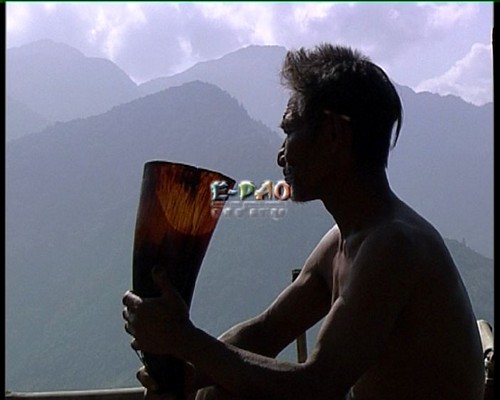
A scene from a Documentary Film by Ronel Haobam - 'The Zeliangrongs'
The structure of Zeliangrong society is based on kinship which is well-knit by clan. The organization of the Zeliangrong community gives due importance to clanhood structure. Clanhood can be said to be the genesis of tribal organization. Uncertainties, myths, legends, and folklores surround the Zeliangrong society due to which the place where the Zeliangrong people have once lived cannot be indicated convincingly. According to the Naga traditional belief, Makhel in north Manipur has been their original homeland. Their coming to present habitat is said to have started with a sudden influx from South-West China to Burma, South-East Asia and then towards the north zone of Manipur.
The cruelty of history and geography caused the identity of Zeliangrongs to lag far behind. Historical incident paved the way for the occupation of the present habitat of Zeliangrong for centuries. It is a common belief among the Zeliangrong people that men and gods once had been living together in the beginning and had a common dormitory which was attended by both men and gods. In the dormitory there was a patriarch deity called Tingpu Rengsonnang who presided over the dormitory. All the social practices, religious ceremonies and functions of men, spirits and animals were said to be administered by the patriarch deity. Then, there was mistrust, misunderstanding and suspicion which led men and gods to conflict and thereby agreed to be separated.
Men and gods were mutually agreed to be parted. Due to the invisibility for men to the gods, the former depended upon the patriarch deity for guidance and consultation pertaining to social, spiritual and cultural matters. The present dormitory system, the sacred ceremonial House Tarengkai and many rites and ritual practices were inherited from the patriarch deity Tingpu Rengsonnang.
The first clan, according to the legend was considered the great law-giver of the Zeliangrong people. Amang/Amangbow, is believed to be from the Pamei clan. The Zeliangrong Nagas lived a well-organised social life based on classless society. The social institution had no conditional consideration of status–high or low, rich or poor–all have equality in every aspect of life. There was no unnecessary social stratification in the Zeliangrong Naga society. Naturally, the elders were respected with special regard by the community members. The composite name of the cognate tribes of Zeme, Liangmai and Rongmei is termed as Zeliangrong which was coined on 15th February, 1947 at the first Zeliangrong Conference with the establishment of the Zeliangrong Council in Imphal. This conglomeration of suffixes of the cognate tribes constituted the nomenclature as Zeliangrong.
Clan structure is the foundation of the Zeliangrong society among the three cognate groups. Owing to the long standing controversy over the identity, Puimei was excluded from the cognate groups. The Puimei complained for the exclusion of its name from the nomenclature and that the prefix of their tribe's name should be added. This controversy had been there for more than half a century. The crisis of identity being faced by the Zeliangrong people has multifaceted ramification in terms of cultural development, social solidarity, economic development and political activities. Prof. B.M. Das and Dr. Roma Chakravarty opined that of the four cognate groups, the Puimei speaks a dialect which is different from the other three but socio-culturally they are same.
It is ethnically true that the kindred groups having different dialects belong to one community. Zeliangrong is a community having four different dialects for each tribe where the difference of each group is more felt by dialect rather than as a separate tribe. Serious deliberations and debates were held on this common issue of identity. In the course of a half century, the four cognate groups developed common written literature and there is a move to have a separate linguistic identity but not separate tribal identity.
The oath taking ceremony Chuk Sumei or Chuk-jag was held on 1st April 1934 at Tamenglong Head Quarters declaring the solidarity and common brotherhood in which elder representatives from the respective tribes of Zeme, Liangmai, Rongmei and Puimei were present.
All the four cognate tribes (Zeme, Liangmai, Rongmei and Puimei) were declared as one people, forgetting and forgiving the past misdeeds of feuds and antagonism and reaffirmed that from then onwards they would help each other and stand united as one for the better future. This oath taking ceremony has been the historic steps towards making Zeliangrong as single entity. Chuk Sumei ceremony was held to withstand against the imminent threats because they had suffered many times at the hands of the Kukis, the Meiteis, and the Britishers. It was the ritual basis of fraternity and brotherhood that constituted the nomenclature of Zeliangrong.
The Zeliangrong society had no account of written historical document but their history was reproduced and reinstated by folklores, myths, legends which had been handed down orally from their ancestors, generation to generation. Their vision on history is limited and revolves around telling the folk accounts of their forefathers' past. Their history is also presented in the folklores, arts and culture, songs, dances, legends, ballads, religious hymns, mythological stories, etc. and they rely on them.
Classless Society: Though the Zeliangrong society is based on clanhood and kinship, it has no class or artificial distinction among the members of the society. They neither have absolute ruler nor king and kingdom. Of course, for all the tribes of Naga there exists one class of society in which all are equal. In other words Naga social system is purely based on justice, liberty, equality and fraternity. There is no distinction between men of different clans, village or communities, between rich or poor, high or low, great or small, master or serf, educated or illiterate, men or women in the matters of status, privilege or rights. Irrespective of clan, community or tribe, anybody can mingle, talk, communicate, sit or work together because there is no such rigid caste systems like that of the Hindu society. Anybody can access to any officials, approach men of high stature. In short, as man is born free, every member of the Zeliangrong Naga Community is free to do, or to hold any position in the society provided he or she is capable.
Racial Features: B.M. Das and Dr. Roma Chakravarty, as alluded by Prof. Gangmumei Kamei, have given their racial composition. Out of the four cognate groups, the Puimei speaks different dialect but culturally and socially identical. In order to constitute a single community status of Zeliangrong the identity is based on the following common features:
(i) common ethnic origin,
(ii) similar historical past,
(iii) common linguistic roots,
(iv) common kinship and social structure and
(v) common cultural pattern.
On anthropological and linguistic bases, the Zeliangrong can be said to be people belong to the Southern Mongoloid who migrated to the North-Eastern India through different routes from South-East Asia several hundreds years ago. Ethnically and linguistically they are grouped as one entity of the Tibeto-Burman (Indo-Mongoloid).
Zeliangrong: An Ethno-Cultural Entity. Some competent anthropologists, after examining the social structure, kinship organization, cultural pattern, linguistic roots and political organizations, have arrived at a conclusion that Zeliangrong is an ethno-cultural entity. Racially, they belong to the speakers of the southern Mongoloid and Tibeto-Burman. According to Sir G.A. Grierson's statement made in his "Linguistic Survey of India", says that all the Zeliangrong languages/dialects belong to the Bodo-Naga Sub-family of Tibeto-Burman.
Pre-Tibeto-Burman elements can also be found among them (the Austric or pro-Austroloid or even Dravidian and Negro elements). They are emotionally attached to their customs and traditions which have rich cultural heritage. This has been reflected in the form of folk dances, music, arts and crafts. They were conservative and culture-conscious people. All the cultural activities were the same among the cognate tribes of the Zeliangrong, except minor variations in dialects, culture, belief, etc.
Origin of the Clan: Naga society is composed of families by the close knit-structure of clan. In order to counteract against any kind of aggression (external or internal) several families united to form a clan. Any clan could be traced back to a single family which had multiplied into numerous families but stayed connected to each other. The clan is believed to have been the continuation of the family unit on the paternal side.
In the Zeliangrong Naga society there are many clans. Some major clans are:
the Pamei,
the Newmei, and
the Gangmei.
These major clans are further sub-divided into many exogamous clans and sub-clans. However, the three cognate tribes-Zeme, Liangmai and Rongmei are sub-divided into different clans with different names and each has a totem locally known as Kagai. Anything that is closely associated with the totem is held as taboo, to that particular clan.
Pamei was divided into lineages like
Kamei,
Phaomei,
Singongmei,
Kamson and
Malangmei.
Newmei was sub-divided into
Gonmei,
Panmei,
Remmei,
Dangmei,
Abonmei,
Thaimei,
Maringmei,
Gonthaimei, etc.
The Gangmei was sub-divided into
Luangmei,
Kamang Gangmei,
Pheiga Gangmei and
Takhao Gangmei, etc.
Kinship: Kinship plays a pivotal role in a family and community life of the tribal. On all important occasions, be it birth, death, marriage, rites and ritual ceremony or other observances each member of the family has individual role to play. Kinship is a covenant bond which is very fundamental for the community members to enable their willing participation in the social intercourse such as worship, celebration, mourning, etc.
The Zeliangrong society could be described as a kin-oriented society. Like other tribes, Zeliangrong tribe also recognizes both types of kinship viz. consanguineous kinship and affinal kinship. Consanguineous kinship comes within the purview of kins related through blood of biological ties and affinal kinship consisted of those recognized through marriage. Both these kinships are separately known.
The Family: The family has been the basic social institution for the Naga society. Generally, most families consisted of husband and wife, their unmarried and minor children. These families are normally nuclear in nature since its core is the married couple. Traditionally, Zeliangrong Nagas have a patriarchal social structure where descendants are traced through their father or forefather. The father is the head of the family. The family usually consists of grant parents, parents and unmarried children. Sometimes, sons or daughters who were married are also allowed to stay with their parents in an exceptional case. Joint family system is common in the Zeliangrong Naga society because they believed that it promotes peaceful and harmonious family relationship.
According to the strict and rigid Zeliangrong custom, the father would stay with his youngest son till his death and the youngest son inherits his father's movable and immovable properties. The eldest son in the family shoulders most of the family responsibilities after the death of his father. The mother also plays a vital role in running the household.
Birth Ceremony: When a child is born, the members of the family used to perform a ceremony by offering rice and ginger lay on plantain leaves to their God. People outside the family are strictly barred from having any casual or physical contact with the family of the new born baby.
Naming Ceremony: Traditionally, in the Zeliangrong society, soon after the birth of the child elders are engaged in the naming of the new born baby. It has been a belief among the Zeliangrongs that in case of delay in naming the child, the god or evil spirit gives a name first to the child and that brings miseries and death of the child. This traditional naming ceremony is locally called Najum Gaimei. Any members could give new names to the newborn child and get it confirmed by elders as per customary practice.
According to McCulloch, the political agent of Manipur, naming of the child begins five days after the birth of the child. Names are not given at random basis but are compounds of their famous father's or grandfather's names or those of other near relations. Ear piercing was literally initiated by an old woman called Kiangja. This ear piercing is associated with a festival called Nah-Nu which falls on the month of February. If a child is born later than February/the festival, then ear piercing ceremony would be postponed till the next February or festival. Ear piercing is performed by a needle or thorn of lemon/orange with a thread attached on it so as to keep the hole open for earrings. The child is blessed during this traditional ceremony by the elders chanting oral recitals which are in accordance with the Zeliangrong traditional and customary practice. This chanting of oral recitals is known as Kasuai-Kadam in local term of the Rongmeis.
Nathanmei (Birthday): Nathanmei is one of the important ceremonies organized by both the rich and the poor. Mostly, this ceremony takes place within the year of the child birth. Some well-to-do families held the ceremony soon after five days lapsed of the birth. But poor families delayed the celebration till two to three years. This ceremony signifies social recognition, acceptance and acknowledgement of the new born baby. People of the village and relatives from different places are invited and performed some rituals which are parts of the ceremony. Invocation of blessings, singing, dancing, drinking and feasting are the characteristics of Nathanmei. A number of bulls, cows or pigs may be slaughtered for the feasting.
Membership Enrolment: As the child grew up and learned to walk, small functions were organized by the dormitory members of the village and gave recognition to the child by including him/her as a new member in their community. Rites were also performed during this ceremony with prayers and offerings made to God. Later, the child even though he might still be a minor becomes full-fledged member of the community.
Related Photo Gallery:
- Scenes from "The Zeliangrongs" : Part 1 :: Documentary Film by Ronel Haobam
- Scenes from "The Zeliangrongs" : Part 2 :: Documentary Film by Ronel Haobam
- Scenes from "The Zeliangrongs" : Part 3 :: Documentary Film by Ronel Haobam
- Scenes from "The Zeliangrongs" : Part 4 :: Documentary Film by Ronel Haobam
To be continued....
* Dr Gaikhamsin Riamei wrote this article for The Sangai Express
This article was posted on January 27, 2013
* Comments posted by users in this discussion thread and other parts of this site are opinions of the individuals posting them (whose user ID is displayed alongside) and not the views of e-pao.net. We strongly recommend that users exercise responsibility, sensitivity and caution over language while writing your opinions which will be seen and read by other users. Please read a complete Guideline on using comments on this website.


