TODAY -

Manipuri in Myanmar
- Part 6-

By: Mutua Bahadur *


Language and script

According to the 1931 census report, two out of every three Myanmarese Manipuri can understand and speak Manipuri language. Manipuri-Kates. Kate-Paonas settled at Yangon, around Mandalay, near Amarapura and Sagaing etc. are not using Manipuri language at their homes. So, most of the youths can no longer speak Manipuri language. Manipuri girls have more capability of speaking Manipuri language than boys.

Most of the Manipuri elders can still speak Manipuri language. A maximum number of Manipuri-Kates, including children and women settled by the Ningthi, can speak Manipuri language. Those Manipuris settled around Mandalay called Manipuri language as Ramon-Ion.

An organization named United Meitei Language and Cultural Group" was established at Mandalay on December 1, 1997 in order to impart lessons on Manipuri language at family level. Manipuri Kate-Paonas settled at Yangon has started to teach Manipuri language at Ram Mandir of Pogodong on a weekly basis. But, it cannot be termed a success story.

Some Manipuris of Yangon and Mandalay can write and read Bengali scripts. Names of temples and slokas are still written in Bengali scripts. One interesting thing is that some elders of Mandalay have started to learn to write their own names in archaic Manipuri script (Meitei Mayek).

When Manipuris departed for Myanmar, they took books on Sagei Yumdaba (settlement of clans), Subika Laishaba (illustrated manuscripts that are concerned with the activities of persons born within the twelve months, the whereabouts loss of properties, a particular day for putting up a house etc). These books are written in archaic Manipuri scripts.

They still use not only those hand-written manuscripts but use transcribed manuscripts also. Slowly, Manipuri Kate-Paonas attempted to translate Subika Laishaba into Myanmarese. Manipuri-Kates of Ningthi did not learn Myanmarese language before the Second World War as they believed that it was untouchable. With the passing of time, they started learning it.

Occupation

From an early stage, Manipuris served as cavalry, foot soldiers, indigenous physicians, carpenters, goldsmiths, rowers and weavers etc. under the patronage of the Myanmarese royalty. Manipuri Kate-Paonas served as purohits (priest) and astrologers. At present, the average Myanmarese Manipuri male and women are engaged in trade and commerce.

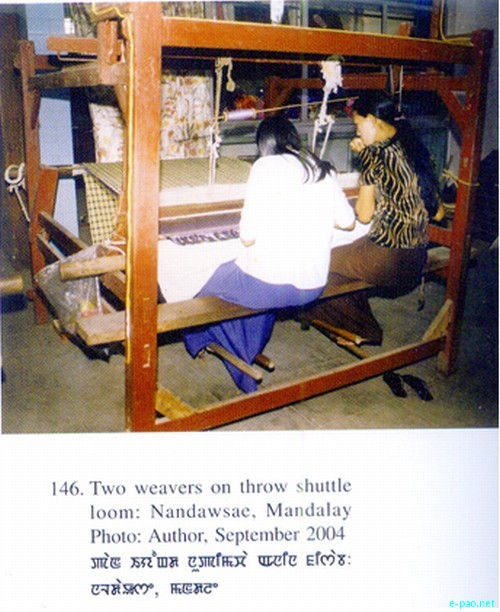
Some men are in government service but some women are found teaching from school to university levels. Women of Nandawsae, Dat Dale, Senga, Latthamar (Kongjengbam Leikai) are weavers, while some male weavers weave plain cloths. Some Manipuri-Kates of Mogok are miners of precious stones. And a large number of Manipuri-Kates settled by the Ningthi do fishing and panning gold from the river bed. Some women of Ningthi bank cross over to Ukhrul district (Manipur : India) and sell clothes and sweets during festivals.

Manipuri textile

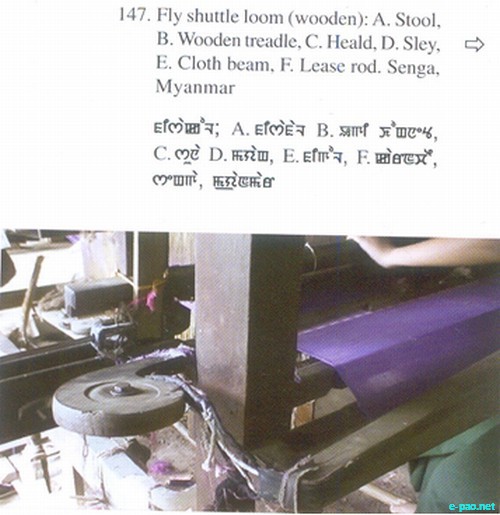
Though the art of textile was already in Myanmar, it developed fast after the Manipuris' settlement there during the 18th century. Manipuri-Kates produced a variety of clothes from khwang-iyong, pan-iyong and fly-shuttle
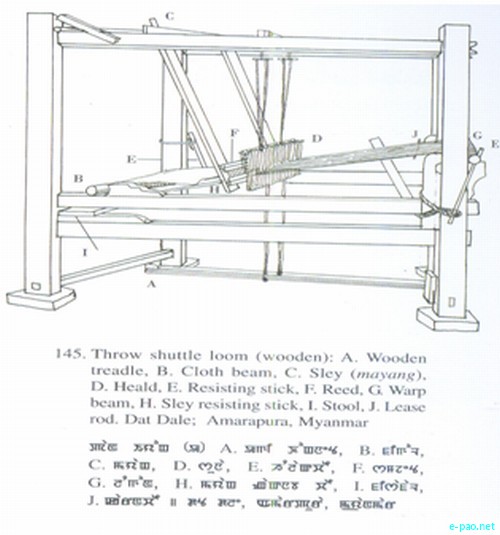


looms. Till 1990 there was the tradition of khwang-iyong. There was a market named 'Zecho' which sold only products of Manipuri-Kates. The word 'zecho' means a market for luxury items and cheap commodities. Usually a Myanmarese will comment like this - "This cloth is fabulous. What is its price?" when she sees a cloth there.

In return Manipuri-Kates give an answer like this - "It costs rupees Rs. 15/- or kyat". In the midst of buying and selling Manipuri language is sometimes spoken. Unfortunately, today, there is no market that sells these products of the Manipuri-Kates.

In Myanmar silk fabrics can be classified into four categories. They are -
i) Bala,
ii) Achiek or Lun
iii) Gaik and
iv) Sat.

The bala fabric is coloured horizontally with colours. The three other fabrics have designs among the horizontal lines. The second one Achiek fabric or lun was introduced by the Manipuri-Kates near Patodas Pegoda near Amarapura in 1775 during the reign of the warrior king, Alungpaya.

The word 'Iun' means spool. Achiek or lun is known as 'lun taya'. 'Taya' means one hundred in Myanmarese language. Since one hundred spools are used in making an achiek cloth, it becomes known as 'lun taya'. During the reign of king Pagan, a cloth, weft woven with three shuttles and having zig-zag designs, was produced before the introduction of achiek. In order to weave these cloths it used silk imported from China. Now-a-days, silk imported from Thailand and Bangladesh etc are also used.
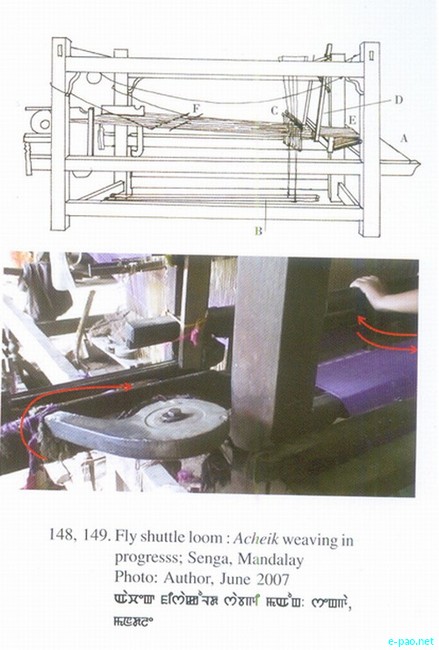


Myanmarese do business crossing the boarder of Manipur. They like the high quality of raw silk of Manipur. Silk-worms were found in plenty in the Kabo valley. Manipur was found growing plenty of silk plants all over the state according to a report of East India Company in 1882. Silk worms where available in its natural condition. Silk textile production started in the second century in Manipur. As such, Myanmarese Manipuri women are skilled in the production of silk textile.

During the reign of king Mindon of Myanmar (1852-1878), achiek was produced by using light shuttles numbering 120. Then there was the trend of increasing the boat-shaped shuttles upto 300 (lun thone-ya) numbers from 200 (lun hanaya) in weaving achiek. Achiek or lun taya. lun-hanaya or lun thone-ya arc silk cloths of high quality.

The designs found in achiek inspire others to use them in other areas. Weavers in the central part of Gangaw and the western part of Arakan started to produce cloths by imitating the pattern of achiek. Weavers of Inle lake and Chithei weavers near Prome and Thabyei Auk of Mandalay can be cited as examples. Lun taya and achiek have continued as the national cloths of Myanmar.

Use of achiek

Achiek longyi or sarong was used by the royalty from early times. Its use by common people was forbidden. Some achiek had been banned for use by them. The green and red coloured achiek were reserved for the king's use only. There is a tradition of using pink- coloured achiek only by the women of the royal family. The other nobles and the rich were allowed using other achieks other than the ones mentioned above.

However, the quality of these achieks must be of an inferior kind. Achiek to be used by the Shan royalty was brought from Amarapura. Classical dancers and married women wear achiek sarong. Different communities of Myanmar from western Rakhein to southern Mon use achiek. Even the middle part of Myanmar also use achiek.
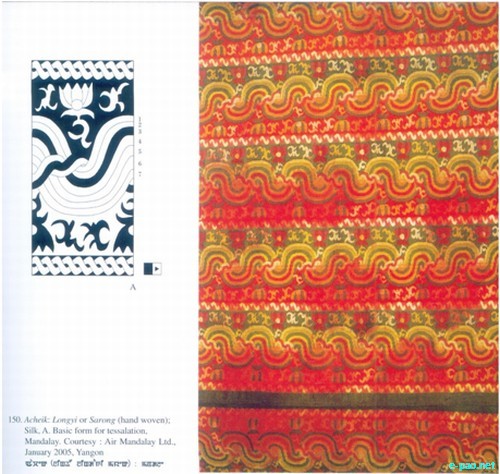


Origin of achiek The meaning of achiek is to connect one another. Some believe that achiek's patterns are found out of zig-zags or ornamental loops. On the other hand there is no vertical design; besides being not embroidered, it can be considered as one based on floral pattern. The design of achiek can be termed as a small rainbow since it has five to eleven layers. Kate women weavers of Amarapura
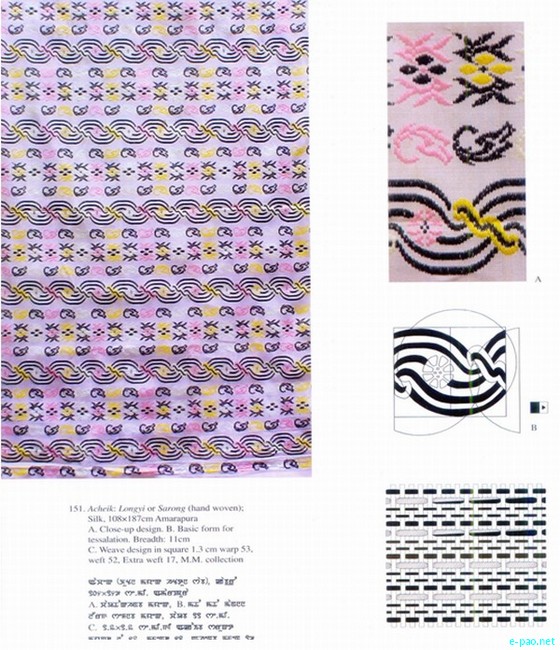
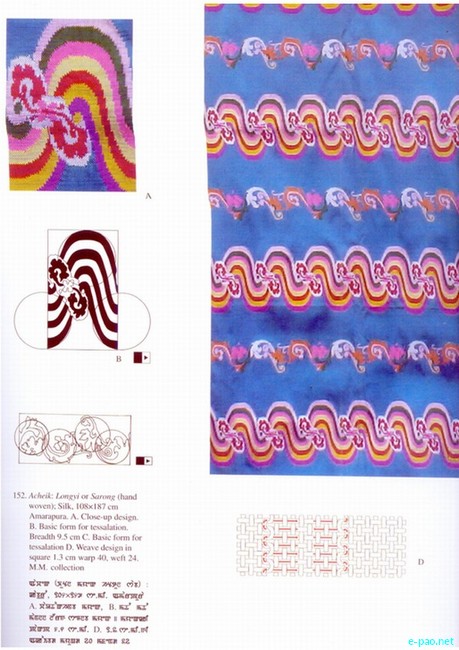
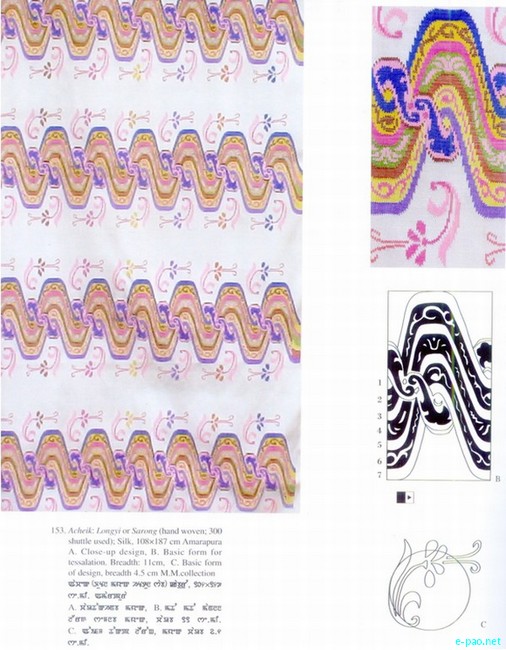
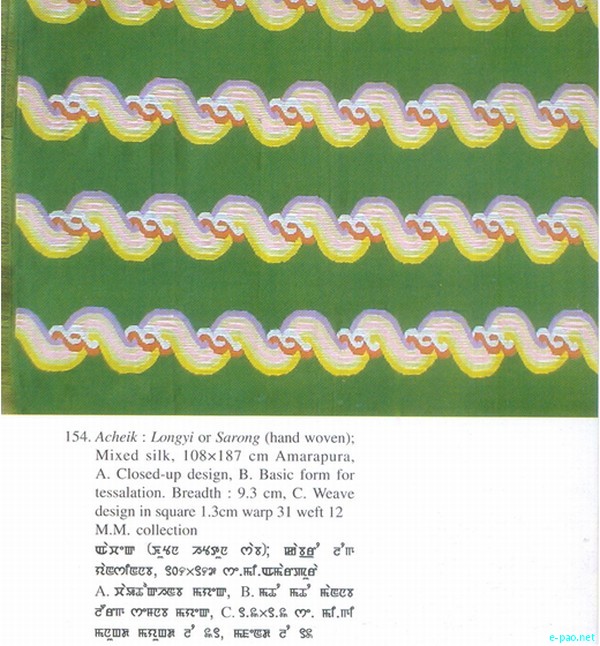
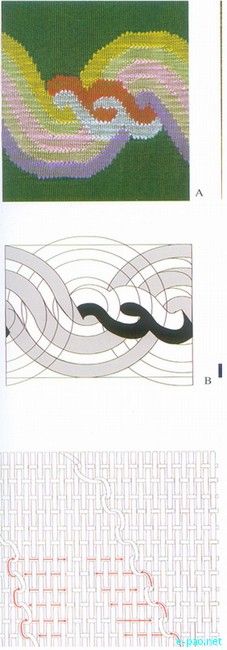


called achiek as thouri-mayek (hind-pin-kyo in Myanmarese). achiek was inspired by the sight of flowers nestled on water waves.


See a gallery photo of Manipur and Myanmar here.

To be continued ....


Mutua Bahadur


* Mutua Bahadur contributes to e-pao.net regularly. This article was webcasted on April 28, 2011.


* Comments posted by users in this discussion thread and other parts of this site are opinions of the individuals posting them (whose user ID is displayed alongside) and not the views of e-pao.net. We strongly recommend that users exercise responsibility, sensitivity and caution over language while writing your opinions which will be seen and read by other users. Please read a complete Guideline on using comments on this website.


LATEST IN E-PAO.NET
  • Moirangthem Chandra's collection of Puyas
  • Violence in Manipur 2023-2026 : Timeline
  • How Insurgent Taxation Shapes Everyday Life
  • 4th National Floor Curling Championship
  • What Manipur conflict reveal about oppression
  • Veterinarian's role beyond treating animals
  • Concern over special security force in Manipur
  • CBSE's Digital Disaster : Future at stake
  • The politics of releasing hostages
  • 'No NRC Update No Census' Rally : Gallery
  • Price of a vote: How debt drives election
  • Guns N' Roses return to India 2026
  • Why are six Nagas still missing ?
  • Seminar on "Media for Communal Harmony"
  • Parties should have cockroach wing
  • Education :: Poem
  • Leaving border villages to their own fate
  • Yaoshang Mei Loukhatpa #3 : Gallery
  • Ibempishak, Moingpha, Thansomi : Eming
  • Showcasing Manipur @Switzerland : Gallery
  • Criticism Without an Alternative is Not Enough
  • Arambam Somorendra: A Visionary
  • A Little Bird and My Net :: Poem
  • Meritorious Award distributed at Singjamei
  • 'Experience LPU- Day of Lifetime Inspiration'
  • Increasingly seen as being partisan
  • The Lament of a Silent Tree
  • Behavior, Psychology & Society
  • 1st Peaceful Coexistence Award 2026
  • Snakebite: A Public Health Emergency
  • Events- Kuki militant & Naga village volunteer
  • A spiral of violence and turmoil :: Poem
  • HSLC Compartmental Exam 2026
  • World Environment @Lamdeng #1 : Gallery
  • India Isn't Becoming a Superpower
  • World Environment Day @ MU
  • World Environment Day @ Moirang College
  • CM @ World Environment Day
  • World Environment Day - For nature
  • Where there is no vision, the people perish
  • Mosquitoes returning in March
  • Fractured Forever :: Poem
  • Waking up to yet another killings
  • Ahingee Laan : Dance-drama #2 : Gallery
  • Tree Plantation @Taobungkhok : Gallery
  • Violation of SoO can lead to termination
  • Application of AI in livestock production
  • Mass Cleanliness Drive @MU
  • Anupam Andhar: Beauty of darkness
  • Feeling the heat? It might be ageing you faster
  • Missing since May 13, 2026
  • Abdul Hafiz graveyard at Imphal War Cemetery
  • Homecoming : Exhibition at Washington DC
  • Why NSCN-IM & ZUF must preserve Naga
  • The Funeral of Kindness :: Poem
  • Dignified menstruation for gender equality
  • World Environment Day 2026
  • Welcomes New DGP
  • Coming together of the indigenes
  • Martyrs' Day @ Cheiraoching #3 : Gallery
  • Showcasing product from IDPs at Switzerland
  • The abduction & 'murder' of 6 Naga civilians
  • Why keep returning to Regional Politics ?
  • One missed coffee & a full existential crisis
  • Trekking, Camping banned in Nongmaiching
  • Avocados Cultivation Programme at Pangin
  • Guwahati Open PWR 200 concluded
  • Focus on flip flop stand of the UNC
  • The King Who Came from the Sky: Pakhangpa
  • SoO : An assault on native people of Manipur
  • Manipur - Example of Underdevelopment
  • Cries in Agony :: Poem
  • 'CCpur & Kpi Road no longer safe'
  • Home Ground: Meghalaya Future of Tourism
  • Burnout healthcare staff & patient safety
  • Fate of hostages : Flip of the coin ?
  • Chakan Gang-Ngai 2026 : Ooba Video
  • Unfinished requiem- Linthoingambi & Hemanjit
  • "Ningol Van" Launched at Taobungkhok
  • Calm reflection vis a vis brute violence : Poem
  • Foundation Days of States/UT
  • World No Tobacco Day 2026
  • Breast Cancer Awareness in Guwahati
  • Licensed to create mayhem ?
  • How to Break Manipur w/o Breaking Any Laws
  • 17th Manipur State Film Awards (MSFA), 2025
  • World We Make, World That Makes Us : Poem
  • Counting Right, Voting Right: What SIR means
  • Calls on Indonesia to ratify tobacco treaty
  • Honourable exit for Ashutosh & Kailun
  • Police Museum at 1st Manipur Rifles
  • Eid-Ul-Zuha @Sangaiyumpham : Gallery
  • June Calendar for Year 2026 : Tools
  • 16th Manipur State Film Awards (MSFA), 2024
  • KIM's proposed rally must be called off
  • International Menstrual Hygiene Day
  • Plants : The force that engineered Earth
  • AC: How does it affect the skin ?
  • Onslaughts at Ukhrul district
  • Lhangpat Mei @Keishamthong #2: Gallery
  • Anthem of Switland :: Poem
  • CM visits Makhan Naga Village
  • Manipur University needs fresh air
  • False Narrative on Killing of Thadou Christian
  • Summer Coaching Camp 2026 @NSU
  • Tribute to Pu Mangvung Paokholun Haokip
  • Incursion from across the border
  • Radio E-pao: 5 new songs updated
  • Manipuri Community in Assam Calls for Vision
  • School dropouts & never-enrolled children
  • M. Tech at Assam University
  • Under One Sky or Leased ? :: Poem
  • When AI speaks in tribal languages
  • 'The Unbecoming' makes Northeast debut
  • After crossing the three year mark
  • Cheirao-chingkaba on Cheiraoba #2: Gallery
  • Anoi Group Art Exhibition 2026 : Download
  • Exploring Hyderabad's Museums #1
  • Maharaja Garib Niwaz : Manipuri civilisation #4
  • IEC Campaign at Willong Khullen
  • World Emergency Medicine Day 2026
  • Liver & GI super-speciality clinic
  • Adding more muscle to State Police
  • Rally at New Checkon- May 25 : Gallery
  • Hritwika Majumder at Miss Grand India 2026
  • How social media fuels division & ethnic tension
  • Saving Manipur's vanishing paddy & wetland
  • Helpline for Thadou people
  • 477 new Manipur Police Vehicles
  • NDPP-NPF merger accepted by ECI
  • Seeking to pitch Nagas against Meiteis
  • 63rd Mr. Manipur #3 : Gallery
  • Why CJP resonates with Manipur's youth
  • A moral, humanitarian reflection on violence
  • Financial assistance to IDPs
  • Legally binding treaty for older persons
  • Zoonotic Disease : Link animal & human
  • Jealous of Meloni
  • Making the bodies disappear !
  • Yaoshang - Cooking Competition : Gallery
  • Manipur State Award for Literature 2024
  • Manipur's unresolved Political Journey
  • 'Kuki is not an ethnic name'
  • Miyawaki Plantation Experiment at Langol
  • A Ploy to Keep the Chasm Wide Open : Poem
  • 45th Water India Expo 2026
  • Beating of the Retreat #1: Gallery
  • Martyred Rev Dr Vumthang Sitlhou
  • When Ima Weeps in Silence :: Poem
  • International Eld's Deer Day
  • Sticking to a consistent narrative
  • Arms recovered from Lamdeng: Gallery
  • Exploring Kolkata: College Street #1
  • Wetland grabbing, hydropower, & ecologies
  • Condoles Demise of Khangembam Kuleswar
  • Upgradation of Imp-Jiri road: Poor planning
  • IEC Campaign at Phaibung, Senapati
  • In a mess for over 3 years now
  • The King Who Built a Golden Bridge : Kyampa
  • Mother's Day at Pukhao : Gallery
  • Manipur in India Constitutional Transition #3
  • Satyajit Ray's universal language
  • Decoding MLR & LR Act, 1960 & Article 371C
  • National Endangered Species Day 2026
  • India-New Zealand step into a new eco league
  • Posers over fate of abducted 6 Naga men
  • Sit-in protest @Kanglatongbi [May 18]: Gallery
  • Why communities must abandon hostility
  • Apatani's Next Top Model @Arunachal
  • The Fog of Uncertainty :: Poem
  • IEC Campaign at Song Song, Senapati
  • Supports TIM Proposal for Thadou-Naga
  • NE's Largest Psychiatric Hospital
  • Triangular clash underway in Manipur
  • Lamjen @ Thangjing Haraoba #1: Gallery
  • From Sympathy to Supremacy :: Poem
  • History repeats itself
  • Church Teams to visit Kangpokpi & Senapati
  • Workshop on Analytical Chromatography
  • Criminal Neglect, Terror Shielding
  • Summer make-up tricks to beat the heat
  • Pulling the strings to block the highways
  • Manipur Art Festival 2025 #3: Gallery
  • Manipur fermented food & scientific recognition
  • Seminar : Development of NE Region
  • Cheiraoba Chak Katpa #2: Gallery
  • Maharaja Garib Niwaz : Manipuri civilisation #3
  • Yumjao Lairembi Haraoba #1 : Gallery
  • Manipur in India Constitutional Transition #2
  • Sit-in protest @Kanglatongbi [May 14]: Gallery
  • Int'l Triathlon Yengkhom Suraj felicitated
  • Colonial Knowledge Production in NE #22
  • Condemns Killing of Thadou Church Leaders
  • Candlelight Vigil @ Bangalore #2 : Gallery
  • Maharaja Garib Niwaz : Manipuri civilisation #2
  • The Green Foundation recognised as a SIRO
  • Waithou Rally condemn civilian killing: Gallery
  • Chahi Taret Khuntakpa
  • HSLC Exam 2026 : Full Result
  • HSLC Exam 2026 : Pass % : Govt Schools
  • HSLC Exam 2026 : Pass % : Aided Schools
  • HSLC Exam 2026 : Pass % : Private Schools
  • HSLC Exam 2026 : Withheld-students
  • HSLC Exam 2026 : Compartmental candidates
  • HSLC Exam 2026 : Statistical Abstract
  • HSLC Exam 2026 : Important Information
  • Chandel District Head Quarters : Gallery
  • Indigenous Leaders Call for Global Recognition
  • Subika Art Exhibition @Washington : Gallery
  • Vegetables @ Waithou Keithel #2 : Gallery
  • Conflict, Displacement in Manipur (2023-2026)
  • Tronglaobi: 2 children laid to rest : Gallery
  • Martyrs' Day @ Cheiraoching #2 : Gallery
  • Featured Front Page Photo 2026 #2: Gallery
  • Free Online access to 'Asangba Nongjabi
  • Candlelight vigil: Killing at TM Kasom : Gallery
  • Fractured sovereignty : Proxy war
  • Mama, I love you- Then the world went silent
  • Khongjom Day @ Khebaching : Gallery
  • Final Merit List : Manipur Civil Services 2022
  • HSE : Pushpa K, H Keniya, P Taibangnganba
  • Yohen Longjam : HSE 2026 : Science Topper
  • Sarangthem Ayingbi : HSE 2026 : Arts Topper
  • Thoihenba Thongam : HSE 2026: Commerce
  • HSE 2026: Science Full Result
  • HSE 2026: Arts Full Result
  • HSE 2026: Commerce Full Result
  • HSE 2026: Pass % - Govt / Non Govt
  • HSE 2026: Pass % - District Institutes
  • HSE 2026: Subject-wise Pass %
  • HSE 2026: Candidates securing Highest Mark
  • HSE 2026: Science Topper List
  • HSE 2026: Arts Topper List
  • HSE 2026: Commerce Topper List
  • The great Manipur betrayal
  • Most Heinous Murder: Derailing Normalisation
  • Martyrs' Day @ Cheiraoching #1 : Gallery
  • Killing of 2 children @ Tronglaobi : Gallery
  • Yaoshang Thabal Chongba #2: Gallery
  • Boong: India's 1st BAFTA in children's cinema
  • PUCL Tribunal report: A shadow of partiality #3
  • PUCL Tribunal report: A shadow of partiality #2
  • PUCL Tribunal report: A shadow of partiality #1