

Thawai Hakchang Khainaba- Shiba
( Death Ceremony )
By: N Mangi Devi *
According to Meitei Puya Shiba is known as Thawai Hakchang Khainaba. Yaibi Thawai (Soul/Spirit) has no death, what dies is the body. When the Thawai leaves the Hakchang (body) the moment is called Shiba( death). Not only the Meitei but also other hill people accept two ways of death that is (1) natural death (2) un-natural death.
People think that natural death is good while un-natural death is bad. Death caused to illness and old age is natural whereas death by suicide, falling from tree or high place getting drowned in water or killed by animals, death by fire shots and shooting and accident on roadsides are un-natural. The process of natural death is elaborate and lengthy while that of un-natural death is short. Death ceremony is called in Meitei society "Pot-Loiba " finishing of body elements i.e. fire, wind, water and earth).
Accordingly there are four kinds of Pot-Loiba
(1) Nungshit Pot - Loi-leaves or end to the wind
(2) I-sing Pot-Loiba -throwing into the water
(3) Leipakki Pot-Loi- burial in the ground and
(4) Meigi Pot-Loi-burning in the fire.
The third and four kinds of Pot-Loi are commonly used in Manipur both in plain and hills.
It is said that the burning of dead body by the Meitei society started from the time of Pamheiba/Garibniwaj in 1709-1748 when he accepted the Hinduism before that both the people of the plain and hills used to bury the dead. Whereas there are other opinion that about 2000 year back the people used burning of dead body as mentioned in the book on "Poleiton Khunthokpa " as Poireiton saw the smoke of burning of the body at the time he looked for settlement at nearby hills.
One thing that can be noted regarding it is that the people of ancient Meitei who settled in Andro, Sehnai, Laimaram, Phayeng and Koudrukhave the convention of burning the bodies after dead. Bathing of dead body and dressing it up, keeping a bundle of raw rice and money coins, other clothing of the bedding besides the dead body and singing of prayer to God have been performed at time of death from early times.
The dead body is put into a wooden coffin and the head is turned on the north and covered with a white clothe. It is then kept in a hut made of bamboo and grass on the south-eastern side of the courtyard. It is rounded by long clothes on all four sides just like the wall of the house.
The place where the temporary hut is made for the deceased one is known as "Khang-ngelpham " It is a very good convention of the people of Manipur both in the plains and hills that a prayer has always been "performed for the dying one indicating the way to heaven or to God. A Maiba (physician) is always in the house to look after the dying one and feel the pulses movement when the Thawai (soul) leaves the body. These Maibas are well trained and their predictions of the time of death are found mostly accurate.
A word or two of how to carry the coffin is given. The feet has to be brought out first while carrying the dead body by four persons/relatives up to the courtyard. They will go round three times. The body is taken to the cremation ground led by the prayer group/ singers then Amaiba then the man who carry the fire-pot and the third one who hold raw-thread or cotton.
If possible the thread will be spread on both sides of the procession or otherwise drop pieces of cotton while going to Mangpham (cremation ground) whatever things used by the dead person will be put into the coffin and burn into the fibre. The drumming of drum (pung) and clashing of cymbals by the singers are in practice while carrying the dead body.
How to make Mang (cremation spot) if the compound of the house is big enough, there can be prepared a Mang in itself. Yet generally, it is prepared far off places of the villages near either the river or the pond. It is written in "Cheitharol Kumbaba" that the making of Mang (cremation spot) far beyond one's living places had been started from 1676 when Iningthou Paikhomba reigned.
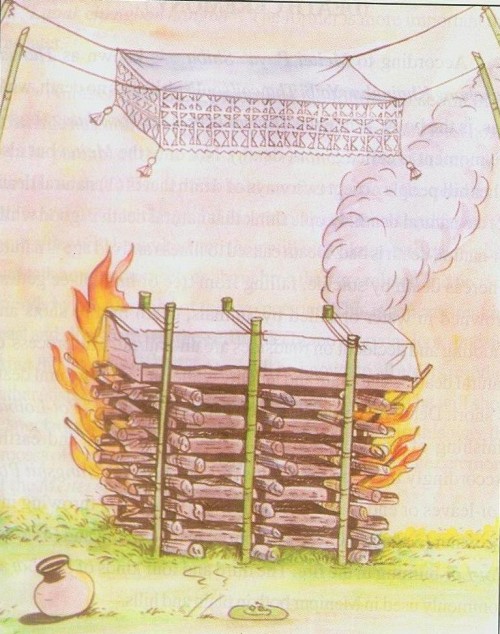
A coin is thrown on the cremation spot to purchase the place for the dead person. On the other hand it also shows that the evil spirits have been driven out from that place to perform the cremation of the dead person. The place will make clean and then six bamboo sticks will be fixed on the ground in parallel position three on the east and three on the west facing each other. Seven fold fire-wood counting from the ground piled one by one above the other is arranged. It represents seven days in a week. Seven is a good number in Meitei convention.
The wood known as "Singaibak" even though it is less it will be assumed that it is 61 (sixty one) in number. The meaning of it is that the human body is made up of 61 Langpum (nerves) as it is believed that one "Singaibak" represents one Langpum of the human body'.
Here it is desirable to mention 64 hand movement of the dance of Umang Lai Haraoba that is related with the creation of the human body. Out of 64 hand movements the first one shows prayer at the navel point, the second indicates the whole body and the third prays for the grace of the Almighty God (Shidaba Mapu) Thus the remaining 61 is to make-up the human body.
Why the head of the dead person turns to the north is for a belief that the KOUBRU is the central point of the head (Lernphu), KANGLA is the navel point (Khoidou) LOKTAK is the sexual reproductive point (Phambi) according to Meitei mythology.
The six bamboo poles paralelling on the east and west will be bounded together by thin bamboo threads (payas). Binding above the breast represent the fire ,that of the navel point and on the legs indicate the wind and water respectively. A fan will be made by a yangkok (winnow) with a handle to fan the fire while burning the dead body.
Four poles of small thin bamboo plants will be put on the four sides of Mang (cremation place). It is believed that each pole represents the four God of four directions, Thangjing, Marjing, Wangbrel and Koubru. Above the four poles a white canopy with a beautiful design will be hung by strong thread.
The preparation of this arrangement of Mang (cremation spot) will be ready by a group of the people of the locality while the essential rites of the dead person are being performed at the courtyard. There is a practice of contributing a fix amount of money from every family of the locality/village of the dead person for purchase of fire wood. This is known as "Singlup".
When the coffin (Ku) passes the gate the Amaiba will shout that the gate is opened and will say the name of God and again when it leaves the gate the Amaiba will shout that the gate is closed. And Amaiba Ipriest purifies the Mang by sprinkling water with taireil/ pungphai/tulasi leaf and carrier of the coffin (Ku) will go round three or five or seven times of the prepared "Shing " and will place the coffin (Ku) above three-fold wood.
Then the next step is the "meikoiba" and prayer to Fire-God to end the body of the dead person. The fire has to be brought from the house in a small earthem pitcher and the Piba (the eldest son) of the house has to bring an earthern pitcher with water who will lead the Mei-Koiba. Others will follow him. The water has to be fetched from the nearby pond/river and not from the house.
The water pitcher has to be placed on the left shoulder and some water has to be dropped at each four corner of the mang-shing that will go round seven times. His right hand will take the prepared torch of the fire-wood and will lit the fire from the south- eastern corner (on the side of the legs of the dead person). One should note that the going round the dead body will move from the left side and is just opposite of the marriage ceremony of going round the bridegroom from the right side. The relatives will follow the leader in litting the pyre. The actual performer of this rite is the first son or any representative and others are helping him.
When, the burning fire starts the four poles on four sides with the canopy (thakal) will got pulled down and thrown into the fire. When the body is almost burnt one can take a bone from the forehead and put it at a safe place near the creamation spot. On the fifth or sixth day there is another ceremony known as "asthi shanchoy " on that day the bone will be taken out in a new cloth and brought back to the house for essential rites to follow.
The bone of the dead person may not procured if one does not like it. In the early days the bone has to be thrown at a sacred river like chingoi turel (river) or to finish it at the Koubru Hill The Hindu Meitei takes it either to Nabadwip or Brindavan or Radhakunda or any other sacred place of the Hindu and performs the simple rite of immersion as they like. After the completion of the burning of the body the remaining ashes will be mixed up with the mud and made a small mound.
The Amaiba or the known old man will recite some sayings from scriptures and pray to God to give peace to the soul, live happily at the feet of the Almighty. Then they will throw plants seed generally of mustard plant seed as it grows soon above the elevated ground. A small pitcher with a little hole below it is hung on.
Some water may be poured into the pitcher to make grow the seed when simple daily rites are performed on that place upto the last day ahead of the Sraddha ceremony of Lanna Thouram. Then an elderly person will draw seven lines by a sword/ chaku/thang counting in an ascending manner from the day of the death of the person.
That is known as Mang Thong-Thingba (closing of the door of death) and the dead person will be entrusted to the last person who died in the locality. The meaning of Pot-Loiba is the ending of four elements of the body, i.e. fire, wind, water, and earth. All the persons who have joined the cremation will wash from the head to the toes at a nearby pond or river and then at their respective gate of the house they will be purified with fire and then sprinkled with the water of tulasi leaf or tairel change their clothes. Thus includes the cremation.
|
The process of cleaning and purification of the house follows. The household articles especially for the kitchen are washed and cleaned . The breakable utensils used in the kitchen will all be broken and thrown away from the house. The house is purified with Tairel or Tulasi leaves whichever may be. Daily at the afternoon there is a convention of recitation of holy events, of the instruction of birth and death, through narration according to the scriptures by the experts from holy books.
This practice is for members of the family and others of the locality to listen and share the sorrow of the bereaved family. This had been done from the very early days in the Meitei society. After accepting the Hinduism the stories of Sri Krishna and Bhagavatham has been in use by the Hindu Meiteis. Either on the 5th day or 6th day of the death there is another performance of rites that is known "Leihun Thouram" to traditional Meitei or "Asthi Sanchoy" to the Hindu Meitei in which the songs of prayer are invariably sung by professional persons with pung (drum) and cymbals.
It will be interesting to note that in the Meitei society groups of special persons are hired from the next day of the death up to the end of "Lan-na Thouram " or Sraddha ceremony to do all the necessary services for all these days. They are the manager or arranger of the whole function. These groups of people are known as "Alangpham " who have been trained from generation to generation by the elders of the locality in such services for the functions and ceremonies whichever may be say, marriage death etc. They are professional, and are well paid at the end of the functions by the owners.
The most important and the biggest ceremonial function of the death is called "Lan-na Thouram" or "Sraddha " that is performed either on the lltn or 13th or 14th day from the death whichever may be as being done either by the Sanamahi Laininglup or Hindu Meitei. One day ahead of the function a lantern has to be lighted all the times at the altar of Sanamahi Lainingthou praying to guard off the hindrances of the function and grace the family.
For this function the professional singers are hired. Special clothes and moneys are offered as gifts to all the singers starting from the two drummers (pung-yeiba) by the owner, relatives and friends and invitees when they feel to offer at the rhythm of the song. Before starting the song or the sankirtana, the performance of rites and rituals oilratphu and Phambal are done by the Amaiba which has been replaced by Ghot and Bhagavad Puja by the Hindu Meitei.
An altar on southwest of courtyard on Mandop is invariably made for the Lainingthou Sana-Mahi and an elderly known person will sit there and who will announce the starting of the prayer song for the function. This particular person is known as "Mandop-Mapu " who will be a Brahmin of the Meitei Hindu. He is the person who will announce the beginning of the prayer song with the words "Hari-Haya-Hayum or Hindu prayer words whatever may be.
It is essential custom to display nicely arranged fruits and betelnut with leaf offer ring to God at the very middle of Mandop. Then the Arangpham will distribute the clothes to all participants and the owner of the function (house) will follow to pay obeisance by offering the money gift to each of them. Such prayer song is all about the soul, how to be with the Almighty God and be peace and happy of the soul.
There is a custom of keeping a pitcher with a seat to sit on, now-a days it is replaced by a chair on the left-east corner of entrance of the Mandop. Those who have come to attend the function will be purified by the Nahaiba at early days. But now-a-days it simply bowing down as it is believed that Siva Mahadeva guards the sankirtana.
There is also a custom of helping breaved family by the money gift by all the invitees who have come to witness the function. This giving or helping with money is called "Potyengba " for the function. Another interesting custom is to display beddings, and daily essential articles for the dead person at a suitable place of the Mandop. This is known as Sheijya.
If the dead person accepts the renouncing order of death the articles are simplified with some bare necessities only. When the prayer song is about to complete there is distribution of packages of eatables to all the participants of the sankirtana and all invitees with small money gift say rupees five or ten notes that is called Dakshina.
At the end of the prayer song or sankirtana all the members of the family will bow down to the sankirtana with a prayer for the peaceful settlement of the dead soul. Thus the function of Lan-na-Thouram or Sraddha is over.
Every month on the day of the death, there performes an offering to God and feeding of the relatives and friends up to the eleventh month and on the twelve month a bigger function of ceremonial rites and grand feasts are performed. The relatives, friends, neighbours are invited to this function to have the Prasadam of the God. This is known as "Phiroi". This is the last and final ceremony of the dead person.
* N Mangi Devi wrote this book entitled "Main Ceremonies of Meitei Society . This article was webcasted on December 22nd 2009.
* Comments posted by users in this discussion thread and other parts of this site are opinions of the individuals posting them (whose user ID is displayed alongside) and not the views of e-pao.net. We strongly recommend that users exercise responsibility, sensitivity and caution over language while writing your opinions which will be seen and read by other users. Please read a complete Guideline on using comments on this website.


