


The EKKA-GARI in Manipur : A personal historical narrative
Debabrata Roy Laifungbam *

Binodini on bicycle; india ink on paper :: Robin Wahengbam (21 January 2012)
A bicycle, also known as a bike, pushbike,
pedal bike, pedal cycle, or simply “cycle”.
Bicycles were introduced in the early 19th
century and now believed to number about
one billion worldwide, twice as many
as automobiles. The bicycle is known as
“ekka-gari” in Manipur. The story of the
ekka-gari in Manipur can only be personal
one, as there are no official historical records
accessible. As a young boy, my father bought
me an ekka-gari in 1970 while I was still in school. It was a Humber bicycle, a nupa gari and there is
an interesting episode about how my younger brother and I ran away from my father’s house on the
bicycle. But it may be not the appropriate time to tell about it.
My first schooldays! I remember my father’s Kabui aide, Ta-Lungjei taking me every day on his
cycle to Little Flower School at its old campus at Nirmalabas. He used to wrap a thick cloth around
the top tube of his nupa-gari so I could sit on it comfortably along the around 2 KM ride. Sitting on
the top tube, I found it very comforting that my two feet could rest on either side of the small
shoulder on the housing to the handle-bar stem. Lungjei hailed from Kakhulong Village and he
looked after my outdoor and play needs as a small boy whenever he was free from his official duties.
I remember him helping me make my first bow and arrows. Ta-Lungjei’s old Humber was the first
bicycle I ever rode, and I shall be always indebted to him for taking me to my first school every day.
I have always wondered about the origin of this name “ekka-gari”. The term originated, I believe, in
Bengal from the Mughal times. The Ekka Gari is a horse-drawn passenger cart, a popular and cheap
mode of transport readily availed by everyone in those days. It was also called an “Ekka” in short
form. So how this name came to Manipur in the form of a bicycle is a mystery. It’s a small historical
vignette that is better left to others to imagine.
To get on with my story, I recollect one that was told to me by the nonagenarian educationist and
thinker, Hijam Romoni of Yaiskul. Baba or “Father” Romoni, who is 92 years old today, is the
endearing name for him in our Leikai. He is the son of Manipur’s prominent poet, dramatist and
litterateur, Hijam Anganghal. He told me that when he was a young teenager, about 15 years old, he
used to see my mother Wangolsana (Maharaj Kumari Binodini Devi) come to Yaiskul on a bicycle to
visit her mother’s natal home and family. Her “mami” Maharani Ngangbi called Dhanamanjuri Devi
maintained an elegant bungalow-type house next to the traditional long house or yumjao of her
younger brother, Ngangbam Shyamkishore Singh. As the queen, Ngangbi’s movements were
restricted and monitored by the British authorities but visits and short stays at her home in Yaiskul
were permitted. This was the house where she would retire to meet her old friends and plan cultural
events. Her daughters were familiar in Yaiskul as they would come with Ngangbi and also used to
frequent on their own too. Wangolsana, the youngest daughter of Ngangbi, tagged along with her
older sisters.
Wangolsana, who was about 14 years and studying in Class VIII or IX at Tamphasana Girls’ High
School, was the first woman to introduce the “lady’s cycle” in Manipur. According to Baba Romoni,
during one of her visits in 1936, he asked her if he could ride it for a while. She readily agreed as
Baba Romoni’s two elder sisters were her close friends and classmates in school, among the
pioneering girls’ Matric batch of Manipur. It so happened that the young lad got quite carried away
by the novel bicycle and went off roaming all over Imphal. He returned quite late in the afternoon to
face an irate princess, and got quite an earful.
Describing this bicycle, the first
lady’s model safety bicycle to be
seen in Manipur, Baba Romoni says
that it was an original British make
“Raleigh”. It had an elaborate metal
grill guard that covered the rear
wheel to prevent the lady rider’s
clothes from becoming entangled.
While telling me the story again, he
ran off youthfully to get a pen and
some paper. He enthusiastically sketched it for me. He told me that the world of the bicycle portrays
the fun of life; it has the capacity to carry aloft the joie de vivre of people and become the very ethos
of the lofty spirit of freedom.

Baba Romoni's sketch of the Lady's bicycle
The safety bicycle gave women unprecedented mobility, contributing to their emancipation in
Western nations. As bicycles became safer and cheaper, more women had access to the personal
freedom they embodied, and so the bicycle came to symbolize the New Woman of the late 19th
century, especially in Britain and the United States.
The bicycle was recognized by 19th-century feminists and suffragists as a “freedom machine” for
women. American civil rights leader Susan Anthony said in a New York World interview on 2nd
February, 1896: “Let me tell you what I think of bicycling. I think it has done more to emancipate
women than anything else in the world. It gives women a feeling of freedom and self-reliance. I
stand and rejoice every time I see a woman ride by on a wheel... the picture of free, untrammeled
womanhood.” Young Wangolsana on her safety bicycle, perhaps, embodied the New Woman in
Manipur!
The bicycle was a very rare thing in Manipur in the mid-30s. Very few could afford to ride one or
own one. There were no shops to sell them and every bicycle had to be imported from Calcutta.
There were a few British girls, daughters of high officers of the Raj, who rode a bicycle in Shillong
those days. Perhaps Wangolsana saw them and requested her father, the Maharajah of Manipur, to
get one for her.
The story of Wangolsana’s bicycle evoked some thought for me. It was a time for Manipur when all
the roads were of mud; there were no metaled roads then. A young girl, a princess, riding around on
a bicycle alone fearlessly in Imphal in the 30s reflects the freedom enjoyed without gender bias in
Manipur by the youth in those days. To me, a teenage daughter of the Maharajah without any
security escort also displays the egalitarian and safe society we lived in, though the bicycle was
certainly a status symbol. Only a few officers and persons of high standing could afford to import a
bicycle from Calcutta.

Cycles are seen in the late 40s at the South Market Manipur
By the late-40s, after the devastation following the Japanese bombing of Imphal, the bicycle had rapidly become a more common form of individual transport in Manipur. Early photographs and stories of those days include the cyclist and portray the fun of cycling. An early photograph taken an enthusiastic amateur from Yaiskul, Ayekpam Gourakishore Singh, around 1947 is captioned by the photographer himself as “South Market of Manipur”. The south market or “Makha Dukaan” is known today as Paona Bazaar. It was set up in the Indian bazaar lay-out style by Major Horatio P. Maxwell, the British chief administrator of Manipur from 1891 till the turn of the 20th century. The cycle became a ubiquitous household object of pride in Manipur.

Dynamism of a Cyclist
The cycle, when it became popular, inspired art and fashion too all over the world, and quickly became a cultural symbol. This painting of the "Dynamism of a Cyclist" painted in 1913 by Umberto Boccioni demonstrates the Futurist interest in film. Borrowing from Cubism, the Futurists were interested in the dynamics of speed and the simultaneity of the image in motion. Boccioni also created sculptures, which attempted to free the object from its traditional status, creating instead, a fluid medium infused by technology and raw energy. The cyclist, to Boccioni, embodied the fusion of technology and raw energy in a medium of balance and elegant fluidity.
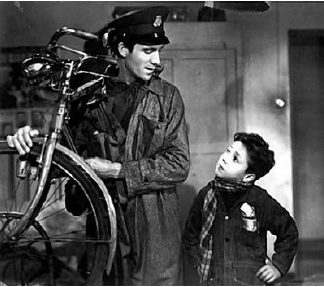
A scene from the movie 'Ladri di biciclette'
The bicycle also inspired film as we see in the classic neorealist black and white story of 1948, Ladri di biciclette (Bicycle Thieves or The Bicycle Thief), by the celebrated Italian filmmaker, Vittorio De Sica. The simple story revolves around a bicycle that gets stolen. The “stolen bicycle” is an enduring motif that is integral to the bicycle. Holland, a small country in northern Europe is well known for its bicycles on the streets and homes. The Dutch are very fond of riding on a bicycle, even the Queen of Holland moves around on a bike. In Holland, all train stations are equipped with provisions for bicycle parking for free or a more secure parking place for a small fee and the larger ones also with bicycle repair shops, and cycling is so popular that the parking capacity is sometimes exceeded. When I was there for a year pursuing higher studies at the Royal Tropical Institute, I must have bought over eight bikes. My cycle kept getting stolen from me. It is a very common experience of the bicycle. In Holland, one is often accosted in the street by a bicycle thief who wants to sell a bike to you at a knock-down price. It may have happened that I bought my own bike more than once from a thief.
Celebrities are often photographed on the bicycle. Albert Einstein, the Beatles (George, Paul, John, and Ringo), and Audrey Hepburn who was a Hollywood icon for her beauty are among many others to be photographed on a bicycle. The Wright brothers who pioneered flight were in the bicycle industry originally. The cycle also became a political statement. Politicians are also seen photographed by the press on a bike.
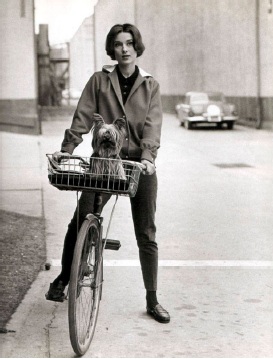
Audrey Hepburn on Cycle
The narrative of the bicycle pervades every nook and cranny of our daily lives and society. Interestingly, experiments done in Uganda, Tanzania and Sri Lanka on hundreds of households discovered that a bicycle can increase the income of a poor family by as much as 35%. Transport, if analyzed for the cost-benefit of rural poverty alleviation, has given one of the best returns in this regard, I am told. For example, road investments in India were a staggering 3-10 times more effective than almost all other investments and subsidies in rural economy in the decade of 1990s. What a road does at a macro level to increase transport, the bicycle supports at the micro level. The bicycle, in that sense, is one of the best and cleanest means to eradicate poverty in poor nations while avoiding the inter-generational burden of a dirty carbon footprint. It is seen more today as a toy and sporting vehicle, not taken as seriously as it used to be – a reliable mechanical work-horse and an essential aide to the family’s earnings. Perhaps the essential statement of the bicycle and its relationship with us is captured by Einstein who said, “Life is like a bicycle. In order to keep your balance, you must keep moving.”
* Debabrata Roy Laifungbam is Director of Health Development and Human Rights at the Centre for Organization, Research and Education (CORE), Manipur, India. He coordinates various cross-sectoral research projects on public health, environment, human rights and gender and has participated in several international meetings to advocate ethnic minority rights.
This feature was writen in relation to the 1st Anniversary of the Manipur Cycle Club.
This article was posted on January 24, 2012.
* Comments posted by users in this discussion thread and other parts of this site are opinions of the individuals posting them (whose user ID is displayed alongside) and not the views of e-pao.net. We strongly recommend that users exercise responsibility, sensitivity and caution over language while writing your opinions which will be seen and read by other users. Please read a complete Guideline on using comments on this website.


