


On Manipur Handlooms: A Clarion Call
S. Bhubol *
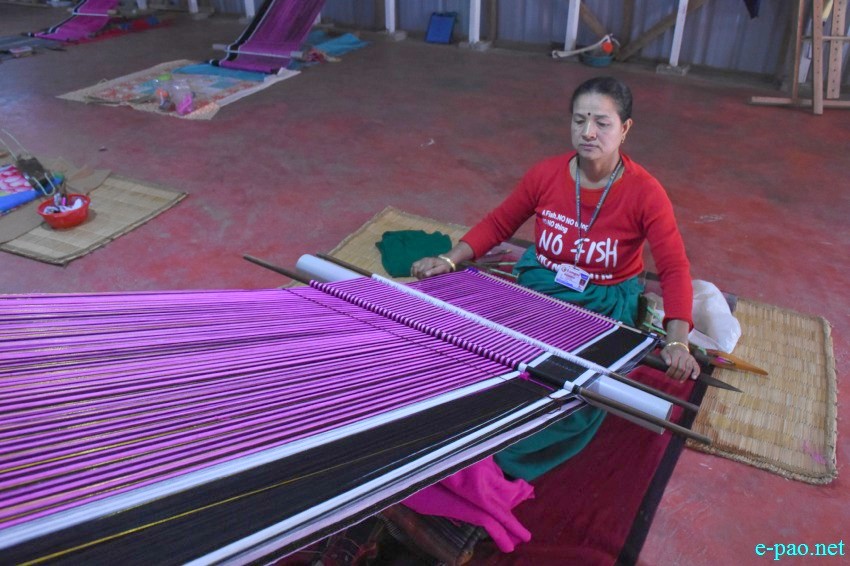
A weaving unit at Nongpok Sanjenbam village, about 15 km East from Imphal in March 2019 :: Pix - Lamdamba Oinam
The state level handloom day falls yearly on August 1 and the national level handloom day observes on August 7 which means that the 1st week of August is an important week for Manipur Handloom. All aspects of the state's handloom sector can be reviewed for better moves and futurity.
he state and central sponsored schemes, evaluation of all their implementations, raw materials, and wages trends welfare schemes can be incorporated in the evaluation and planning. Because, out of the state's nearly 29 lakhs population, there is nearly 6 lakh population are weavers and artisans that indicate 20.7% are weavers and artisans. The handlooms and textiles sector are giving second largest employment in the state next to cultivators.
Manipur handloom sector of the textile industry is ancient practice that is still continuing at best at present juncture too with playing a major role in the quota free trade regime by getting rationalized and supported for bringing out with value added and customized products for consumers. For this a right type of support by the Government becomes inevitable.
Directorate of handlooms and Textiles, Govt. of Manipur has been endeavoring with implementing selective projects and schemes through its implementing agencies like the Manipur Handloom and Handicrafts Development Corporation (MHHDC) a Govt. of Manipur enterprise and the Manipur Apex Handloom Weavers and Handicrafts Artisans C.S.Ltd., a state govt. identified agency as the sole Apex Society of the state's primary weavers and artisans cooperative societies , the handlooms and textiles entrepreneurs.
Some individual societies and N.G.O's are also working for amelioration of the state's handloom sector at best capacities.
The power or strength of Manipur handlooms is its innovation and dynamism in relating itself to the changing market needs and requirements. Manipur textile industry, including spinning, weaving (and knitting), fabric processing and garment-making units, play for major outputs of the state's GDP likewise in the national trends that the handloom sub-sector in fabric output is around 35 percent and also contributes nearly 23 percent of the total cloth produced.
The traditional significance of this sector along with its inseparable links with our ancient cultural heritage further expounds the vitality of this sector. This more than 2,000 years-old Manipur's cottage industry has a broad spectrum of production techniques - from hand-operated loin loom to throws shuttle loom to fly shuttle loom and further to automated technology.
Important features include a dualistic structure including decentralized or \ unorganized\ small-scale segment in weaving, knitting and apparel/garment-making along with recently introduced semi automatic and second generation powerlooms (about 4000 numbers).
Manipur Handlooms is a predominantly domestic-oriented industry with cotton and silk as the primary raw materials extending to wools, acrylics and other manmade fibres. When the importance of the handloom sector is of such colossal character then the question is why this particular sector is facing so many problems?
Why handloom weavers and handicrafts artisans today are not a happy lot with facing a series of problems ranging from unorganized nature of their business to threat from cheap imported items? Why such unruly situation has led to closure of many handloom units that will certainly be resulting in massive unemployment in the state.
Some of the reasons may be cited as;
(1).Raw materials: In the national level scenario but affecting to the sates' weavers is, de-linking of yarn production from cloth production that s impacting upon the handloom industry in a number of ways. India became the supplier of raw cotton and importer of mill spun yarn during British rule, and the consequent development of composite mills in the country came up.
This change in source of yarn supply - from local to distant - altered the very organization of the industry, necessitating a role of increased importance to the middleman. Today, the non-availability of adequate quantities of good quality yarn at reasonable prices since yarn manufacturing and supplying are in the hands of other entities.. The gap between the supply and demand for hank yarn - which is what is used by the handloom sector - is around 150 million kgs.
The government took certain measures to deal with this problem: (a) the setting up of co-operative spinning mills to ensure supplies to the handloom sector (b) the obligation on mills to pack 50% of their total marketable yarn as hank yarn but it is rarely done. Since the production and supply of yarn vests with the mill sector, the fortunes of the handloom sector get tied to this.
The supply of yarn contracts or its price goes up whenever mills require it, forcing handloom weavers in the decentralized sector to turn to private traders for yarn. The yarn availability scenario is also affected by the proliferation of the powerloom sector.
Though powerlooms use cone yarn, they seek to avoid high yarn duty imposed on it by buying up hank yarn and converting it to cones (the cost of re-reeling being minimal). There is thus a considerable diversion of hank yarn meant for the handloom sector to other players, creating conditions of shortage, high rates, etc. Estimates of this linkage range from 15 to 25% to 40%.
Manipur Spinning Mills which was closed down with malpractices and that the present government is struggling to revive even by planting cottons around the state for raw materials shall have to materialized to reducing the risks of materials.
(2). Competition from Powerlooms: It is true that the fast growth of powerlooms in India in the recent years gives a fatal impact upon the unprepared and marginalized weavers. The Sivaraman Committee observed that between 1963 and 1974 the overall growth rate of powerloom sector was 9.67% and between 1975 and 1982-83 was 11.7%.
In numerical terms, the growth was phenomenal, an addition of 2.3 lakhs new cotton powerlooms to the 1.93 cotton powerlooms already existing in 1975, with the overall addition of around 2.9 lakhs powerlooms, the total tall going upto 6 lakhs with another 1,60,000 awaiting regularization (Srinivasulu, 1996: 3202).
Today, authorized (registered) powerlooms stand at 16.55 lakhs with the total being 34 lakhs inclusive of the unauthorized. Powerlooms have already entered into Manipur but without enforcement of state regulation. Besides about 300 powerlooms units established recently under state sponsorship, it is suspected that not less than 1000 unregistered powerloom units have been operating in the state.
Though the remarks of powerloom units are beautiful that they are for producing cloths to replacing the importing huge quantity of cloths, many units are producing the cloths meant for handloom sector and selling them as handlooms products at cheaper rates without least thinking on the fact that an established powerloom unit in India kills the livelihood of 20 weavers every day.
We support the entry of powerlooms into the state but we strongly put objection to any act of encroachment upon handloom sector. We demand enforcement of Handloom (Reservation of Articles for Production) Act, 1985 in the state and proclamation of handloom reserved items that cannot be produced by powerlooms.
(3). Credit & assistance: Handlooms will unfailingly be developed only when credits and assistance facilities reach the genuine weavers. The present credit and other facilities meant for weavers are yet to be monitored adequately. Facilities given off as parts of components of schemes are often manipulated by middlemen and so hardly go down to the needy sections for whom it is intended.
This is because master weavers control a number of co-operatives and tend to corner a substantial proportion of institutional credit. Majority of weavers are to be found outside the co-operative fold and weavers are controlled by master weavers and as they take away maximum shares of schemes for their own benefits thereby the credit needs of this sector have remained unaddressed. State govt. has to constitute a powerful Monitoring Committee to look in this yet to address matter.
(4). Marketing: Disproportionate in between cloth production and marketing is truly there and it is to be seriously addressed. Declining of local markets for handlooms and unable to produce exportable qualities is realities of today and it is to be tackled both in terms of cost factor, skill factor as well as other scientific strategies. There is separation of producers from the market that is partitioned by middlemen.
Of course they can be there but being trader entrepreneurs who know the market well with understanding market demands and so having capacities of marketing channels. they shall not have to block the trickledown of benefits of producers even though the profit margin is quite high in realities.
Equitable sharing of benefits should always be applied to and here the strong bodies like the MHHDC, the AWAS (Apex Society) and the handlooms and textiles entrepreneurs as state players shall have to take concrete roles.
(5). Lack of Reliable Database: Lack of authentic and reliable data in regard to number of looms, number of weavers, classification of weavers and productivity, etc. is another major drawback of the handloom sector.
For India as whole till 1964, the decentralized sector's production excluding khadi, was on the assumption that 90% of the free yarn delivered by the mills is consumed by handloom sector and the share of handlooms was computed on the assumption that 76% of the yarn was consumed by the latter.
On the basis of the quantum of yarn consumed, the output of each sector was arrived on the basis of some accepted conversion factor (1 pound of yarn= 4.5/5 yards of cloth or 1 kg of yarn=10 metres of cloth) (Chandrasekhar: 2001).
The number of weavers is often arrived at by multiplying the number of looms by an employment co-efficient. Likewise, there is also difference of opinion in the calculation of dormant and idle looms especially while taking into account the domestic looms of North Eastern India. Besides, if 2.9 lakhs powerlooms were added between 1975 and 1983, it should have displaced 17.4 lakhs handlooms but the Census of Handlooms show only a decline of 4.85 lakhs handlooms (Srinivasulu, 1996: 3202).
In addition to all these, it is very interesting to note that the Abid Hussain Committee's field visits for the purpose of review did not include any of the handloom centers in the country. Manipur state need to develop a Data base for all realities that shall not only benefits to future planning but also helpful to scholars who want to extend academic intervention taking then as reference.
To conclude, it is further suggested that the state authorities of Manipur shall have to enact the draft state textiles policy and in the while the Manipur Handloom Development Programme is in need of active implementation by incorporating the nook and corner of all dormancies into the budget planning.
* S. Bhubol wrote this article for Imphal Times
This article was webcasted on August 12 2019.
* Comments posted by users in this discussion thread and other parts of this site are opinions of the individuals posting them (whose user ID is displayed alongside) and not the views of e-pao.net. We strongly recommend that users exercise responsibility, sensitivity and caution over language while writing your opinions which will be seen and read by other users. Please read a complete Guideline on using comments on this website.


