


Leishaphan - Meitei Women's Ideals-Framework for Meitei Women's Future
Shanjoy Mairembam *
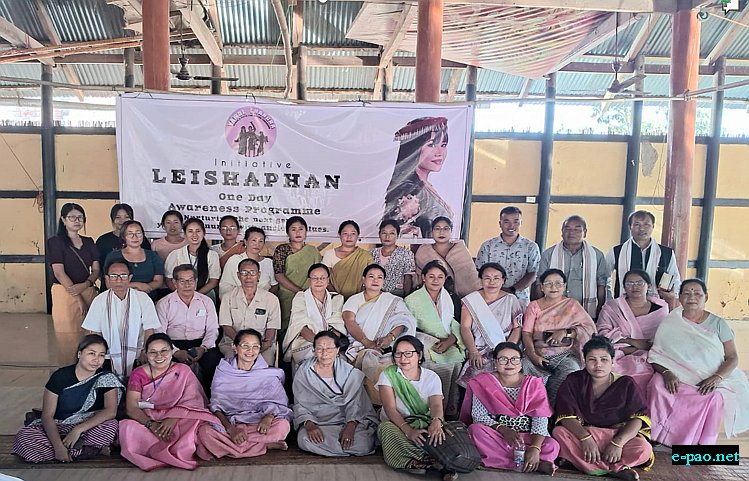
Leishaphan - Meitei Women's Ideals-Framework for Meitei Women's Future
"Leishaphan - Meitei Nupisingi Chaokhatnabagi Wakhallon Meitei Nupisingidamak"
As the Change is the only constant, we must prepare ourselves of how we wish to carry forward our past legacy for today and the future. Meitei women may explore how they can prepare themselves (at the level of an individual as well as group of individuals), through an Ideals-Framework, of identifying ways to sustain 'being a Meitei with cultural traditional values', in preparation of the future generation of Meitei Women to come.
Therein, Yawol Chanura (a like-minded group of few Meitei Women) has explored and reignited the wish to bring out an Ideals-framework for Meitei Women, having a direct historical and cultural connection to 'the ways of how Meitei Women used to share their ideas and extend support to one another for a progressive future of Meitei Women themselves' during 'the then Moirang Kingdom's era of Princess Thoibi (in the ancient Manipur State, India)'.
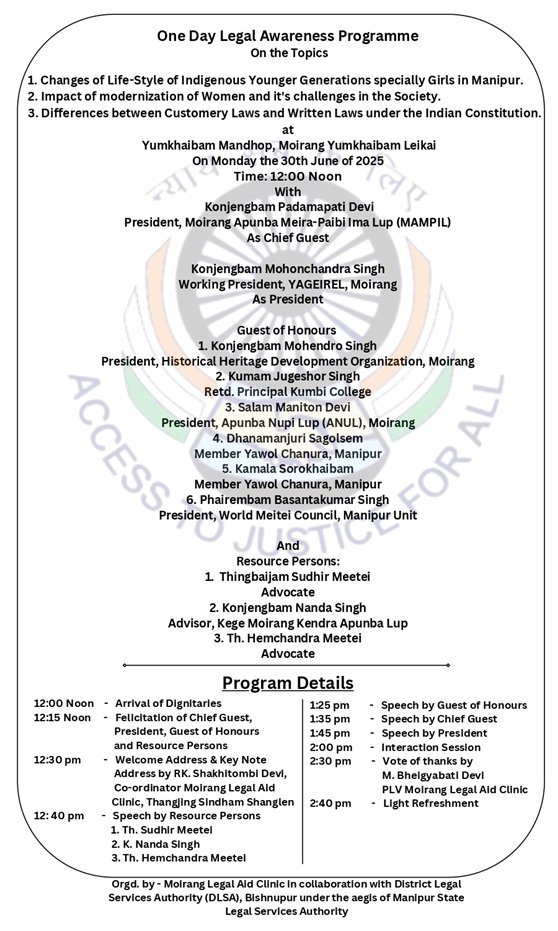
After seeking blessings of the Supreme Deity of Moirang 'The Ebuthou Thangjing' at the Ebuthou Thangjing Temple, Yawol Chanura team reintroduced the concept of Leishaphan - 'Meitei Women's Ideals-Framework for Meitei Women's Future' on the auspicious day of 30th June 2025, through an event hosted at the venue of Yumkhaibam Leikai Mandop in Moirang, by Moirang Legal Aid Clinic (in collaboration with District Legal Services Authority (IDLSA), Bishnupur under the aegis of Manipur State Legal Services Authority).
The Day's event discussed various individual views across three themes of why/how the Leishaphan could become an essential support system for Meitei Women in Today's world and for the Future:
(1) Changes of Life-stye of indigenous Younger Generations specially Girls in Manipur
(2) Impact of modernization of Women and it's challenges, in a transitional stage in the Society
(3) Differences between Customary Laws and Written Laws
The Leishaphan, basically, is a principle for Meitei Women to support themselves (at the levels of an individual and a group) both 'physically and behaviourally' by following certain cultural/traditional practices of being a Meitei in Today's World (just like Lean/Kaizan is for manufacturing, Yoga is for Health, Ying-Yang is for balance and interdependence).
The core message of Leishaphan's relevance is 'transferring and sharing of women-specific or women-related knowledge and learnings' from the life experience of a women from a grandmother to a mother, and onto a daughter (i.e. life experience and knowledge acquired by a woman as she grows up through the lifecycle of 'being a child, to a teenage, to a youth, to a married woman, to a mother, and finally to a grandmother').
The Leishaphan is practicable for adoption by women within Manipur and at any other places of the World, wherever Meitei Women resides in some numbers for more quality learning experiences as it is about a group of individual Meitei Women interacting and supporting one another.
The Leishaphan is neither about 'unmarried Meitei adult women (i.e. Leishabi) only' nor that 'unmarried young Meitei Men (i.e. Pakhang)' cannot be part of the Leishaphan (i.e. Pakhangs can be part of Leishaphan, wherever appropriate to do so on certain relevant/possible areas of engagement). In ancient times, there are other similar Ideals-frameworks such as Pakhangphan (meant for unmarried Young Meitei Men).
Yawol Chanura proposed its conceptual framework, for the first time in this topic, after having heard about the beautiful historical oral stories of how Leishaphan was prevalent during the ancient era of Princess Thoibi in the then Moirang Kingdom. The framework, which is based on three core 'Ideals of personal growth', emphasises on making a Meitei Woman as 'a self-sufficient individual who is fully prepared to face any challenges of life, for today and tomorrow':
(1) As a Person: A well-balanced growth as a woman both behaviourally and physically (via listening to the experience and knowledge of elderly women)
(2) On the Faith: Reaffirming belief in Meitei's traditional Faith (i.e. Sanamahism and Umang Lais, on achieving peace and prosperity to one's life)
(3) With the Skills: Learning traditional life skills of being a Meitei (across aspects such as dance, martial art, sports, language, ethics, traditional values, etc.)
Since sharing of the life experiences and knowledge of senior Meitei Women to young Meitei Women can enhance the outlook of unmarried young Meitei Women, Leishaphan does need 'active participation' of Elderly Meitei women (esp. those who are married).
A woman is likely to understand and better able to guide another generation of women (on how to carry on own Meitei culture while aspiring for the future); e.g. a girl child transitioning into a teenage (i.e. showing 'how to depend on self'), a teenage girl transitioning into a young lady (i.e. showing how to be in the marriable age or socially-active environment), a young lady transitioning into a married women (i.e. showing how to be in the age of having a new family of own), and a mother into an elegant grandmother (i.e. helping a mother to prepare own future while there is an elderly grandmother to seek wisdoms).
Often, there are moments wherein a woman relative or a woman from the same community seems to have a better understanding of what a particular woman is going through in her life, and 'consulting a doctor or a saint or any other elder or professional doesn't feel appropriate or ineffective to the specific situation'.
Leishaphan may help filling the gap of 'speaking to or listening from' other elderly Meitei Women in various topic areas (esp. Woman-related, wherein the other Meitei Women have already experienced through or the other Meitei Women can help in connecting the dots in finding a meaningful support in one's life). Leishaphan may be considered as an ancient practice of enabling 'women empowerment' in the then Meitei Society.
If Leishaphan is to be explained in a simplified way on how to adopt this Ideals-Framework anywhere in the world wherever few numbers of Meitei Women reside in a nearby locality or even if living in a scattered manner across a large region (such as a country or a continent), the starting point is 'to resolve in forming a knowledge sharing group of Meitei women comprising elders and youngsters (either married or unmarried), preferably in a physically connected manner rather than virtually'.
Though modern means of virtual communication can be adopted for interactions among individuals, a physical in-person engagement is often recommended as such an approach is irreplaceable when it comes to sharing human-to-human learning experiences. The intent of forming Leishaphan (as the Ideals-framework) is to allow 'having a support system of one-to-another' across the three core ideals of 'as a person, on the faith, with the skills' for being a Meitei Woman.
Knowledge sharing events and social interaction programmes are to be conducted 'majorly' on women related topics (with the traditional/cultural context of being a Meitei), both at one-to-one level as well as group level. Where there is lack of knowledge/skills on a topic area, other Women/Men experts can be invited physically or virtually for listening to others' life experiences and ideas.
The emphasis of Leishaphan is not to become a master on a specific skillset of being a Meitei Woman (though anyone can aspire to be on a particular skillset), but an overall holistic development of mind and body by acquiring knowledge and skills of being a Meitei (to instil a firm conviction on Meitei's traditions and roots).
Such a learning process does not have to be limited to a specific geographical location among the few Meitei Women therein, and Meitei Women of one area may travel to another geographical location to meet up other Meitei Women to learn/share others' experiences.
A crucial aspect of setting up and maintaining the ethos of 'Leishaphan' thereafter is to consider visiting the Temple of Ebuthou Thangjing at Moirang (Manipur, India) and seek the blessing of Ebuthou Thangjing (as would have been done by the then Princess Thoibi in the ancient Moirang Kingdom) for infusing the spiritual values of Leishaphan upon the team.
The outcomes of adopting Leishaphan depends on how the group of individual Meitei women decide and operate the Ideals-framework, as there is absence of a concrete rule book on it and the intent of Yawol Chanura to bring out Leishapan newly is to attempt reigniting the purpose of being a Meitei among Meitei Women.
Adoption of traditional/historical practices to the lives of Meitei Women in the Modern era of Today demands careful consideration of acceptability and applicability. Yawol Chanura, as a women team of facilitating change for a better Manipur and prosperous Manipuris, neither makes a claim to be the Experts in the topic of Leishaphan nor the Authority to represent/guide Meitei Women in it.
However, Yawol Chanura firmly believes that 'Meiteis have got this wonderful practice of Leishaphan in the ancient times, and it's worth rediscovering it for adoption by Meiteis'. Yawol Chanura hopes that Today's Meitei women will get curious about 'what the Leishaphan is all about' and 'how they can try adopting this Ideals-Framework of being a Meitei Woman in a school of thought process in a way to help themselves, while retaining the ethos and roots of being a Meitei at their heart and soul'.
Yawol Chanura hopes that 'Meitei Women (and Men) will henceforth come to the Ebuthou Thangjing Temple at Moirang, Manipur (India) to seek His blessing with a desire to adopt Leishaphan for shaping their own lives of today and the future of Meiteis as a community, to pass on their knowledge and skills of a Meitei Women to future generations'.
* Shanjoy Mairembam wrote this article for e-pao.net
The writer is (B.Eng, MBA, LLM), Newcastle upon Tyne (UK)
and can be contacted at shanjoym(AT)gmail(DOT)com
This article was webcasted on July 17 2025 .
* Comments posted by users in this discussion thread and other parts of this site are opinions of the individuals posting them (whose user ID is displayed alongside) and not the views of e-pao.net. We strongly recommend that users exercise responsibility, sensitivity and caution over language while writing your opinions which will be seen and read by other users. Please read a complete Guideline on using comments on this website.


