


Source: The Sangai Express / Athokpam Jiten
Imphal, May 07:
Apart from the formally recognised Indo-Myanmar trade through Moreh, two ancient trade routes between Manipur and the neighbouring country exist still today on the eastern border in Ukhrul district.
Though in lesser quantum, informal transaction of goods continue in the route connecting Somrah tract of Myanmar with Kamjong sub-division of Ukhrul district.
However, majority of the traders in this route belong to Myanmar and the trading pattern is largely dominated by imports.
Through the ancient trade route connecting Chingai sub-division of Ukhrul district with Somrah tract of Myanmar, Myanmarese traders bring in goods walking for 1/2 day(s) till Chingai.
Some more adventurous traders venture into Nagaland through NH 150 (Jessami road).
|
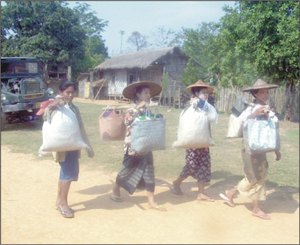
The trade route to Kamjong takes only about 5/6 hours of walking.
Interestingly, import items through the two trade routes and syndromes of underdevelopment in the border villages of Manipur under Chingai sub-division and Kamjong sub-division are strikingly similar.
It was only last year that this reporter observed Myanmarese villagers looking at a television set with much curiosity and amazement in Chingai.
Recently too, when the same reporter was preparing to take some snaps at Aishi in Kamjong sub-division, another group of Myanmarese citizens were dumbfounded.
Some of them even fled away in fear.
Most of the traders who come to Kamjong belong to Moumo, Ongshia and other remote villages of Myanmar located near border pillar no 101,102 and 103.They can speak both Tangkhul and Kuki dialects.
After passing through the border villages of Phaikot, Molnoi and Aishi, they come till Kamjong to sell their goods.
Women traders bring in dried fish, green tea leaves and cosmetic items.
The import items of these Myanmarese traders include edible salt, cooking oil and kerosene.
Their male counterparts cross into Manipur to sell buffaloes, pigs etc.
The bulk of the trade in these routes is constituted by timber.
On an average, 6/7 trucks loads of teak, Khangra and timber of other species are imported from Myanmar daily.
Even as they are ignorant of who were the traders, illegal and contraband goods are imported through these routes occasionally, said some Aishi villagers.
Aishi village chief Lethong Haokip remarked that it was none of their business to see whether Myanmar has been developing or not but the most detestable truth is that all the Manipuri villagers along the Indo-Myanmar border are being neglected and marginalised by the Govt for a long time.
Corroborating his claim, that even as his is just 30 kms away from Kamjong sub-divisional Hqs, there is no electricity facility and whatever health and educational infrastructure available there is just for namesake.
The most predominant and persistent hardship of the village is unavailability of safe drinking water.
At present, one can reach the village only by Shaktiman truck of jeep.
The journey will be really a nightmare if it happens to be rainy season.
Even though India's planned Look East Policy and Vision 2020 cannot invigorate the stagnant formal border trade through Moreh, the border trade on the Eastern side of the State through Kamjong and Aishi sub-divisions remains unexploited.
The border trade through these routes has been going on without any major hitch for many centuries though in lesser quantum and fewer items.
 Comment

